Florida Authority Network | Home Services | September 13, 2026
Quick Answer
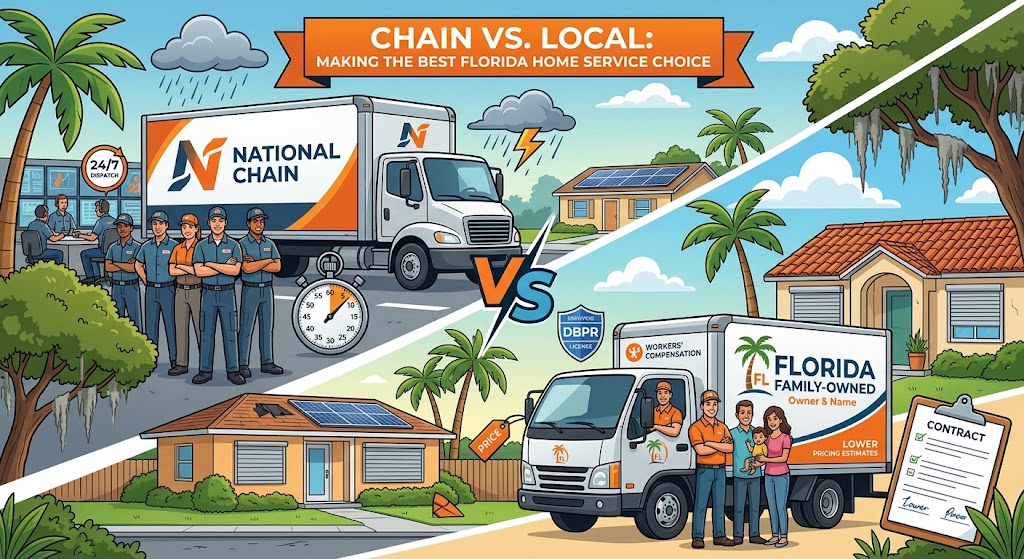
National home service brands (franchised plumbing, HVAC, roofing, pest, restoration and handyman networks) sell predictability: uniform pricing, financing, written warranties, 24/7 dispatch and a corporate office behind the truck. Florida family-owned companies sell judgment: the owner on site, custom work a franchise playbook will not touch, and pricing that is often 15 to 30 percent lower on the same job. In Florida the tie-breaker is rarely the logo. It is whether the company holds a state DBPR license, carries verifiable liability and workers’ compensation coverage, and puts the job in a written contract, because those three things, not the brand, determine what happens when the work goes wrong or the hurricane season interrupts it.
Why This Decision Is Different in Florida
Florida homeowners hire more service contractors per household than almost any state. Salt air, humidity, termites, 100-degree attics, and a June-to-November storm season mean roofs, air conditioners, pool equipment, screens and water heaters wear out on an accelerated clock. The state also attracts a steady flow of out-of-state and unlicensed operators after every major storm, which is why Florida built one of the country’s most extensive contractor-licensing and consumer-recovery systems. The national-versus-local question therefore has a Florida-specific answer: the safest company is the one that fits inside that system, whatever size it is.
Head-to-Head: The Factors That Matter
National Chain vs. Local Family-Owned: Summary Scorecard
| Factor | National Chain | Local Family-Owned |
|---|---|---|
| Price | Higher, standardized | Usually lower, negotiable |
| Custom / odd jobs | Often declined or scripted | Core strength |
| Who shows up | Rotating technicians | Owner or long-tenured crew |
| Financing | Built in | Limited or none |
| Warranty backing | Corporate + franchisor | Owner’s reputation |
| Emergency response | 24/7 call center | Depends on size |
| Storm-season surge | Deep bench, may import crews | Local first, capacity-limited |
| Insurance | Usually complete | Verify every time |
| Continuity | Survives owner turnover | Ends if owner retires |
| Upselling pressure | Common (commission techs) | Lower |
Personal Service and Custom Work
This is where the local company wins most clearly. A national HVAC or plumbing franchise trains technicians to a flat-rate book: diagnose, quote from the tablet, install the approved part. The system produces consistency but not creativity. Ask a franchise plumber to reroute a line around a 1950s terrazzo slab in St. Petersburg, match a 1920s Mediterranean tile roof in Coral Gables, or rebuild a custom pool cage after a storm, and the answer is often “we don’t do that” or a quote built to make you go away.
A family-owned company lives on exactly those jobs. The owner has typically worked the same neighborhoods for 20 years, knows which subdivisions have polybutylene pipe or cast-iron drains, and will stand in your kitchen and solve the problem instead of reading a script. You also get continuity: the same person who quoted the job is the person you call when it fails, and his name is on the truck parked in front of your house.
The national advantage on service is the machine behind it: online booking, text-message ETA, a technician tomorrow morning even in August, and a call center that answers at 2 a.m. when the AC dies. Small companies with one dispatcher and four trucks cannot always match that, and in peak season a Florida homeowner may wait days.
Cost
National brands are almost always more expensive on comparable work. They carry franchise royalties (typically 5 to 8 percent of revenue), national advertising funds, call-center overhead, wrapped fleets and commissioned sales technicians, and the flat-rate price book is built to absorb all of it. Florida homeowners routinely report franchise quotes for water heaters, AC replacements and drain work running 20 to 40 percent above local bids.
What you get for the premium is price certainty and financing. The national quote is the national quote; there is no “it took longer than I thought” surcharge, and a $14,000 AC system can be paid over 60 months through the franchisor’s lender. The local company’s lower number sometimes comes with cash-only terms, a handwritten invoice and a bill that grows if the job does.
Illustrative Florida Job Pricing (2026 ranges)
| Job | National Chain | Local Family-Owned |
|---|---|---|
| 40-gal water heater replaced | $2,400–$3,500 | $1,600–$2,400 |
| 3-ton AC system, 16 SEER2 | $12,000–$17,000 | $8,500–$12,500 |
| Main drain hydro-jet | $600–$1,100 | $350–$650 |
| Roof tune-up / minor repair | $500–$1,200 | $300–$800 |
| Quarterly pest control | $140–$200 | $90–$150 |
FAN composite ranges; actual quotes vary by county and season.
Insurance: The Non-Negotiable
Florida law requires construction-trade contractors to carry general liability insurance and, with limited exemptions, workers’ compensation once they have a single employee. National franchises almost always comply because the franchisor audits them. Small local companies are where gaps appear, and the gap lands on the homeowner: if an uninsured roofer’s helper falls off your roof, you and your homeowner’s policy are the deepest pocket in the room.
The rule for either type of company is identical: ask for a certificate of insurance naming you as certificate holder, sent directly from the insurance agent, and check the workers’ comp exemption status on the state’s database. A family-owned company that produces a certificate in ten minutes is as safe as any franchise. One that says “I’m covered, don’t worry” is not.
Licensing and Liability
Florida’s Department of Business and Professional Regulation licenses roofing, HVAC, plumbing, electrical, pool and general contractors statewide; counties license many specialty trades locally. Working unlicensed in these trades is a crime, and an unlicensed contractor’s contract is generally unenforceable, which cuts both ways.
Licensing is what unlocks Florida’s key consumer protection. The Florida Homeowners’ Construction Recovery Fund compensates homeowners who suffer financial losses from the misconduct or financial failure of state-licensed contractors, funded by contractor fees and fines rather than taxpayers. For contracts signed on or after July 1, 2024, the fund can pay up to $100,000 per claim against a Division I contractor (general, building, residential) and up to $30,000 for Division II specialty trades such as pool, roofing and marine contractors, with contracts signed earlier capped at $50,000. The fund is a last resort: homeowners must first obtain a final judgment, arbitration award or licensing-board restitution order and show they tried to collect, and investigations in Southwest Florida after recent hurricanes found the process slow and the payouts rarely covering the full loss. Contracts over $2,500 for residential work must include a written notice of these rights.
The practical liability difference: a national franchise adds a second layer, the franchisor’s brand and sometimes a corporate customer-resolution desk, on top of the state system. A local company offers only the state system and the owner’s assets. Both are adequate if the license is real; neither helps if it is not.
Job Completion Assurances
Abandoned jobs are among Florida’s most common consumer complaints, and they cluster after storms when contractors take deposits on more roofs than they can build. Nationals mitigate this with capital, a bench of technicians, and a franchisor that does not want a local unit’s failure on the news. A well-run family company mitigates it with reputation and the owner’s personal stake, but a single illness, a key employee leaving or a bad receivable can stall a small firm’s schedule for weeks.
Protection is contractual, not brand-based:
- Keep deposits at or below 10 percent; Florida law penalizes contractors who take more than 10 percent and fail to apply for permits within 30 days or start work within 90.
- Pay by milestone, never in advance of the phase.
- Require a written schedule with a completion date and a per-day or per-week remedy for delay.
- Collect lien releases from subcontractors and suppliers with every payment. Under Florida’s construction lien law, a subcontractor who is not paid by your contractor can lien your home even if you paid the contractor in full.
- Confirm the permit is pulled in the contractor’s name, not yours.
Nationals typically hand you this paperwork by default. With a local company you may have to ask, and a company that resists a written contract or milestone payments has told you what you need to know.
Warranties
National brands lead here on paper: written labor warranties, manufacturer relationships that speed part claims, and a warranty that survives the local franchisee selling the territory. Local warranties are only as durable as the company; a family firm that closes when the founder retires takes its 10-year roof labor warranty with it. Ask any company, of either type, how long it has operated under the same license number and who backs the warranty if it stops operating.
When a National Company Is the Better Choice
- Emergency work on a schedule you cannot control. A failed AC in July, a burst supply line, a mid-night sewage backup. The 24/7 dispatch and deep bench are worth the premium.
- Large financed replacements. New HVAC, whole-home repipes, water treatment. Built-in financing and a transferable written warranty matter more on a $15,000 job than a 20 percent price gap on a $700 one.
- Absentee and seasonal owners. Snowbirds and out-of-state landlords benefit from online booking, photo-documented service reports and a company that will still exist next season.
- Post-storm surge. When every local roofer has a six-month backlog, a national brand’s ability to bring in licensed crews from other markets can be the difference between a tarp and a roof. Verify the imported crews work under the local licensee’s number.
- Warranty-sensitive equipment. Some manufacturers offer extended coverage only through authorized dealer networks, which are disproportionately franchise operations.
When a Local Family-Owned Company Is the Better Choice
- Custom, older-home and non-standard work. Historic districts in Tampa, St. Augustine, Key West and Lake Wales; slab reroutes; tile roof repairs; custom cages, docks and lanais.
- Ongoing relationship work. Quarterly pest, pool service, lawn and irrigation, seasonal AC maintenance. The same tech every visit catches problems a rotating crew misses.
- Price-sensitive jobs under $5,000. The overhead premium on a small ticket is disproportionate.
- Homeowners who want the owner’s judgment. “Fix it or replace it?” is a question a commissioned franchise technician has an incentive to answer one way.
- Rural and smaller markets. In much of the Panhandle, the Nature Coast and inland Central Florida the nationals are thin and the best-reviewed local family firm has been the only reliable option for decades.
The Six-Point Florida Vetting Checklist
Apply it to both types; the brand does not exempt anyone.
- Verify the license on the DBPR website by license number and check for disciplinary history.
- Obtain a certificate of liability and workers’ comp insurance directly from the agent.
- Confirm the company has operated under the same name and license for at least five years.
- Get a written contract with scope, price, schedule, permit responsibility and the recovery fund notice.
- Keep the deposit at 10 percent or less and pay by milestone with lien releases.
- Check reviews across at least two platforms and one neighbor, and ignore any company that pressures a same-day signature.
Brian’s Take
By Brian French, Publisher, Florida Authority Network
Having looked at a lot of businesses, I read the national-versus-local question as a question about where risk sits. A franchise transfers execution risk to a system: the price book, the call center, the franchisor’s balance sheet. You pay for that transfer in every invoice, and for a large, standardized, urgent job it is usually money well spent. A family-owned company keeps the risk with a person, and the quality of that person is the whole investment thesis. When the owner is good, you get better work at a lower price with someone who actually cares whether your roof leaks; when the owner is bad or simply overextended, there is no corporate office to call.
Florida’s licensing and recovery-fund system exists precisely to level that risk, but it only works for licensed contractors with real insurance and written contracts. So my rule is simple: let the paperwork choose. If the family company clears the six-point checklist, hire it for anything custom, ongoing or under $5,000 and enjoy the savings. If it cannot produce a license and a certificate of insurance in a day, the national’s premium is cheap by comparison. And in the two weeks after a hurricane, hire nobody who knocked on your door.
Frequently Asked Questions
Are national home service companies more expensive in Florida?
Generally yes. Franchise royalties, advertising funds and call-center overhead are built into flat-rate pricing, and comparable jobs typically quote 20 to 40 percent higher than local family-owned bids.
Is a local company less safe than a franchise?
Not if it is properly licensed and insured. Florida’s recovery fund and licensing board protect homeowners equally whether the licensee is a franchise or a family firm. The risk is unlicensed or uninsured operators, which are more common among small companies.
What is the Florida Homeowners’ Construction Recovery Fund?
A DBPR-administered fund that reimburses homeowners harmed by licensed contractors, up to $100,000 per claim for general contractors and $30,000 for specialty contractors on contracts signed after July 1, 2024. Claimants must first win a judgment or restitution order and show attempts to collect.
How much deposit should I pay a Florida contractor?
Ten percent or less. Florida law penalizes contractors who accept more than 10 percent and then fail to apply for permits within 30 days or begin work within 90.
Can a subcontractor lien my house if I paid the contractor?
Yes, under Florida’s construction lien law, unless you collected lien releases from subcontractors and suppliers as you paid. Require them with every milestone payment.
Who is better after a hurricane?
Licensed local companies you already know come first; if they are booked out, national brands that bring crews in under the local license are a reasonable second. Avoid anyone soliciting door-to-door or asking for a large upfront deposit.
How do I verify a Florida contractor’s license?
Search by license number on the DBPR license verification portal at myfloridalicense.com and review the disciplinary section; county licenses can be checked through the county building department.
Sources and Further Reading
- Florida Department of Business and Professional Regulation, “Construction Industry – Recovery Fund” – myfloridalicense.com/construction-industry/recovery-fund
- Florida Statutes § 489.1425 and Chapter 489, contractor licensing, deposits and recovery fund – leg.state.fl.us
- WFLA 8 On Your Side, “Burned by a contractor? State fund could help get money back,” Oct. 2025 – wfla.com
- WINK News Investigates, “Help, but not whole: Inside Florida’s Homeowners’ Construction Recovery Fund,” Feb. 2026 – winknews.com
- Wyman Legal Solutions, “Florida’s New Contractor Law (HB 1335),” Nov. 2025 – wymanlegalsolutions.com
Swap the header brand line for the specific FAN home-services domain before publishing.