By Brian French | Florida Home Services | September 14, 2026
Quick Answer
Florida kitchen remodeling in 2026 has moved away from stark white, high-gloss, wide-open layouts toward transitional design: warm wood cabinetry (now the top cabinet finish at 29 percent, edging out white), matte finishes, cream and taupe palettes, and full-height slab backsplashes that run countertop material up the wall. Slab backsplashes now account for roughly 28 percent of renovated-kitchen backsplash installations and cost $70 to $180 per square foot installed, versus $10 to $60 for tile. In Florida, the shift is as practical as it is aesthetic: solid slabs, non-porous quartz, and plywood-box cabinets with moisture-resistant finishes hold up to coastal humidity better than grout lines and MDF. Major Florida kitchen remodels run $25,000 to $150,000+, with a national median near $55,000.
Why the White Kitchen Era Ended
For most of the 2010s and into the pandemic remodeling boom, the Florida kitchen had a formula: white shaker cabinets, white or gray quartz, a subway-tile backsplash with contrasting grout, stainless appliances, and an open-concept layout that put the whole room on display. It photographed well, it resold reliably, and it suited the light-filled aesthetic Florida buyers expected.
By 2026 that formula has run its course. Houzz’s annual kitchen trends study, the National Kitchen & Bath Association’s 2026 design report, and Florida contractors from Jacksonville to Naples all describe the same shift: homeowners want kitchens that feel warmer, calmer, more textured, and more personal. Wood tones have overtaken white as the leading cabinet finish. Cool gray, the defining neutral of the last decade, is on its way out. Matte has replaced gloss on hardware, fixtures, and countertops. And the backsplash, once a 4-inch strip or a tile grid, has become the design anchor of the room.
The style label most designers use is “transitional,” a blend of traditional warmth and contemporary restraint. The materials label is “organic” or “nature-infused.” In Florida, both labels point to the same set of practical decisions, because the finishes that define the trend also happen to be the ones that survive coastal humidity.
This article covers what is trending in Florida kitchens, what it costs, how the choices perform in Florida’s climate, and how the state’s new permitting rules affect a kitchen refresh.
The Five Defining Trends of 2026 Florida Kitchens
1. Warm wood cabinetry
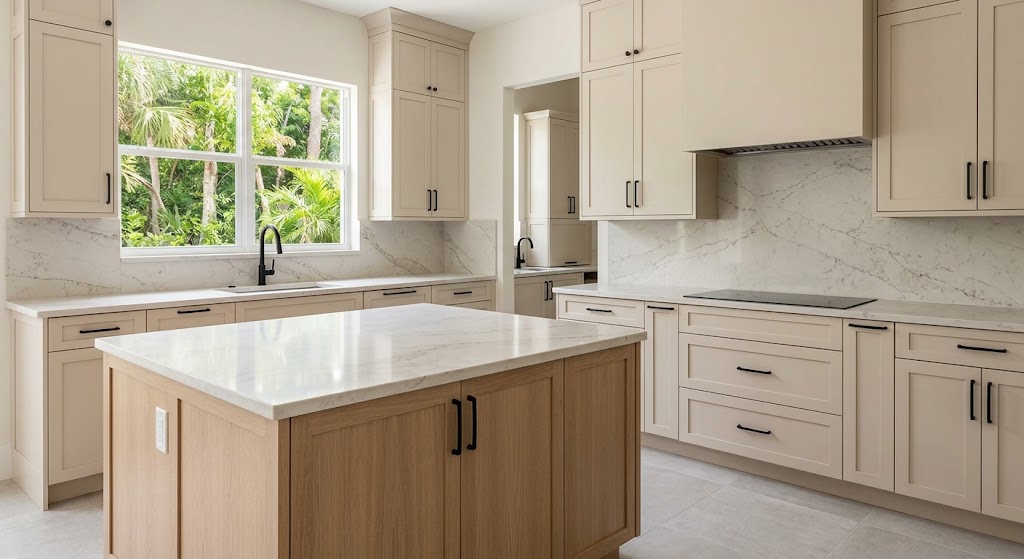
Wood is the leading cabinet finish in 2026 at 29 percent, surpassing white at 28 percent for the first time in more than a decade. The specific look is stain-grade natural wood, not the orange oak of the 1990s: rift-cut white oak with its tight, straight grain leads, followed by walnut, ash, and lighter species finished in matte clear coats.
In Florida, the choice is often a two-tone scheme: wood on the island or lower cabinets, painted uppers in cream, taupe, or soft green. The combination keeps the room bright while adding the warmth homeowners are asking for.
2. Cream, taupe, and earth-tone palettes
The most-specified cabinet paint colors of 2026 are beige, cream, taupe, and muted greens. Pure white is fading, and cool gray is the finish designers now most often recommend removing. The Florida version leans into sandy and sun-bleached tones that echo the coastal landscape without reading as “beach house.”
3. Full-height slab backsplashes
The fastest-growing backsplash category. Instead of tile, the countertop material continues up the wall to the underside of the upper cabinets or to the ceiling behind the range. Engineered quartz is the most common slab material, followed by quartzite, porcelain, and marble.
Ceramic tile remains the most popular backsplash material overall, but in renovated kitchens slab installations now represent roughly 28 percent of the total. Where tile is still used, the trend is handmade zellige with its irregular glaze, in warm neutrals rather than high-contrast patterns.
4. Matte finishes everywhere
Glossy lacquer cabinets, polished chrome, and high-shine countertops are out. Matte and honed surfaces are in: honed quartzite, leathered granite, matte black or brushed brass hardware, and cabinet finishes with a soft sheen. Beyond the look, matte surfaces hide fingerprints and water spots, which matters in a humid kitchen.
5. Defined spaces over full open concept
The all-in-one great room is giving way to layouts with more definition: partial walls, a scullery or butler’s pantry, and islands positioned to separate cooking from gathering. Butler’s pantries with dedicated pantry cabinetry are among the most requested upgrades in higher-end Florida remodels. The open kitchen is not disappearing, but the “everything visible from the front door” version is.
Two supporting trends: induction cooktops integrated flush into the counter (a natural pairing with slab backsplashes, since there is no range hood splash zone to tile), and butcher-block or wood-slab island tops as a contrast surface.
Why These Trends Fit Florida’s Climate
The design shift is national. The reasons it has taken hold so quickly in Florida are local.
Humidity and grout. Florida kitchens run at 55 to 70 percent relative humidity for much of the year. Grout lines absorb moisture, discolor, and harbor mildew. A slab backsplash has no grout. A quartz or porcelain slab is non-porous and wipes clean. This is the single most practical argument for the trend.
Salt air and hardware. Polished chrome and lacquered brass pit and spot in coastal homes. Matte black, brushed nickel, and unlacquered brass that is meant to patina hold up better and hide wear.
Cabinet construction. Florida contractors consistently specify plywood cabinet boxes over particleboard or MDF, with moisture-resistant finishes. A painted MDF door in a humid Gulf Coast kitchen can swell at the edges within a few years. Stain-grade wood with a durable matte topcoat is more forgiving, which is part of why the wood trend is landing so well here.
Countertop choice. Quartz remains the top countertop pick, though its share has been slipping since 2024 as quartzite and honed natural stone gain. In Florida, quartz’s non-porous surface and lack of sealing requirements keep it dominant; quartzite is the upgrade for homeowners who want natural veining with near-quartz durability. Marble, prized for the look, is a maintenance commitment most Florida designers steer clients away from except on a low-traffic bar or butler’s pantry.
Light. The move to warm tones has a Florida-specific risk: too much dark wood can make a kitchen feel heavy under intense subtropical light. The two-tone approach and lighter species like white oak keep the warmth without losing the airiness Florida buyers expect.
What It Costs in Florida
| Component | 2026 Florida range |
|---|---|
| Minor kitchen remodel (national median) | ~$20,000 |
| Major kitchen remodel (national median) | ~$55,000 |
| Full gut remodel, Florida | $25,000–$150,000+ |
| Stock cabinets, 10×12 kitchen | $3,000–$8,000 |
| Semi-custom cabinets | $8,000–$18,000 |
| Custom cabinets | $15,000–$40,000+ |
| Quartz countertops, installed | $50–$150/sq ft |
| Quartzite countertops, installed | $80–$200/sq ft |
| Tile backsplash, installed | $10–$60/sq ft |
| Quartz slab backsplash, installed | $80–$150/sq ft |
| Quartzite or marble slab backsplash | $100–$200+/sq ft |
| Porcelain slab backsplash | $60–$120/sq ft |
| Typical slab backsplash total (30–40 sq ft) | $2,500–$7,000 |
| Full gut timeline, custom cabinetry | 4–6 months |
Cabinets consume 35 to 40 percent of a Florida kitchen budget; countertops and backsplash together run 15 to 20 percent. Layout changes that relocate plumbing or electrical add significantly to cost and permitting.
The slab backsplash math
A slab backsplash is the most expensive backsplash choice per square foot, but the total footprint is small. On a typical 30 to 40 square foot backsplash, a quartz slab runs $2,500 to $6,000 installed versus $700 to $1,200 for standard ceramic tile. The premium is real, but on a $55,000 remodel it is a rounding error, and on the room’s visual impact it is the highest-leverage dollar in the project.
Cost-saving strategies Florida fabricators recommend: use the same slab as the countertop and order together (matching veins across the seam is where the look pays off), source remnants for smaller runs, and limit full-height coverage to the range wall while using a shorter slab elsewhere.
Where the slab premium is poor value: a slab backsplash that does not match the countertop. Designers are nearly unanimous that this is the worst-value decision in the category.
What HB 803 Means for a Kitchen Refresh
Florida’s new $7,500 building permit exemption, effective July 1, 2026, changes the permitting calculus for smaller kitchen projects. The exemption covers non-structural, non-trade work under $7,500 on single-family homes outside flood hazard areas.
A cosmetic refresh, new cabinet doors, painted cabinets, a new backsplash, or replacement countertops that keep the sink and cooktop in place, can qualify for the exemption if the total job value is under $7,500. That is a meaningful change for the “minor remodel” tier.
What does not qualify, regardless of cost: moving a sink (plumbing), adding an outlet or under-cabinet lighting circuit (electrical), installing an induction cooktop that requires a new 240-volt line (electrical), relocating a range hood vent (mechanical), or removing a wall (structural). Most full remodels touch at least one of these and require a permit. HB 803 also prohibits splitting one project into sub-$7,500 pieces to avoid permitting.
Flood zone properties, which include large portions of coastal South Florida, Tampa Bay, and Southwest Florida, get no exemption at all.
For HOA communities, HB 803 bars associations from requiring a permit before reviewing a proposed improvement. Interior kitchen work rarely needs HOA review, but exterior-facing changes tied to the remodel (a new window over the sink, an exterior vent) may.
The Resale Question
Florida homeowners remodeling in 2026 are doing so in a cooler market than the one they bought into. Orlando’s median sale price in the spring was around $410,000 and down year over year, inventory was up sharply, and homes are taking longer to sell across much of the state. That changes the remodeling motive from “add value for a quick flip” to “build a kitchen we will live in for a decade.”
Which is exactly what the transitional trend is designed for. Designers describe 2026’s palette and materials as a 7-to-15-year look, in contrast to the high-contrast, trend-driven kitchens of the late 2010s that already date a listing. A slab backsplash and matte wood cabinetry signal a considered, premium finish to a future buyer without tying the kitchen to a moment.
The caution is the same one designers give every cycle: the trend that reads as timeless is the restrained version. A single accent of warm wood and a neutral slab age well. A kitchen that is dark walnut on every surface, dramatic bookmatched veining, and brass everywhere is the 2026 equivalent of the 2016 gray-everything kitchen.
What This Means for Florida Remodelers and Fabricators
For Florida kitchen contractors, the trend shift has three business implications.
Fabrication complexity is up. Slab backsplashes require field measurement after countertops are set, precise cutouts for outlets and windows, and vein-matching across the seam. Shops that can template and install slab walls cleanly have a differentiator; shops that treat the backsplash as an afterthought will lose the high end.
Cabinet sourcing matters more. With wood finishes leading, stain-grade quality and species consistency are visible in a way painted white never was. Contractors are steering clients toward plywood-box, factory-finished lines and away from the cheapest painted MDF imports that were fine for a white kitchen and are not fine for a humid Florida one.
The minor-remodel tier just got easier. HB 803’s exemption removes permit friction from cosmetic refreshes under $7,500. Contractors packaging a “cabinet refinish plus slab backsplash” offer under that threshold, outside flood zones, have a faster, cheaper product to sell into a slower housing market.
Brian’s Take
The interesting thing about the 2026 kitchen is that the aesthetic trend and the Florida-specific practical case point in the same direction. Slab backsplashes, matte finishes, non-porous quartz, and plywood cabinet boxes are what a designer would spec for a magazine and what a building scientist would spec for a house at 65 percent humidity. When style and durability align, a trend has legs.
The economics are worth noting too. The housing market has cooled, inventory is up, and the “remodel to sell” motive is weaker than at any point since 2019. That favors exactly this kind of restrained, long-horizon design over the high-contrast statement kitchens that dominated the boom. Homeowners who remodel now should plan to live in the result.
On HB 803, my read is that the $7,500 exemption will pull demand into the cosmetic-refresh tier. A painted cabinet refresh plus a slab backsplash is a $5,000 to $7,000 project that now skips the permit queue in most inland counties. That is a real product for Florida remodelers in a slow year, and I would expect to see it marketed as such by the end of the fall.
One flag on materials: watch the quartz-versus-quartzite share. Quartz has been losing ground since 2024 as homeowners chase natural veining. In Florida, that trade has a cost. Quartzite needs sealing and varies in hardness by slab. Homeowners should ask for a scratch and etch test on the actual slab, not a showroom sample, before committing.
Frequently Asked Questions
What is the most popular kitchen cabinet color in Florida in 2026?
Natural wood, particularly rift-cut white oak, at 29 percent, narrowly ahead of white at 28 percent. Cream, taupe, and muted green are the leading paint colors.
How much does a slab backsplash cost in Florida?
$80 to $150 per square foot installed for quartz, $100 to $200+ for quartzite or marble. A typical 30 to 40 square foot backsplash runs $2,500 to $7,000.
Are slab backsplashes better than tile in Florida’s humidity?
Yes for maintenance. No grout means no mildew, staining, or discoloration. They are also easier to wipe clean.
Is white quartz going out of style?
Bright white is fading in favor of cream, warm gray, and veined neutrals. Quartz as a material remains the top countertop choice, though quartzite is gaining.
Do I need a permit for a kitchen remodel in Florida?
Cosmetic work under $7,500 (paint, cabinets, backsplash, countertops without relocation) is exempt under HB 803 outside flood zones. Any plumbing, electrical, mechanical, or structural work requires a permit regardless of cost.
What is transitional kitchen design?
A blend of traditional warmth (wood, softer colors, classic proportions) with contemporary simplicity (clean lines, minimal ornament, slab surfaces).
How long does a full kitchen remodel take in Florida?
Four to six months for a full gut with custom cabinetry; six to ten weeks for a cosmetic refresh.
What kitchen trends are fading in 2026?
High-gloss white cabinets, cool gray palettes, busy mosaic backsplashes, high-contrast grout, polished chrome, and the 4-inch backsplash strip.
Sources and Further Reading
- Houzz, “2026 U.S. Houzz Kitchen Trends Study” (January 2026)
- National Kitchen & Bath Association, “2026 Kitchen Trends Report”
- Sunshine Premier Design & Construction, “Kitchen Remodeling in Tampa FL: Your Complete 2026 Guide” (July 2026)
- KBF Design Gallery, “Slab Backsplashes and Premium Kitchen Planning in Orlando” (July 2026)
- The Kitchen Depot, “How Much Does a Kitchen Remodel Cost in Florida? (2026 Guide)” (June 2026)
- Avery Home Remodeling, “The 2026 Kitchen & Home Remodeling Trends Every Florida Homeowner Should Know” (October 2025)
- USA Cabinet Store, “Kitchen Backsplash Trends 2026: Slab, Zellige & Warmth” (July 2026)
- Block Renovation, “Kitchen Backsplash Costs: Installation, Materials & More” (April 2026)
- Property Blueprint Co., “Kitchen Backsplash Cost 2026 (US Guide)” (July 2026)
- MSI Surfaces, “How Much Do Quartz Countertops Cost in 2026?” (July 2026)
- Redfin and Orlando Regional REALTOR Association, Orlando market data (May 2026)
- Florida Authority Network, “Florida’s $7,500 Permit Exemption: What HB 803 Really Changes” (September 2026)