By Brian French | Florida Home Services | September 12, 2026
Quick Answer
Three categories of smart home equipment earn measurable Florida homeowners insurance discounts in 2026: automatic water shutoff valves (typically 3 to 10 percent off the premium with many private carriers), centrally monitored fire alarms, and centrally monitored burglar alarms. Water shutoff systems deliver the largest and fastest-growing credits because non-storm water damage is the most frequent claim Florida insurers pay. A whole-home flow-based shutoff costs $500 to $2,000 installed and often pays for itself in two to four years on the discount alone. Wind mitigation remains the biggest single discount in Florida, but it is a construction feature, not a smart device. Beep-only leak sensors rarely qualify.
Why Insurers Pay You to Automate
Florida homeowners insurance is among the most expensive in the country, and after several years of carrier exits and rate spikes, the market has stabilized enough in 2026 that insurers are competing again on price. That competition is showing up in a place many homeowners overlook: mitigation credits for technology that reduces the frequency and severity of claims.
The logic is arithmetic. Water damage accounts for roughly 28 percent of homeowner claims nationally, and about one in fifty homes files a water damage or freezing claim each year. The average repair runs north of $11,000, and a supply-line failure in an unoccupied seasonal home can produce a six-figure loss. A device that stops the water in the first 30 seconds converts that loss into a mop-up. Insurers have the loss data to prove it, and they price accordingly.
Florida adds two accelerants. The state has an unusually high share of seasonal and secondary homes that sit empty for months, which is precisely the scenario where an undetected leak becomes catastrophic. And Florida’s coastal humidity means that even modest water intrusion turns into mold remediation, which inflates claim severity.
This article covers which smart systems actually earn discounts from Florida carriers, what they cost, how the numbers work, and the permitting and documentation steps that trip up homeowners trying to collect.
The Three Categories That Earn Florida Discounts
Not every smart device qualifies. A smart thermostat, video doorbell, or Wi-Fi light switch improves convenience but does not reduce insured loss, and carriers generally do not credit them. The categories that consistently move the premium in Florida:
1. Automatic water shutoff systems
The single most valuable smart home discount in 2026. Carriers distinguish sharply between two device types:
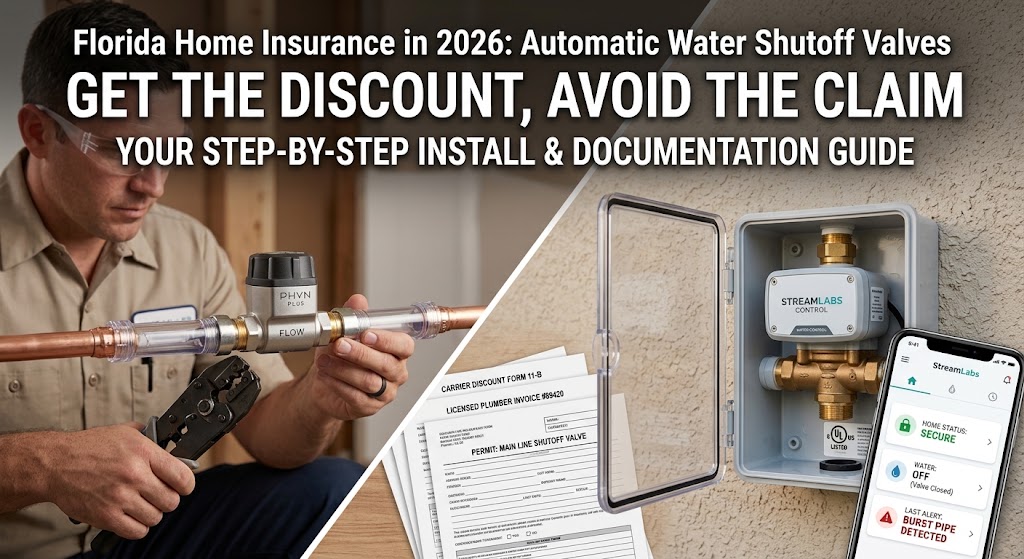
Flow-based whole-home shutoff valves install on the main water line and monitor flow, pressure, and temperature continuously. When they detect abnormal flow (a burst pipe, a failed supply line, a running toilet at 3 a.m. in an empty house), they close the valve automatically and alert your phone. This is the category insurers credit.
Point leak sensors sit on the floor under water heaters, dishwashers, and washing machines and alert you when they get wet. They are inexpensive and useful, but on their own they typically do not qualify for a discount because they do not stop the water. Many carriers will credit a sensor network only when it is tied to an automatic shutoff valve.
2. Centrally monitored fire alarms
A smoke or fire alarm connected to a professional monitoring center that dispatches fire services. Local-only alarms (the kind that beep) do not qualify. Citizens Property Insurance Corporation, Florida’s state-run insurer of last resort, offers this credit, as do most private carriers.
3. Centrally monitored burglar alarms
Same principle: a security system with professional monitoring and dispatch. Self-monitored camera systems where alerts go only to your phone generally do not qualify, though some carriers are beginning to recognize monitored video verification services.
A monitored security hub that combines fire, intrusion, and water sensing under one professionally monitored account can stack all three credits with some carriers.
What Florida Carriers Are Offering in 2026
Discount programs vary by carrier and are filed with the Florida Office of Insurance Regulation, so the exact percentage depends on your policy. Published ranges and partnerships as of mid-2026:
| Carrier segment | Water shutoff credit | Notes |
|---|---|---|
| High-net-worth carriers (Chubb, PURE) | Up to 10%+ plus device subsidies | Increasingly required to write large or secondary homes |
| Mainstream private Florida carriers | 3–10% | Varies; UL-listed, auto-shutoff device usually required |
| Citizens Property Insurance | No published water device credit | Monitored fire and burglar alarm credits available |
| Surplus lines / E&S | Varies | Some require shutoff as a condition of coverage |
Chubb maintains an approved-device list and runs partnerships with Leak Defense and StreamLabs, with policyholders receiving device discounts (Leak Defense advertises 37 percent off for Chubb clients) plus a premium credit once installed. PURE negotiates member pricing with Flo by Moen, Phyn, FloLogic, and Flume, and its risk managers specifically recommend automatic shutoffs for seasonal homes. Several mainstream carriers, Amica among them, publish tiered discounts from basic sensors up to whole-home systems.
The most important trend is not the size of the credit but the shift toward eligibility. A growing list of carriers now require an automatic shutoff valve before they will write or renew a large home, a waterfront home, or a secondary residence. For those homeowners, the device is not a discount play; it is the price of admission.
Citizens is the exception worth flagging. Its published discount list covers wind mitigation, roof construction, FBC compliance, and centrally monitored fire and burglar alarms, but not water shutoff devices. Citizens policyholders should still install one for loss prevention, but should not expect a premium credit for it unless Citizens files a new discount.
What the Equipment Costs
| System | Device cost | Installed cost | Auto shutoff |
|---|---|---|---|
| Flo by Moen Smart Water Monitor & Shutoff | ~$500 | $800–$1,300 | Yes |
| Phyn Plus | ~$700 | $1,000–$1,500 | Yes |
| StreamLabs Control | ~$500 | $800–$1,300 | Yes |
| FloLogic | $1,500–$2,000 | $2,000–$3,000 | Yes |
| YoLink valve controller + sensor kit | $100–$250 | $300–$600 | Yes (retrofit motor) |
| Flume 2 (meter-strap monitor) | ~$200 | DIY | No |
| Point leak sensors (Govee, Honeywell, SmartThings) | $15–$35 each | DIY | No |
Installation on the main line requires cutting into the supply, which is licensed plumbing work. Florida plumbers typically charge $300 to $800 for the install depending on pipe material, access, and whether a power outlet must be added near the valve. Homes with a water softener or irrigation tee may need the valve positioned to protect the house branch only.
Monthly monitoring fees are a factor for some systems. Flo by Moen’s FloProtect subscription runs about $5 per month and adds an insurance-facing feature: a water damage deductible reimbursement guarantee. Phyn and StreamLabs offer app monitoring without a required subscription. Centrally monitored fire and burglar systems run $20 to $60 per month.
The Payback Math for a Florida Home
Take a representative Central Florida single-family home with a $4,800 annual homeowners premium, a private carrier offering a 5 percent water mitigation credit, and a Flo by Moen system installed for $1,100.
- Annual premium savings: $240
- Simple payback on discount alone: 4.6 years
- Add a $150 annual water bill reduction from catching a running toilet or slab leak early: payback drops to 2.8 years
For a Sarasota waterfront home with a $9,500 premium and an 8 percent credit, the same $1,100 install returns $760 a year and pays back in under 18 months.
That math ignores the actual purpose of the device, which is avoiding the claim. A single prevented $11,000 water loss returns ten times the equipment cost, and avoiding the claim keeps your loss history clean, which matters more in Florida than almost anywhere else. Carriers here scrutinize prior water claims at renewal, and a home with a water loss on record can face non-renewal or a forced move to Citizens.
The HB 803 Permit Question
Florida’s new $7,500 building permit exemption, effective July 1, 2026, exempts non-structural, non-trade residential work under that value from permit requirements. Installing a shutoff valve on the main water line is plumbing work, and plumbing is explicitly excluded from the exemption. A permit is still required.
This matters for the discount. Carriers that credit shutoff systems typically require documentation of professional installation, and some ask for the permit or a licensed plumber’s invoice. A DIY install on the main line, or an unpermitted one, can void the credit and create a disclosure problem at resale.
Point sensors, meter-strap monitors like Flume, and battery-powered devices that do not modify plumbing require no permit. Low-voltage alarm and security installations are handled under separate alarm contractor licensing and typically do not require a building permit, though a few Florida jurisdictions require a low-voltage permit for hardwired systems.
How to Actually Collect the Discount
Homeowners regularly install qualifying equipment and never see a premium reduction because they did not close the loop with the carrier. The process:
- Call your agent before you buy. Ask which devices are on the carrier’s approved list, what documentation is required, and what percentage credit applies. A UL-listed, auto-shutoff, flow-based valve is the safest specification.
- Use a licensed plumber and pull the permit. Keep the invoice and permit record.
- Submit the mitigation form. Most carriers have a smart device or water mitigation affidavit. Some accept a photo of the installed device with the model and serial number visible.
- Confirm the credit on the declarations page. Discounts appear as line items. If it is not there at the next renewal, it was not applied.
- Keep the system online. Some carriers reserve the right to verify the device is active. A valve that lost Wi-Fi six months ago may not qualify at audit.
For centrally monitored alarms, the monitoring company issues an alarm certificate. Submit it to the carrier.
Coastal Florida Considerations
Waterfront and barrier-island homeowners face the highest premiums in the state and gain the most from mitigation credits. A few coastal-specific points:
Wind mitigation still dominates. A wind mitigation inspection ($75 to $150, valid five years) documenting roof shape, roof-to-wall attachment, secondary water resistance, and opening protection can cut a coastal premium by 20 to 45 percent. No smart device comes close. Do the wind mitigation inspection first, then layer the smart credits on top.
Secondary water resistance is an insurance feature. The self-adhesive underlayment on the roof deck that Citizens and private carriers credit is installed during reroofing. If you are replacing a roof in 2026, specify it.
Seasonal occupancy is where shutoffs earn their keep. A snowbird home unoccupied from May through November is the single highest-risk profile for a slow leak. Several HNW carriers now decline to write these homes without an automatic shutoff. Set the valve to “away” mode, which closes on any sustained flow, before leaving.
Salt air and electronics. Outdoor-mounted valves near the meter in coastal zones should be housed in a weatherproof enclosure. Indoor installation in the garage or utility closet is preferable where the plumbing layout allows.
What This Means for Florida Home Services Businesses
Plumbers, alarm installers, and smart home integrators have a clear 2026 sales story: the device pays for itself through the insurance credit. The contractors capturing this market are packaging the install with the paperwork, providing the carrier-facing documentation, permit record, and photo set as part of the job.
For plumbing contractors specifically, the whole-home shutoff valve has moved from a novelty upsell to a standard line on repipe and water heater estimates. Two studies released this summer project a shortage of roughly 550,000 plumbers by 2027, which makes every avoided emergency callback more valuable and every flow-monitoring device a dispatch tool: the technician arrives already knowing what failed.
Insurance agents benefit too. An agent who proactively tells clients about mitigation credits retains policies through renewal cycles that would otherwise shop.
Brian’s Take
The Florida insurance market spent three years in crisis and is now in recovery. Tort reform worked, carriers are back, and rate filings in 2026 are flat to down for the first time in years. In a softening market, carriers compete for the best risks, and they define “best risk” with data. A home with an automatic shutoff, a monitored alarm, and a clean wind mitigation report is the risk every carrier wants.
The homeowner who installs a $1,100 shutoff valve to save $240 a year is making a fine decision. The homeowner who installs it to keep a water claim off the record is making the important one. In Florida, claims history is destiny. One water loss can push a household from a competitive private carrier into Citizens, and the premium difference over five years dwarfs any discount.
Two cautions. Do not buy a device before talking to your agent; the approved-device lists are carrier-specific and change. And do not confuse point sensors with protection. A $15 puck under the water heater tells you the floor is wet. It does not turn off the water while you are in Asheville for the summer.
Watch for Citizens to add a water device credit. It is the largest Florida insurer by policy count, its book is disproportionately older and coastal, and water loss is exactly the exposure it should be pricing for. When that filing comes, the market for shutoff installations in Florida roughly doubles overnight.
Frequently Asked Questions
How much does a smart water shutoff valve reduce Florida homeowners insurance?
Typically 3 to 10 percent of the premium with private carriers that offer the credit. High-net-worth carriers may offer more, plus device subsidies.
Does Citizens offer a discount for water leak detection?
Not as of September 2026. Citizens credits wind mitigation, roof features, and centrally monitored fire and burglar alarms.
Do I need a permit to install a smart water valve in Florida?
Yes, if it is installed on the main line. Plumbing work is excluded from HB 803’s $7,500 permit exemption.
Do leak sensors alone qualify for a discount?
Usually not. Carriers want automatic shutoff. Sensors typically qualify only when connected to a shutoff valve.
What is the best smart water shutoff for Florida homes?
Flo by Moen, Phyn Plus, and StreamLabs Control are the most widely accepted by carriers. Check your insurer’s approved list first.
Do video doorbells or smart thermostats lower insurance premiums?
Generally no. They do not reduce insured loss. Monitored security systems with professional dispatch do.
How much does whole-home leak detection cost installed?
$800 to $1,500 for mainstream systems; $2,000 to $3,000 for premium systems like FloLogic.
Which Florida discount is bigger, wind mitigation or smart devices?
Wind mitigation, by a wide margin. Get the inspection first, then add smart device credits on top.
Sources and Further Reading
- Citizens Property Insurance Corporation, “Discounts,” citizensfla.com/discounts
- Florida Office of Insurance Regulation, “Premium Discounts for Hurricane Loss Mitigation,” Rule 69O-170.017
- Latent Insurance, “Water Leak Detection Insurance Discounts” (July 2026)
- Grus.io, “Do Smart Water Shutoff Valves Qualify for Home Insurance Discounts in 2026?” (March 2026)
- WrightWay Emergency Services, “Smart Water Sensors: Are They Worth It for Florida” (May 2026)
- SupplyHouse Real Talk, “Smart Shutoff Valves and Leak Detection: A 2026 Guide for Plumbers” (August 2026)
- North Fort Myers Plumbing, “Smart Shut-Off Valves for Insurance Savings” (2025)
- Sungate Insurance Agency, “A Smart Water Sensor Can Save You Money on Home Insurance” (November 2025)
- LiveCovered, “The Complete Guide to Florida Homeowners Insurance” (February 2026)
- Insurance Information Institute, “Facts + Statistics: Homeowners and Renters Insurance” (water damage claim frequency data)
- Chubb, “Water Leak Detection and Protection” policyholder resources; PURE Insurance member device programs
- Florida Authority Network, “Florida’s $7,500 Permit Exemption: What HB 803 Really Changes” (September 2026)