By Brian French | Florida Home Services | Authority Network | September 16, 2026
Quick Answer
Florida pool owners face two converging decisions in 2026. First, federal Department of Energy rules now require most replacement pool pump motors to be variable-speed: Tier 1 (motors 1.15 total horsepower and up) took effect September 29, 2025, and Tier 2 (0.5 to 1.15 THP) arrives September 28, 2027. A variable-speed pump runs $900 to $1,500 installed and cuts pump electricity by 50 to 80 percent, paying for itself in 12 to 24 months in Florida’s year-round season. Second, resurfacing costs $6,000 to $20,000 depending on finish: plaster ($6,000–$8,500, lasts 7–12 years), quartz aggregate ($8,000–$12,500, 12–18 years), or pebble ($10,000–$18,000, 15–25 years). Pebble and quartz win on cost per year in Florida’s UV and chemical exposure. Saltwater conversion runs $1,500 to $3,000 and pairs well with variable-speed pumps but requires attention to nearby stone and metal.
Why Pool Hardware Became a Regulatory Story
Florida has more residential swimming pools than any state, roughly 1.5 million, and they run nearly year-round. That makes the pool pump the largest single electricity user in most Florida homes with a pool, typically 20 to 30 percent of the monthly bill. It also means pool surfaces here degrade faster than anywhere in the continental U.S.: intense UV, high water temperatures, heavy chemical demand, daily summer rain, and, for coastal owners, salt air.
For years, the pool equipment decision was a private one. Replace the pump with whatever was cheapest, resurface with plaster when the old finish went rough, and move on. In 2026 that has changed on both fronts. Federal efficiency rules have effectively removed single-speed pumps from the market for most residential pools, and rising labor and material costs have pushed the resurfacing decision toward premium finishes with longer lifespans.
This article covers the pump rules, the resurfacing choices, the saltwater question, what each costs in Florida, and how the state’s new permitting law applies.
The Variable-Speed Pump Mandate
What the federal rule requires
The DOE has regulated dedicated-purpose pool pumps in two stages.
The first rule, under 10 CFR Part 431 effective July 19, 2021, set a minimum weighted energy factor for newly manufactured self-priming pool pumps above 0.711 hydraulic horsepower. In practice, that eliminated most new single-speed pumps above roughly 1 THP.
The second rule, published September 2023, targets replacement motors, closing the gap that let owners keep a single-speed pump running indefinitely by swapping motors:
| Tier | Effective date | Motors covered | Requirement |
|---|---|---|---|
| Tier 1 | Sept 29, 2025 | 1.15 THP and above | Must be variable-speed |
| Tier 2 | Sept 28, 2027 | 0.5 to 1.15 THP | Must be variable-speed |
Tier 1 has been in effect for nearly a year. If a typical in-ground Florida pool pump fails today, a compliant single-speed replacement motor is generally no longer available. Tier 2 will finish the phaseout for smaller pumps in two years.
The Florida Building Code’s energy chapter aligns with the federal standard for permitted installations, and new pool construction in Florida already requires variable-speed pumps. Where state and federal rules differ, the stricter one governs.
What it costs and saves
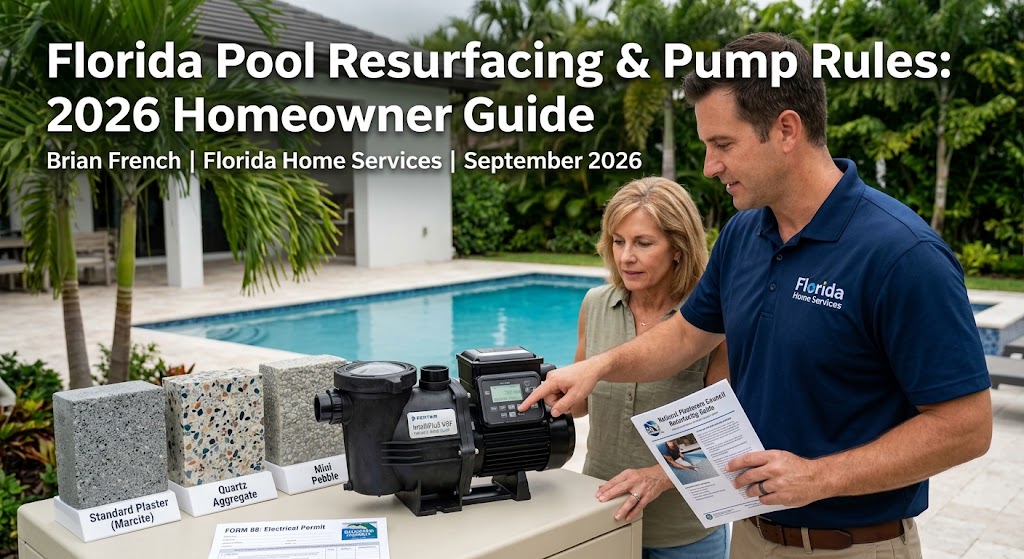
A variable-speed pump costs $900 to $1,500 installed in Florida, versus $400 to $700 for a single-speed unit where one is still legal. The energy math favors the upgrade heavily because pump power scales with the cube of speed: running at half speed uses roughly one-eighth the electricity.
A representative Florida example: a 1.5 HP single-speed pump drawing about 2,300 watts for eight hours a day at $0.15 per kWh costs roughly $83 a month. A variable-speed pump programmed to run 80 percent of its schedule at low RPM costs about $25 a month for equivalent turnover. That is $700 a year in savings on a $1,200 pump, a 12-to-24-month payback that most Florida contractors cite.
The savings depend on programming. Variable-speed pumps ship with factory defaults that suit nobody’s pool. The schedule is the product: long low-RPM filtration blocks (often 14 to 16 hours total), a short high-RPM block for skimming and cleaner operation, and a flow rate that keeps any salt cell’s flow switch engaged. A pump left at default high speed saves little.
Florida utility rebates
Several Florida utilities offer variable-speed pump rebates, typically $50 to $150, though programs change and funding is limited. FPL, Duke Energy Florida, and TECO have all run pump programs in recent years. Check the utility’s current residential rebate page before purchase; the rebate is small relative to the energy savings but is easy money for a purchase you are making anyway.
Resurfacing: Plaster, Quartz, or Pebble
Every concrete or gunite pool surface wears out. The National Plasterers Council’s triggers for resurfacing are rough texture, persistent staining that does not respond to treatment, and plaster delamination (hollow spots that sound drummy when tapped). In Florida, those signs appear years earlier than in northern climates.
2026 Florida resurfacing costs
| Finish | Installed cost (350–500 sq ft pool) | Lifespan in Florida | Cost per year |
|---|---|---|---|
| Standard white plaster (marcite) | $6,000–$8,500 | 7–12 years | ~$640 |
| Quartz aggregate | $8,000–$12,500 | 12–18 years | ~$760 |
| Pebble (PebbleTec, Mini Pebble, etc.) | $10,000–$18,000 | 15–25 years | ~$590 |
| Glass bead blends | $14,000–$22,000+ | 20+ years | varies |
| Tile (full) | $25+/sq ft | 25+ years | premium |
Cost-per-year figures are approximate, from Tampa Bay contractor analysis, and reflect only the resurfacing itself. Plaster’s true cost is higher: it needs more frequent acid washing and chemistry adjustment, adding $300 to $500 a year in maintenance, and each resurfacing cycle triggers a drain, refill, and startup chemistry event that pebble owners face half as often.
Regional variation is meaningful. Central Florida vacation-rental corridors (Clermont, Davenport, Winter Garden) run 15 to 20 percent above state average due to rental demand. South Florida labor and materials rose roughly 10 percent from 2024–25. Orlando pricing has stabilized in 2026 as supply chains for white marble dust and specialty aggregates normalized.
How to choose
Plaster is the right call if you are selling within a few years or the budget is fixed. It looks clean, especially in white, and it works. But in Florida it is a 7-to-12-year finish, and the porous surface demands more chemical attention.
Quartz aggregate is where most Florida contractors steer homeowners. Colored quartz crystals bound in a polymer-modified plaster resist staining and chemical etching far better than plain plaster, the surface stays smooth, and the finish holds up 12 to 18 years.
Pebble is the durability leader. Small river pebbles in a cement matrix produce a textured, natural look that hides wear and lasts 15 to 25 years. Standard pebble can feel rough underfoot; mini-pebble and polished aggregate variants soften the texture at a price premium. For homeowners staying 10 or more years, pebble delivers the lowest cost per year despite the highest upfront number.
Glass bead and polished finishes are the luxury tier, chosen for appearance rather than economics.
What separates a good resurfacing bid from a bad one
A proper resurface requires a full chip-out of the old finish and preparation of the shell. Low bids that propose a skim coat over the existing plaster fail within one to two years. A complete quote includes a structural assessment and a repair allowance: crack repair runs $1,000 to $5,000 depending on severity, and delamination cannot be quoted accurately until the shell is exposed. Contractors recommend a 10 to 20 percent contingency.
Timing matters in Florida. Winter and early spring, with lower humidity and no daily thunderstorms, produce better cures and fewer weather delays, and off-season booking can earn a 5 to 10 percent discount. Coordinating resurfacing with a pump or equipment replacement avoids a second round of disruption.
Saltwater Conversion: What Florida Owners Should Know
Saltwater pools use a chlorine generator (salt cell) to produce chlorine from dissolved salt rather than adding it manually. The water is still chlorinated, just at a steady, lower level that most swimmers find gentler on skin and eyes.
Cost. Conversion runs $1,500 to $3,000 installed for a residential salt chlorine generator, plus the initial salt load. The cell itself lasts three to seven years in Florida and costs $500 to $900 to replace. Annual operating cost is generally lower than buying chlorine, and the convenience is the main selling point.
Pairing with variable-speed pumps. Salt cells work best with consistent, moderate flow. A variable-speed pump running long low-RPM cycles keeps the cell producing evenly and reduces high-velocity scaling that shortens cell life. The two upgrades are complementary; contractors often bundle them.
Florida-specific cautions. Salt is corrosive. Travertine and other soft natural stone decking, common around Florida pools, can pit and spall from salt splash unless sealed. Unsealed limestone, some pavers, and metal fixtures (ladders, handrails, light rings, screen enclosure frames near the water) are also at risk. Saltwater conversion on a pool with a plaster surface can accelerate surface wear; quartz and pebble hold up better. Coastal owners already fighting salt air should weigh whether adding salt to the pool is the right trade.
Resale. Saltwater pools are a modest positive for many Florida buyers, though some inspectors flag corrosion around equipment pads and screen enclosure bases in older conversions.
Hurricane Season and Pool Equipment
Florida’s storm season shapes both decisions. Variable-speed pumps with app connectivity can be shut down remotely before a storm and restarted after; surge protection on the equipment pad is cheap insurance. After a storm, debris load and phosphate spikes from runoff stress the surface and chemistry. Resurfacing scheduled for late fall gives the new finish a full cure before the next summer, and a pump replacement in spring avoids failing mid-August when contractors are booked and the pool is turning green.
Never drain a pool before a storm. A drained pool in saturated Florida soil can float out of the ground.
Permits, Licensing, and HB 803
Florida’s new $7,500 building permit exemption, effective July 1, 2026, exempts non-structural, non-trade residential work under that value from permit requirements, outside flood hazard areas. Pool work sits mostly outside the exemption.
Pump replacement involves electrical connection. Electrical work is excluded from HB 803 regardless of cost, so a pump swap still requires a permit in most jurisdictions. Florida Certified Pool/Spa Contractors (CPC license) can pull permits for pool electrical and mechanical work within their scope; panel-level changes may require a separate electrical contractor.
Resurfacing is a gray area. It is arguably non-structural cosmetic work, but a full chip-out and refinish typically exceeds $7,500, and many Florida jurisdictions require a permit for resurfacing independent of value. Assume a permit is required and ask the building department.
Flood zones. Large shares of coastal Florida pool owners are in mapped flood hazard areas, where the exemption does not apply at all.
Licensing did not change. Florida requires a state-licensed pool contractor for resurfacing and most equipment work. HB 803 changed permits, not licensing. A contractor citing the new law to justify skipping a permit on a pump install is wrong on both counts.
The bill’s other provisions do help pool contractors: shorter review clocks (5 business days for single-trade work on a single-family home using a private provider), deemed-approval when departments miss deadlines, and a ban on requiring invoices as a permit condition.
What This Means for Florida Pool Businesses
For pool service and construction companies, the pump mandate has converted a discretionary upsell into a compliance event. Every pump failure is now a variable-speed sale, and the companies winning that business are the ones that program the pump correctly and document the savings, rather than installing it at factory defaults.
Resurfacing demand is shifting up-market. As labor costs rise, the relative premium for pebble over plaster shrinks, and the cost-per-year argument sells itself to owners who plan to stay. The 2027 Tier 2 deadline gives contractors a two-year window to move remaining small-pump customers before the last single-speed inventory disappears.
Saltwater conversion remains a strong add-on, best sold alongside a variable-speed pump and a quartz or pebble surface, with honest disclosure about stone and metal exposure.
Brian’s Take
The pool pump rule is one of the rare regulations where the compliance cost and the economic answer point the same way. A Florida pool owner forced into a $1,200 variable-speed pump recovers it inside two years and pockets $500 to $1,000 a year after that. The only people losing are those who install it and leave it at 3,450 RPM. Program the schedule or pay someone to.
Resurfacing is a longer-horizon bet, and Florida’s climate tilts it toward the premium finishes. Plaster’s low sticker price is an illusion for anyone staying a decade; the second resurfacing arrives before a pebble finish would have needed its first. The honest exception is a seller with a two-year horizon, for whom a clean white plaster job is exactly right.
On saltwater, I am more cautious than most contractor marketing. It is a good system on a quartz or pebble pool with sealed decking and stainless or polymer hardware. It is a poor fit on plaster with travertine and an aluminum screen enclosure sitting in the splash zone, and that describes a lot of Florida backyards.
The 2027 Tier 2 date is the one to watch. When it lands, the last legal single-speed replacement for small pools goes away, and the roughly quarter of Florida residential pools still running older equipment will move to variable-speed on failure. That is a large, predictable wave of demand for pool contractors and a good reason for owners to replace on their own schedule rather than in an August emergency.
Frequently Asked Questions
Are single-speed pool pumps illegal in Florida?
For most replacements, yes in practice. Since September 29, 2025, replacement motors of 1.15 THP and up must be variable-speed. Motors 0.5 to 1.15 THP follow on September 28, 2027. Existing pumps may keep running.
How much does a variable-speed pool pump cost in Florida?
$900 to $1,500 installed. Energy savings of $500 to $1,000 a year typically recover the cost in 12 to 24 months.
How much does pool resurfacing cost in Florida in 2026?
$6,000 to $8,500 for plaster, $8,000 to $12,500 for quartz, $10,000 to $18,000 for pebble on a standard residential pool.
Which pool finish lasts longest in Florida?
Pebble, at 15 to 25 years, followed by quartz at 12 to 18. Plaster lasts 7 to 12 years under Florida sun and chemistry.
How much does saltwater pool conversion cost?
$1,500 to $3,000 installed, plus $500 to $900 for a replacement cell every three to seven years.
Does a saltwater pool damage travertine?
It can. Salt splash pits and spalls unsealed travertine and other soft stone. Seal the decking and keep metal fixtures out of the splash zone.
Do I need a permit to replace a pool pump under HB 803?
Yes. Pump replacement is electrical work, which is excluded from the $7,500 exemption.
When is the best time to resurface a pool in Florida?
Late fall through early spring: lower humidity for curing, no daily storms, and possible off-season discounts.
Sources and Further Reading
- U.S. Department of Energy, Energy Conservation Standards for Dedicated-Purpose Pool Pumps, 10 CFR Part 431 (2021 rule) and Dedicated-Purpose Pool Pump Motors final rule (Federal Register, September 28, 2023)
- Florida Building Code, Energy Conservation chapter, residential pool pump provisions
- Sharper Image Pools, “Swimming Pool Pump Maintenance: 2026 Tampa Bay Guide” (May 2026) and “Pool Resurfacing Costs: Complete Breakdown (2026)” (June 2026)
- Florida’s Best Pool Service, “Pool Pumps (Including Variable Speed)” (April 2026) and “VFD Programming for Variable-Speed Pumps” (April 2026)
- Pelican Bay Pools & Spas, “Pool Resurfacing Cost Florida 2026” (February 2026)
- Solara Pools, “The Ultimate Guide to Pool Resurfacing Costs in Orlando (2026)” (January 2026)
- The Pool Mechanic, “Pool Resurfacing Cost Florida: 2026 Pricing Guide” (July 2026) and “Variable Speed Pool Pump Florida: Worth the Investment in 2026?” (July 2026)
- Pool Goods, “Variable Speed Pool Pump Energy Savings: Real Numbers by Pool Size” (May 2026)
- Space Coast Pool Service, “Variable Speed Pool Pumps on the Space Coast: Energy Savings and Florida Rebates”
- National Plasterers Council, resurfacing guidance and startup standards
- Florida DBPR, Certified Pool/Spa Contractor licensing requirements
- Florida Authority Network, “Florida’s $7,500 Permit Exemption: What HB 803 Really Changes” (September 2026)