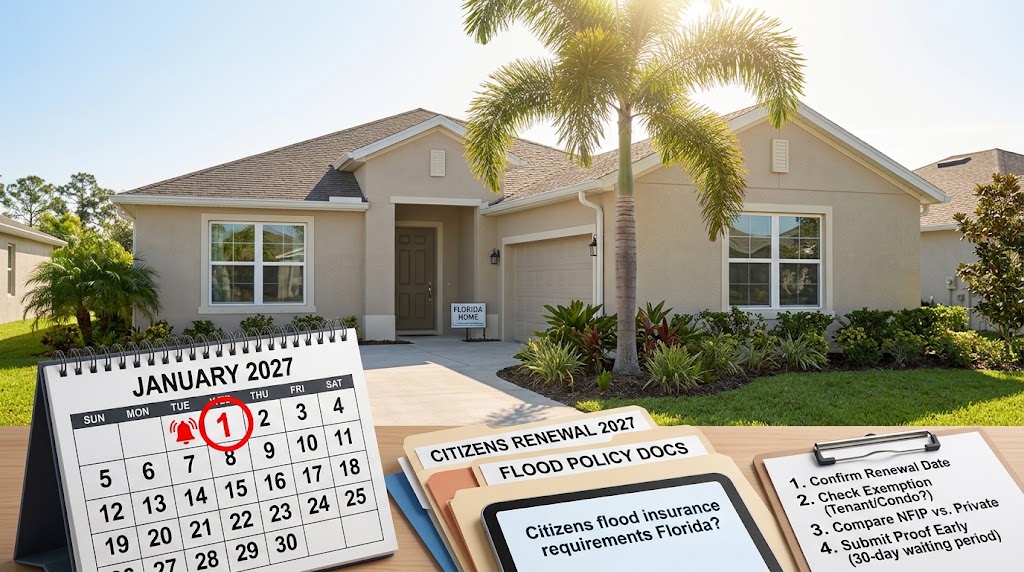
Quick Answer: Yes, for most homeowners. Starting with new policies and renewals on or after January 1, 2027, every Citizens Property Insurance personal residential policy that includes wind coverage must be backed by a flood insurance policy, regardless of flood zone or home value. The flood policy’s dwelling coverage must at least equal your Citizens dwelling limit, or the maximum available from the NFIP. Condo unit-owner policies, tenant policies and policies that exclude wind are exempt. Bills to relax the requirement died in the 2026 legislative session.
Why This Matters Right Now
The final phase of Citizens’ flood insurance mandate takes effect January 1, 2027, less than three months away. When the requirement was created, coverage estimates suggested that roughly 720,000 additional Citizens policies would fall under the rule in this last phase, most of them homes outside designated flood zones whose owners have never carried flood coverage.
Homeowners who renew in early 2027 without proof of flood insurance risk losing their Citizens eligibility. And because new NFIP flood policies generally carry a 30-day waiting period before coverage starts, waiting until the renewal notice arrives can leave too little time.
Where the Requirement Comes From
The Florida Legislature created the flood requirement in Senate Bill 2-A during its December 2022 special session after Hurricane Ian. Ian caused catastrophic flood damage in areas where few homeowners had flood coverage. Standard homeowners policies, including Citizens policies, exclude flood damage, so many Ian victims had no coverage for their largest losses.
Lawmakers phased the requirement in over several years, starting with homes in the highest-risk flood zones and highest-value homes.
The Full Phase-In Timeline
| Effective Date | Who Must Have Flood Insurance |
|---|---|
| April 1, 2023 | New policies on homes in FEMA special flood hazard areas |
| July 1, 2023 | Renewing policies on homes in special flood hazard areas |
| January 1, 2024 | Policies with dwelling coverage of $600,000 or more |
| January 1, 2025 | Policies with dwelling coverage of $500,000 or more |
| January 1, 2026 | Policies with dwelling coverage of $400,000 or more |
| January 1, 2027 | All remaining policies with wind coverage, regardless of value or zone |
The requirement applies at new business or renewal. A policy renewing in March 2027, for example, must show flood coverage at that renewal.
Special Flood Hazard Areas
Homes in FEMA special flood hazard areas, including zones beginning with A or V, have been required to carry flood insurance for any Citizens personal residential policy with wind coverage since 2023, regardless of dwelling value.
Homes Outside Flood Zones
The January 2027 phase is the one that reaches homes in moderate- and low-risk zones, such as X zones. Many of these homeowners have never been required to carry flood insurance by a lender.
Who Is Exempt
Citizens says the following are not required to purchase flood insurance:
- Condominium unit-owner policies. A 2023 law exempted condo unit owners, and Citizens rescinded non-renewals that had been issued to condo owners solely for lack of flood coverage.
- Tenant contents policies. Renters insuring their belongings are not subject to the requirement.
- Policies that exclude windstorm or hail coverage. The requirement attaches to policies that include wind.
Homes Ineligible for NFIP Coverage
Citizens has said risks that are ineligible for an NFIP flood policy may be eligible for a Citizens policy that excludes wind coverage, with documentation such as a declination or cancellation notice showing NFIP ineligibility. In practice, this usually affects homes in communities that do not participate in the NFIP.
How Much Flood Coverage You Need
Citizens requires flood dwelling coverage equal to or greater than your Citizens policy’s dwelling coverage (Coverage A).
If that amount is not available from the NFIP, Citizens accepts the maximum coverage you are eligible for. Under the NFIP’s regular program, that is $250,000 of building coverage.
Contents Coverage No Longer Required
When the mandate began, Citizens also required flood coverage for contents. A later law change eliminated the contents requirement, so flood coverage is now required only for the dwelling. Contents flood coverage is still worth considering, since furniture, appliances and personal belongings are often a large share of a flood loss.
Example
| Citizens Dwelling Coverage | Minimum Flood Building Coverage |
|---|---|
| $180,000 | $180,000 |
| $250,000 | $250,000 |
| $375,000 | $250,000 if purchased through NFIP (program maximum) or $375,000 through a private flood policy |
NFIP vs. Private Flood Insurance
Either an NFIP policy or a qualifying private flood policy can satisfy Citizens’ requirement.
| Factor | NFIP | Private Flood |
|---|---|---|
| Building coverage limit | Up to $250,000 | Often higher limits available |
| Contents limit | Up to $100,000 | Varies |
| Pricing | Individual risk-based pricing under FEMA’s Risk Rating 2.0 | Set by each insurer |
| Waiting period | Generally 30 days for new policies, with limited exceptions | Often shorter; varies by insurer |
| Extras | Limited coverage for basements, no loss-of-use | May include additional living expenses or replacement cost on contents |
| Availability | Available in participating communities | Availability and underwriting vary |
Florida has one of the most competitive private flood markets in the country, and agents often compare both. For many homes outside high-risk zones, flood premiums are lower than homeowners expect, but prices vary widely by elevation, construction and location.
Risk Rating 2.0
FEMA now prices NFIP policies based on each home’s individual flood risk rather than primarily on flood zone. Homes outside special flood hazard areas can still have meaningful flood risk based on distance to water, elevation and rainfall exposure. Annual increases for existing NFIP policyholders are limited by law, so starting coverage earlier can matter for future pricing.
How to Prove Compliance
New applicants and renewing policyholders must submit two things:
- Proof of flood coverage, which can be:
- A copy of the flood policy declarations page, or
- A copy of a submitted flood application and proof of payment, if coverage is still pending
- A signed Policyholder Affirmation Regarding Flood Insurance, Citizens form CIT FW01
Citizens Wind-Only Policies
If Citizens covers only your wind risk and another insurer covers other perils, you must show proof of a flood endorsement or flood policy that meets the minimum standard on your underlying policy.
Keep Coverage in Force
The requirement is to obtain and maintain flood coverage. Letting a flood policy lapse can create eligibility problems at your next Citizens renewal.
Step-by-Step: What to Do Before Your 2027 Renewal
Step 1: Check Your Renewal Date
Find your Citizens policy’s renewal date. If it falls on or after January 1, 2027, the requirement will apply at that renewal unless you are exempt.
Step 2: Check Whether You Are Exempt
Confirm whether your policy is a condo unit-owner policy, tenant policy or a policy that excludes wind. If so, the flood requirement does not apply.
Step 3: Find Your Dwelling Coverage Amount
Look for Coverage A on your Citizens declarations page. That number sets your minimum flood building coverage, up to the NFIP maximum.
Step 4: Shop for Flood Coverage Early
Ask your agent for quotes from both the NFIP and private flood insurers. Have your elevation certificate ready if you have one, since it can affect pricing.
Step 5: Account for Waiting Periods
New NFIP policies generally take effect 30 days after purchase, with limited exceptions. Buy at least 30 to 45 days before your Citizens renewal to avoid a gap.
Step 6: Submit Proof and the Affirmation Form
Send the flood declarations page or application with payment proof, plus the signed CIT FW01, to your agent before renewal.
Step 7: Calendar Both Renewal Dates
Your Citizens policy and your flood policy may renew on different dates. Track both so neither lapses.
Should You Stay With Citizens or Shop Privately?
The flood requirement changes the cost comparison. When you add flood premiums to a Citizens policy, a private homeowners policy without a flood requirement may look closer in price, even if the private premium itself is higher.
Things to weigh:
- Total cost: Citizens premium plus flood premium versus a private policy alone
- Flood exposure: a private policy without flood coverage leaves you uninsured for flood
- Eligibility: Citizens rules require you to accept a comparable private offer within 20% of the Citizens premium at renewal
- Coverage quality: compare deductibles, roof provisions and claims handling
Many agents and insurance experts recommend flood coverage for most Florida homes regardless of insurer, since a large share of recent flood claims came from outside high-risk zones.
The 2026 Legislative Session: No Relief
Bills filed for the 2026 session, Senate Bill 1024 and House Bill 909, would have expanded the categories of Citizens policies that do not require flood insurance, among other eligibility changes. Both died in committee in March 2026. The January 1, 2027 phase remains in effect as written.
Common Questions From Homeowners Outside Flood Zones
“My home has never flooded.”
Many homes that flooded in recent Florida hurricanes had never flooded before. Rainfall flooding and storm surge can reach areas outside mapped high-risk zones.
“My lender doesn’t require flood insurance.”
Lenders generally require flood insurance only in special flood hazard areas. Citizens’ requirement is separate and applies regardless of your mortgage.
“Can I just drop wind coverage to avoid the requirement?”
Policies that exclude wind are exempt, but dropping wind coverage in Florida leaves you uninsured for hurricane wind damage, and your mortgage lender likely requires wind coverage. This is rarely a practical option for homeowners with mortgages.
“What happens if I don’t get flood coverage?”
Without proof of compliant flood coverage, your Citizens policy may not be eligible to renew. Under Florida law, residential non-renewals generally require advance notice, but losing Citizens eligibility can still leave you searching for coverage on short notice.
Brian’s Take
The final phase of the Citizens flood mandate is the one that will surprise the most people. Homeowners in X zones who were never required to carry flood insurance by a lender are about to face a new line item, and many will learn about it from a renewal letter.
The practical advice is simple: shop for flood insurance now, not in the month before renewal. The 30-day NFIP waiting period alone makes procrastination risky.
There is also a bigger point. The requirement exists because Hurricane Ian exposed how many Floridians had no protection against their largest risk. Flood coverage in a lower-risk zone is often far less expensive than people assume, and the homeowners who complained loudest about the mandate in 2023 were frequently paying far less for flood than they expected once they got quotes.
Frequently Asked Questions
When do all Citizens policyholders need flood insurance?
For policies with wind coverage, the requirement applies to all remaining personal residential policies at new business or renewal on or after January 1, 2027, regardless of value or flood zone.
Do Citizens condo owners need flood insurance?
No. Condominium unit-owner policies are exempt under a 2023 law change.
Do renters with Citizens policies need flood insurance?
No. Tenant contents policies are exempt.
How much flood insurance does Citizens require?
Flood building coverage equal to or greater than your Citizens dwelling coverage, or the maximum available from the NFIP, which is $250,000 in the regular program.
Does Citizens require flood coverage for contents?
No. A law change eliminated the contents requirement. Only dwelling coverage is required.
Can I use private flood insurance for Citizens?
Yes. Either an NFIP policy or a qualifying private flood policy satisfies the requirement.
What documents does Citizens need?
Proof of flood coverage, such as a declarations page or a pending application with proof of payment, plus a signed Policyholder Affirmation Regarding Flood Insurance (CIT FW01).
Did Florida change the Citizens flood requirement in 2026?
No. Bills to expand exemptions died in committee in March 2026.
How long does it take for flood insurance to start?
New NFIP policies generally have a 30-day waiting period, with limited exceptions. Private flood policies vary.
Sources and Further Reading
- Citizens’ Flood Insurance Requirements, Citizens Property Insurance Corporation
- New Flood Rules Could Save You Money, Citizens Property Insurance Corporation
- Updates to Flood Coverage Law Bring More Changes, Citizens Property Insurance Corporation
- Personal Lines Bulletin: Updated Flood Requirements for Condominiums, Citizens Property Insurance Corporation
- Personal Lines Bulletin: Flood Insurance Requirements for Renewal Eligibility, Citizens Property Insurance Corporation
- Personal Lines Bulletin: Flood Insurance Requirements for Coverage Limit, Citizens Property Insurance Corporation
- Depopulation Activity Increasing as Market Improves, Citizens Property Insurance Corporation
- Got Hurricane Insurance From Citizens? Here’s a New Reason Your Bill May Rise, WLRN
- Flood Insurance Will Be Mandatory for Most Citizens Policyholders by 2027, News4Jax
- Citizens Insurance Expands Flood Insurance Requirement to Those Not in Flood Zones, ABC Action News
- Florida Flood Insurance Guide, Bankrate
- Senate Bill 1024 and House Bill 909 (2026), Coverage by Citizens Property Insurance Corporation, Bill History, The Florida Senate and LegiScan
- Florida Statutes Section 627.4133, Notice of Cancellation, Nonrenewal, or Renewal Premium, The Florida Senate