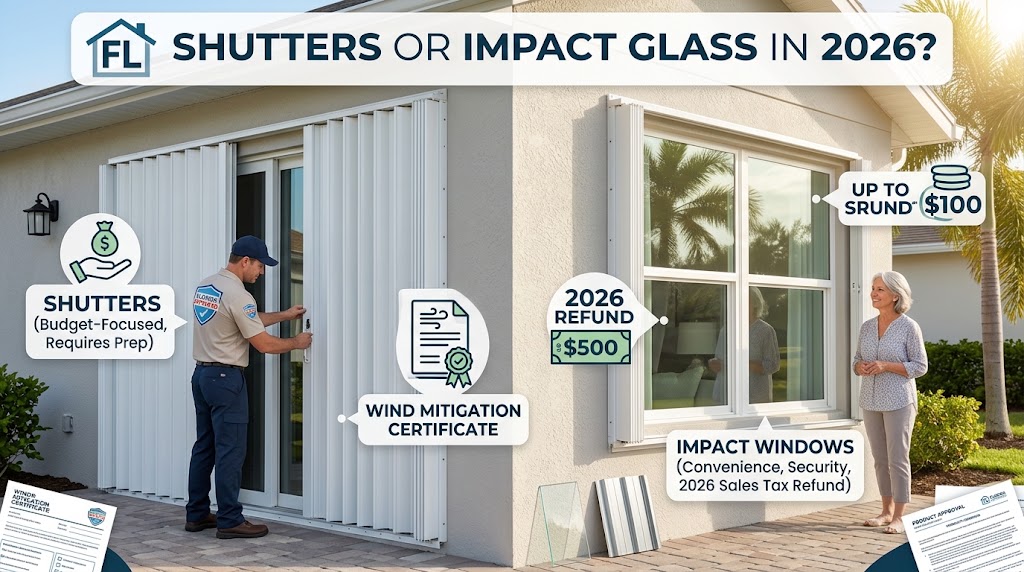
Quick Answer: Both can meet Florida’s building code and earn insurance wind mitigation credits when every opening is protected. Impact windows cost more up front but stay in place year-round, need no storm prep and qualify for Florida’s 2026 sales tax refund of up to $500. Hurricane shutters usually cost less but must be deployed before each storm and do not qualify for that refund. Many Florida homeowners combine both, using impact glass where convenience matters most and shutters elsewhere.
Why This Decision Matters in Florida
Windows, glass doors and garage doors are the weakest points in a home’s storm defense. When an opening fails during a hurricane, wind can rush in and pressurize the house, contributing to roof and wall failure. Florida’s building code, insurance discounts and state grant programs all focus heavily on opening protection for that reason.
The choice between shutters and impact windows affects five things:
| Factor | Why It Matters |
|---|---|
| Code compliance | Homes in wind-borne debris regions need protected openings |
| Insurance premium | Wind mitigation credits reward full opening protection |
| Storm readiness | Shutters require action before every storm; impact glass does not |
| Upfront cost | Shutters are usually cheaper per opening |
| Daily living | Impact glass adds security, noise reduction and UV protection |
What Florida Law Requires
Wind-Borne Debris Regions
The Florida Building Code requires glazed openings to be protected in wind-borne debris regions. These include areas within 1 mile of the coastal mean high-water line where the ultimate design wind speed is 130 mph or more, and anywhere the design wind speed is 140 mph or more. Miami-Dade and Broward counties fall within the High-Velocity Hurricane Zone, which has the strictest product testing standards in the state.
In these regions, homeowners generally have two code-compliant paths:
- Impact-resistant windows and doors that are tested and approved to resist debris impact
- Non-impact windows protected by approved impact-resistant coverings, such as rated shutters or panels
Outside Debris Regions
Homes outside these regions are not required to have impact protection, but windows must still meet design pressure requirements for wind. Many inland homeowners still add protection for safety and insurance savings.
Product Approval and Permits
Both impact windows and shutters sold for Florida installations need Florida Product Approval, or a Miami-Dade Notice of Acceptance in the High-Velocity Hurricane Zone. Installing either typically requires a building permit and inspection. Product approvals include specific installation instructions, and inspectors check anchors and fasteners against them.
Types of Hurricane Shutters
| Shutter Type | How It Works | Strengths | Tradeoffs |
|---|---|---|---|
| Storm panels (aluminum or steel) | Removable panels attached to tracks or bolts | Lowest cost per opening | Heavy, storage needed, slow to install |
| Clear polycarbonate panels | Removable panels that let light in | Daylight during storms | Higher cost than metal panels; still need installation |
| Accordion shutters | Permanently mounted, fold out and lock | Fast to close, no storage | Visible tracks; moving parts need maintenance |
| Roll-down shutters | Permanently mounted, roll from a housing | Fastest deployment, motorized options | Highest shutter cost; motors need backup power |
| Bahama and colonial shutters | Permanently mounted decorative shutters | Shade plus storm protection | Style limits; not suited to every window |
| Fabric storm screens | Heavy fabric panels anchored over openings | Lightweight, lets in light | Deflection limits near glass; installation matters |
What About Plywood?
The building code allows precut wood structural panels as opening protection for certain one- and two-story homes outside the High-Velocity Hurricane Zone, but only with specific thickness, span and fastening requirements. Plywood is a stopgap, not a long-term solution. It takes time and labor to install, deteriorates in storage and may earn a smaller insurance credit than tested impact products.
How Impact Windows Work
Impact windows use laminated glass, two layers of glass bonded to a strong plastic interlayer, set in reinforced frames anchored to the structure. When struck by debris, the glass may crack, but the interlayer is designed to hold it in place and keep the opening sealed.
Beyond Storm Protection
- Always on. No deployment before a storm, which matters for older homeowners, people who travel or second-home owners.
- Security. Laminated glass is harder to break through.
- Noise reduction. Laminated glass dampens outside noise.
- UV filtering. The interlayer blocks most ultraviolet light, reducing fading of floors and furniture.
- Energy efficiency. Many impact units include low-E coatings or insulated glass.
Limitations
- Higher upfront cost than shutters
- Longer manufacturing lead times
- Damaged laminated glass must be replaced after impact
- Frame color and style choices may be limited by HOA or condo specifications
Side-by-Side Comparison
| Category | Hurricane Shutters | Impact Windows |
|---|---|---|
| Upfront cost | Lower, especially panels | Higher |
| Storm prep | Required before each storm | None |
| Code compliance | Yes, with approved products | Yes, with approved products |
| Insurance credit | Yes, when all openings are protected | Yes, when all openings are protected |
| 2026 sales tax refund | Not eligible | Eligible, up to $500 with qualifying conditions |
| My Safe Florida Home grants | Eligible improvement | Eligible improvement |
| Daily benefits | Some shade and security when closed | Security, noise and UV reduction year-round |
| Natural light during storms | Blocked, except clear panels | Unchanged |
| Maintenance | Tracks, hinges, motors, storage | Seals and hardware |
| Best fit | Budget-focused, full-time residents able to deploy | Seasonal residents, older owners, long-term owners |
Insurance: Getting the Opening Protection Credit
Florida law requires insurers to offer discounts for documented wind mitigation features. Opening protection is a major category on the state’s wind mitigation inspection form.
The Key Rule: Protect Every Opening
The largest opening protection credits generally require protection of all glazed openings, and the top categories also look at non-glazed openings such as entry doors and garage doors. A home with impact windows but an unprotected sliding door or older garage door can lose much of the credit.
Openings to account for:
- Every window
- Sliding glass and French doors
- Entry doors, especially with glass
- Garage doors
- Skylights
Mixing Shutters and Impact Glass
Insurers and inspectors evaluate whether each opening is protected by an approved product, not whether every opening uses the same product. A mixed approach can qualify if every opening is covered and documented.
Documentation You Need
- Closed permits for the work
- Product approval numbers for each product
- A new wind mitigation inspection after installation
Inspectors may need to see product labels or approval documents. If they cannot verify a product, they may not give credit for it.
2026 Incentives and Funding
Florida Sales Tax Refund
Florida created a refund of sales tax paid on qualifying impact-resistant windows, doors and garage doors installed on eligible homes. Department of Revenue guidance says eligible homes must be site-built with a just value of $700,000 or less, the refund is capped at $500 and limited to one property per owner, and claims are filed after purchase with Forms DR-26S and DR-26HH plus receipts. Claims are accepted through September 30, 2029. Shutters are not listed as qualifying products.
My Safe Florida Home
The state’s grant program covers opening protection, including impact windows, impact doors, garage doors and qualifying shutters, when recommended by the program’s inspection. Grants reach up to $10,000, generally with the state paying $2 for every $1 the homeowner spends, and eligible low-income applicants may receive grants without the match. Eligibility has been limited to low- and moderate-income homeowners with homestead exemptions on site-built single-family homes or townhouses, and funding opens and closes as money is available.
Federal Credits
The federal energy-efficiency tax credit for windows and doors ended for property placed in service after December 31, 2025. It does not apply to 2026 installations, and it never covered shutters.
HOA and Condo Rules
Homeowners Associations
Since 2024, Florida law requires homeowners associations to adopt hurricane protection specifications for structures in the community. Those specifications may address color and style and must comply with the building code. The association may not deny an application to install, enhance or replace hurricane protection that conforms to its adopted specifications. The statute’s definition of hurricane protection includes permanent fixed storm shutters, roll-down track shutters, impact-resistant windows and doors, polycarbonate panels and reinforced garage doors.
What this means for you: your HOA can dictate the look, but it cannot block compliant protection. Request the association’s written hurricane protection specifications before getting quotes.
Condominiums
Condominium boards must also adopt hurricane protection specifications. Under Section 718.113(5), a board may not refuse to approve a unit owner’s installation or replacement of hurricane protection that conforms to the board’s specifications. Boards may also install hurricane protection association-wide with the required owner approval, and owners who previously installed compliant protection receive a credit if the association later installs protection uniformly.
Condo owners should check the declaration to see whether windows and shutters are the unit owner’s or association’s responsibility, since that affects who pays for maintenance and replacement.
Cost Considerations Without the Sales Pitch
Prices vary widely by region, home size, number of openings, product type and installation complexity. Rather than rely on average-cost charts, compare quotes on these points:
- Cost per opening, broken out by window size and type
- Garage door and entry doors, which are often left out of window-only quotes
- Permit fees and engineering, if included
- Stucco, drywall and paint repair, which impact window replacement often requires
- Storage and installation labor for removable shutters
- Backup power for motorized roll-down shutters
- Expected insurance credit, which your agent can estimate before you buy
Thinking in Total Cost
Shutters often win on upfront cost. Impact windows can narrow the gap when you factor in years of storm deployment labor, storage, maintenance, the sales tax refund, possible grant eligibility and the daily benefits of laminated glass. The right answer depends on how long you plan to stay, who will deploy shutters and your budget today.
Which Option Fits Your Situation?
Impact Windows Often Make Sense If You:
- Plan to stay in the home for many years
- Travel or own a seasonal home
- Have physical limits that make deploying shutters difficult
- Want security and noise reduction
- Are already replacing old or failing windows
Shutters Often Make Sense If You:
- Have newer windows that do not need replacement
- Need code-compliant protection quickly on a tighter budget
- Live in the home full time and can deploy protection before storms
- Want to protect large openings, such as patios, at lower cost
A Hybrid Approach Works When You:
- Want impact glass on main living areas and bedrooms
- Use roll-down or accordion shutters on large sliders or lanais
- Add an impact-rated garage door to complete opening protection
Step-by-Step: Planning Opening Protection
- Pull your current wind mitigation report to see which openings are protected.
- Check your wind zone to confirm code requirements.
- Get HOA or condo specifications before collecting quotes.
- Ask your insurance agent what credit full opening protection would earn.
- Check My Safe Florida Home status before starting work if you may qualify.
- Get at least three quotes covering every opening, including garage and entry doors.
- Verify licenses on MyFloridaLicense.com and check product approval numbers.
- Confirm permits and inspections are included.
- Install and close permits before hurricane season if possible.
- Order a new wind mitigation inspection and send it to your insurer.
- File the sales tax refund for qualifying impact products.
- Keep documentation, including product labels, for future inspections and resale.
Storm-Day Reality Check
If you choose shutters, plan for deployment:
- Practice installing panels before hurricane season
- Label panels by window and store fasteners with them
- Lubricate accordion and roll-down tracks yearly
- Have a manual override or backup power for motorized shutters
- Know who will deploy shutters if you are away
Shutters provide no protection if they are still in the garage when the storm arrives. That single factor is why many seasonal residents and older homeowners lean toward impact glass.
Brian’s Take
The shutters-versus-windows debate often misses the bigger point: insurers and the building code care about whether every opening is protected, not which product protects it. A home with expensive impact windows and an old garage door can perform worse in a storm and earn less credit than a home with well-chosen shutters on every opening.
For long-term owners replacing aging windows anyway, impact glass is usually the more practical upgrade, especially with the 2026 sales tax refund. For homeowners with good windows and a tight budget, rated shutters remain a legitimate, code-compliant answer. The worst option is partial protection that leaves one vulnerable opening.
The 2024 HOA and condo law changes also shifted power to owners. If your association’s specifications allow it, you have a legal right to protect your home.
Frequently Asked Questions
Are impact windows better than hurricane shutters in Florida?
Both can be code-compliant and earn insurance credits. Impact windows offer always-on protection and daily benefits; shutters usually cost less but must be deployed before storms.
Do I need impact windows or shutters in Florida?
Homes in wind-borne debris regions need protected openings, either impact-rated products or approved shutters. Homes outside those regions are not required to have impact protection but must meet wind pressure requirements.
Will hurricane shutters lower my insurance?
They can, when approved shutters protect all openings and a wind mitigation inspection documents them.
Can I mix shutters and impact windows?
Yes. Many homes use both. For insurance credit, what matters is that every opening is protected by an approved product.
Do shutters qualify for Florida’s 2026 sales tax refund?
No. The refund covers qualifying impact-resistant windows, doors and garage doors.
Can my HOA stop me from installing hurricane shutters?
An HOA may not deny an application for hurricane protection that conforms to its adopted specifications. It can regulate color and style.
Can my condo board refuse impact windows or shutters?
A condo board may not refuse a unit owner’s installation that conforms to the board’s hurricane protection specifications.
Is plywood legal hurricane protection in Florida?
Precut plywood panels are allowed for certain one- and two-story homes outside the High-Velocity Hurricane Zone if they meet code requirements, but they may earn less insurance credit than tested products.
Do I need a permit for hurricane shutters?
Installing hurricane shutters or impact windows typically requires a building permit and inspection. Check with your local building department.
Sources and Further Reading
- Florida Building Code 8th Edition (2023) Wind-Borne Debris Region Definition and Annual Technical Amendment, Florida Building Commission
- Florida Building Code Resource Guide, PGT Innovations
- Florida Building Code and Product Approvals, Florida Roofing and Sheet Metal Contractors Association
- Chapter 2024-205, Laws of Florida (HB 293), Hurricane Protections for Homeowners’ Associations
- Architectural Review in Homeowners’ Associations, Becker & Poliakoff
- Governor Signs HB 293 Requiring HOA Hurricane Protection Specifications, Shumaker
- Florida Statutes Section 718.113, Maintenance; Hurricane Shutters and Protection, The Florida Senate
- 2024 Hurricane Law Update for Condominiums, Florida Condo & HOA Law Blog
- Hurricane Shutters and Hurricane Protection in Condominiums, JD Supra
- Florida Home-Hardening Sales Tax Refund, Tax Information Publication No. 26A01-09 summary, Sales Tax Institute
- My Safe Florida Home Program Has Money Left From Last Year to Keep Grants Flowing in 2026, WFLX
- My Safe Florida Home Program 2026: Grants, Eligibility, and Status, Latent Insure
- What Section 70505 Ended for the 25C Home Energy Credit, Instead
How is Claude doing this s