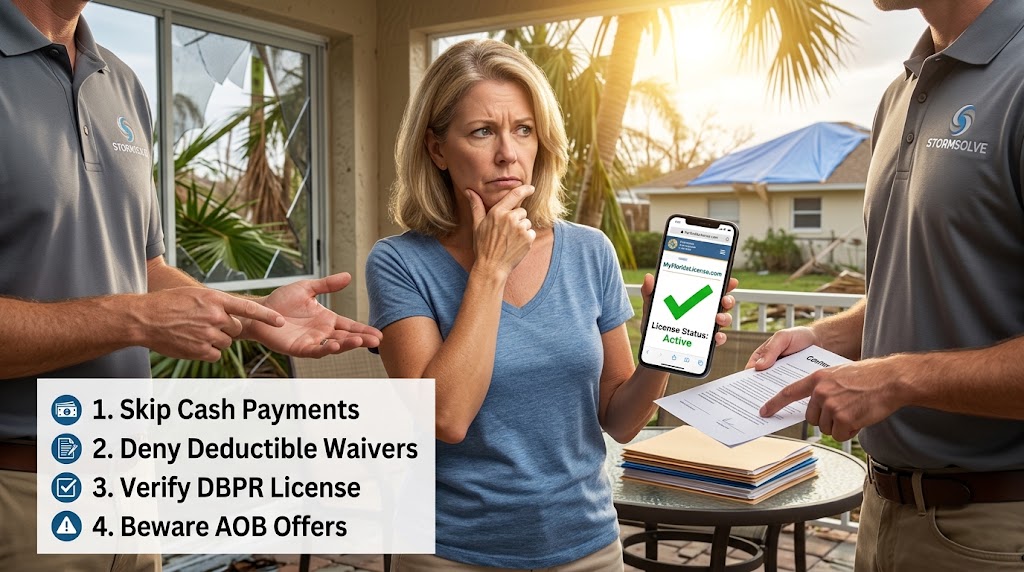
Quick Answer: After a Florida storm, verify every contractor’s license at MyFloridaLicense.com before signing anything. Walk away from anyone who demands cash up front, offers to waive your deductible, pressures you to sign an Assignment of Benefits, or can’t show a state license number. Unlicensed contracting during a declared state of emergency is a third-degree felony in Florida. Report suspected unlicensed activity to DBPR at 1-866-532-1440.
Why Scams Spike After Florida Storms
Every hurricane and major windstorm brings two waves into Florida neighborhoods. The first is legitimate crews. The second is storm chasers: out-of-state operators, unlicensed workers and fraud rings that follow damage reports from county to county.
They count on three things: homeowners who are stressed, insurance money that is about to arrive, and legitimate contractors who are booked for weeks. That combination makes a stranger at the door offering to start tomorrow sound like good news.
Florida law treats this seriously. Under Section 489.127, unlicensed contracting is normally a first-degree misdemeanor. During a state of emergency declared by the governor, it becomes a third-degree felony, and that elevated penalty applies to all types of construction work, not only storm repairs.
Red Flags at a Glance
| Red Flag | Why It Matters |
|---|---|
| Cash-only or large upfront demand | Limits your recourse if work never starts |
| Offers to waive or pay your deductible | Insurance fraud under Section 489.147 |
| Unmarked truck, out-of-state plates, no local office | Hard to locate after payment |
| No Florida license number on contract or truck | Licensed contractors must display it |
| Pushes you to sign an Assignment of Benefits | Void on policies issued on or after Jan. 1, 2023 |
| Offers gifts or cash to inspect your roof | Prohibited by Section 489.147 |
| Says they’ll “handle your insurance claim” | Only licensed public adjusters may do this |
| Asks you to pull the permit yourself | Shifts legal liability to you |
| “Leftover materials” or “today only” pricing | Classic pressure tactic |
The Five Tactics Florida Homeowners See Most
1. The Deductible Waiver
A contractor offers to “eat” or rebate your hurricane deductible. It sounds like a discount. Under Section 489.147, it is insurance fraud and a third-degree felony for a contractor to knowingly pay, waive or rebate any part of an insurance deductible with intent to defraud. The homeowner is responsible for paying the deductible.
2. The Free Roof Inspection With a Gift
Florida bars contractors from offering rebates, gift cards, cash, coupons, deductible waivers or anything else of value in exchange for letting them inspect your roof or file a roof damage claim. Contractors also may not solicit homeowners with ads that encourage contacting a contractor or public adjuster to file a roof claim.
3. “We’ll Handle the Insurance Company”
A contractor may not interpret your policy, advise you on coverage, or adjust your claim unless the contractor also holds a public adjuster license. If someone at your door offers to negotiate with your insurer, ask for the public adjuster license number and verify it separately through the Florida Department of Financial Services.
4. The Assignment of Benefits Push
An Assignment of Benefits (AOB) transfers your insurance claim rights to the contractor. Florida’s 2022 reforms prohibit assigning post-loss benefits under residential property policies issued on or after January 1, 2023. Because most homeowners policies renew annually, nearly every current policy falls under the ban. A contractor asking for an AOB today is either outdated or working an angle.
5. The Deposit and Disappear
Florida does not cap contractor deposits, but Section 489.126 sets deadlines once a contractor collects more than 10% of the contract price as an initial payment on residential work. The contractor must apply for required permits within 30 days of payment and start work within 90 days after permits are issued. Missing those deadlines without just cause can be prosecuted as theft.
How to Verify a Contractor License on MyFloridaLicense.com
The Florida Department of Business and Professional Regulation (DBPR) licenses construction contractors through the Construction Industry Licensing Board and electrical contractors through the Electrical Contractors’ Licensing Board.
Step 1: Get the License Number in Writing
Ask for the license number before any inspection or estimate. Licensed contractors are required to include it on contracts, estimates and advertising.
Step 2: Search the DBPR Database
Go to MyFloridaLicense.com and choose the Verify a License option. Search by license number first. If you only have a name, search by individual name and by business name, since they may differ.
Step 3: Read the Result Carefully
| Field | What to Look For |
|---|---|
| Status | “Current, Active” — anything else is a warning |
| License type | Matches the job (roofing work needs a roofing or general license) |
| Name | Matches the person or company on your contract |
| Expiration date | Not expired or about to lapse |
| Complaints/discipline | Review any public disciplinary history |
Step 4: Understand Certified vs. Registered
A certified license is issued by the state and lets a contractor work anywhere in Florida. Certified license numbers generally begin with “C,” such as CGC (general), CBC (building), CRC (residential) or CCC (roofing). A registered license is tied to local competency and generally begins with “R.” Registered contractors can work only in the jurisdictions where they hold local certification.
Step 5: Check Local Registration and Permits
Many counties require contractors to register locally before pulling permits. Call your county or city building department or use its online permit search to confirm the contractor is registered and has pulled permits for past jobs.
Step 6: Confirm Insurance
Ask for certificates of general liability and workers’ compensation insurance, with your address listed as the job location. You can check workers’ compensation coverage through the Florida Division of Workers’ Compensation proof of coverage search. Unlicensed workers usually cannot obtain either policy, which can leave the property owner exposed if someone is injured on site.
Door-to-Door Solicitation: Your Rights
Many post-storm deals start on the doorstep. Florida’s Home Solicitation Sale law gives buyers the right to cancel most consumer contracts signed at home with a door-to-door seller until midnight of the third business day after signing. The seller must give you written notice of that right. If the contractor didn’t provide a cancellation notice, that alone is a red flag.
Check your city or county code as well. Many Florida municipalities require door-to-door solicitors to carry a local solicitation permit, and some restrict hours.
Before You Sign: Homeowner Checklist
- Verify the state license on MyFloridaLicense.com.
- Confirm local registration with your building department.
- Get at least three written, itemized estimates.
- Read the contract for the license number, scope of work, payment schedule and start and completion dates.
- Confirm the contractor, not you, will pull the permit.
- Pay by check or card, never cash, and keep receipts.
- Tie payments to completed milestones, not calendar dates.
- For roof contracts, confirm the contract includes the required notice that the contractor may not offer prohibited inducements.
- Get lien releases from the contractor and major suppliers before final payment.
- Notify your insurer of damage directly, not through the contractor.
Where to Report Post-Storm Fraud
| Problem | Agency | Contact |
|---|---|---|
| Unlicensed contractor | DBPR Unlicensed Activity Hotline | 1-866-532-1440 |
| Licensed contractor misconduct | DBPR Construction Industry Licensing Board | File a complaint at MyFloridaLicense.com |
| Insurance fraud, deductible schemes | Florida DFS Division of Investigative and Forensic Services | Report through the DFS fraud portal |
| Price gouging during an emergency | Florida Attorney General | 1-866-966-7226 |
| Theft, deposit not returned | Local law enforcement | Non-emergency line |
Tips to the DBPR Unlicensed Activity Hotline can be anonymous. DBPR must refer unlicensed activity cases to the local State Attorney’s Office for prosecution.
Brian’s Take
The single most protective habit is boring: write down the license number and look it up before the contractor sets foot on your roof. It takes two minutes and filters out most of the storm-chaser problem.
The deductible waiver is the trap that catches otherwise careful homeowners. It feels like a favor. It is actually a felony for the contractor, and it puts your claim at risk if the insurer finds out.
Florida has some of the strongest anti-fraud contractor laws in the country, from the felony upgrade during emergencies to the AOB ban to the deposit rules. Those laws only help homeowners who know to use them. Licensed, local contractors who are booked three weeks out are usually the safer choice than the crew that can start tomorrow.
Frequently Asked Questions
How do I check if a Florida contractor is licensed?
Search the license number or name on MyFloridaLicense.com using the Verify a License tool. Confirm the status reads “Current, Active” and the license type matches the job.
Is it illegal to hire an unlicensed contractor in Florida?
The crime falls on the unlicensed contractor. During a declared state of emergency, unlicensed contracting is a third-degree felony. Homeowners who hire unlicensed workers can face liability for injuries, failed permits and denied insurance claims.
Can a contractor pay my insurance deductible?
No. Knowingly waiving, paying or rebating an insurance deductible with intent to defraud is a third-degree felony under Florida law.
Can I still sign an Assignment of Benefits in Florida?
Not for residential property policies issued on or after January 1, 2023. Any such assignment is void.
How much deposit can a Florida contractor take?
Florida does not cap deposits. If an initial payment exceeds 10% of the contract price on residential work, the contractor must apply for permits within 30 days and start work within 90 days after permits are issued.
Can I cancel a contract I signed with a door-to-door contractor?
Under Florida’s Home Solicitation Sale law, you can generally cancel until midnight of the third business day after signing. Send cancellation in writing and keep proof of delivery.
Can a roofer negotiate my insurance claim?
Only if the roofer also holds a Florida public adjuster license. Otherwise, contractors are barred from interpreting your policy or adjusting your claim.
Sources and Further Reading
- Florida Statutes Section 489.127, Prohibitions; Penalties (Unlicensed Contracting), The Florida Senate
- Florida Statutes Section 489.147, Prohibited Property Insurance Practices; Contract Requirements (2026), The Florida Senate
- Florida Statutes Section 489.126, Moneys Received by Contractors (2025), The Florida Senate
- Florida Statutes Section 627.7152, Assignment Agreements, The Florida Senate
- Florida Statutes Sections 501.021–501.055, Home Solicitation Sales, The Florida Senate
- Unlicensed Activity FAQs, Florida Department of Business and Professional Regulation
- 2022A Special Session Legislative Summary: Assignment of Benefits, Florida Association of Insurance Agents
- Unlicensed Contracting Is a Felony During a State of Emergency, Charlotte County Community Development Department
- Verify a License Portal, Florida Department of Business and Professional Regulation (MyFloridaLicense.com)