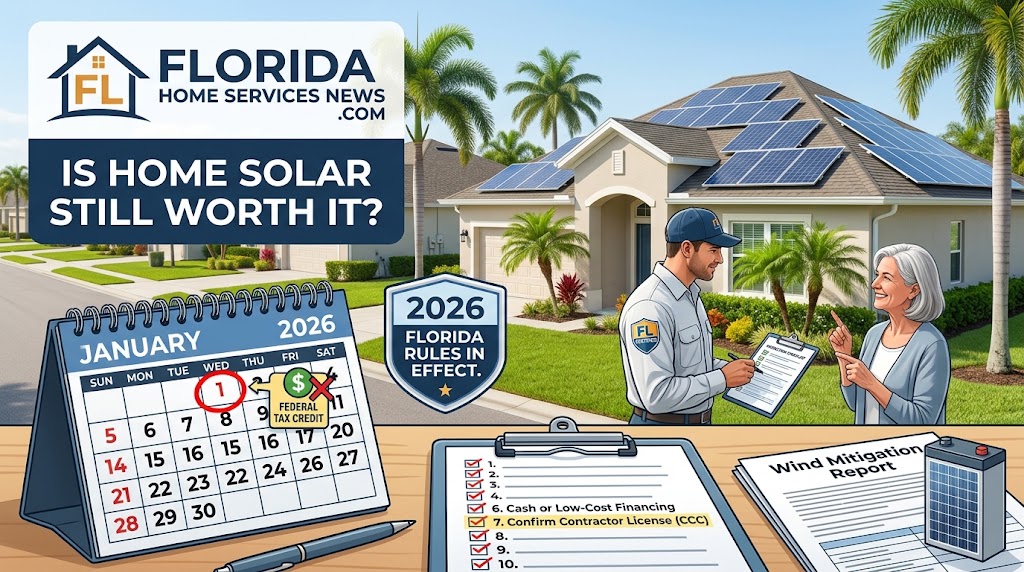
Quick Answer: For many Florida homeowners, yes, but the math changed in 2026. The 30% federal residential solar tax credit ended for systems placed in service after December 31, 2025. Florida still offers a sales tax exemption on solar equipment, a property tax exclusion for the added value, full retail net metering from investor-owned utilities, faster permitting under a 2025 state law, and legal protection against HOA bans. The best results go to homeowners with a newer roof, good south-facing exposure and a cash purchase or low-cost financing.
What Changed for Florida Solar in 2026
| Factor | 2025 | 2026 |
|---|---|---|
| Federal residential solar credit (25D) | 30% of system cost | Ended for systems placed in service after Dec. 31, 2025 |
| Florida sales tax exemption on solar systems | Available | Still available |
| Florida property tax exclusion | Available | Still available |
| Net metering with investor-owned utilities | Full retail credit | Still full retail credit |
| Permitting | Varied by jurisdiction | Streamlined under 2025 state law |
| HOA protections | Solar Rights Act | Still in force |
Losing the federal credit was the biggest change. Nationally, analysts forecast residential solar installations would shrink in 2026. Florida has moved the other way. BloombergNEF projected Florida could install about 710 megawatts of residential solar in 2026, up 62% from 2025, and called it the fastest-growing state for home solar. Reporting from Insurance Journal and others credits Florida’s permitting reforms with lowering soft costs and speeding installations.
Incentives Still Available in Florida
Sales Tax Exemption
Florida exempts qualifying solar energy systems from state sales tax. The exemption is built into state law and applies at purchase. Confirm with your installer that the exemption is reflected on your invoice.
Property Tax Exclusion
Florida law excludes the added value of qualifying residential renewable energy devices from your property’s assessed value. Adding solar should not increase your property taxes, even though it may increase your home’s market value.
Utility and Local Programs
Some utilities, municipalities and counties offer occasional rebates, financing programs or community solar options. These change frequently. Ask your utility directly rather than relying on older online lists.
What Is No Longer Available
The federal Residential Clean Energy Credit, Section 25D, ended for systems placed in service after December 31, 2025, under the One Big Beautiful Bill Act. Systems completed by that date may still be claimed on 2025 tax returns. Be cautious of any sales pitch in 2026 that promises a 30% federal tax credit for a new residential system you buy and own.
Net Metering in Florida
How It Works Today
Florida’s investor-owned utilities, including Florida Power & Light, Duke Energy Florida and Tampa Electric, operate under Public Service Commission net metering rules. When your system produces more electricity than you use, the excess flows to the grid and you receive a credit at the retail rate. That one-for-one credit is one of the main reasons home solar works financially in Florida.
The 2022 Attempt to Cut Credits
In 2022, the Legislature passed House Bill 741, which would have phased down net metering credits for new solar customers starting in 2024, including a reduction to 60% of value for systems approved in 2026. Gov. Ron DeSantis vetoed the bill. Full retail net metering remains in place for investor-owned utility customers as of 2026.
Watch for Future Changes
Utilities have continued to argue that net metering shifts costs to non-solar customers, and the policy could change through future legislation or Public Service Commission rulemaking. Earlier proposals included grandfathering existing customers, so systems installed under current rules have historically been protected for a period of years. No one can guarantee future treatment.
Municipal and Co-op Utilities
Customers of city-owned utilities and electric cooperatives may face different net metering rules than investor-owned utility customers. Check your utility’s interconnection and credit policies before signing a solar contract.
Permitting: Faster in 2026
A construction reform law signed in June 2025 and effective July 1, 2025 streamlined residential solar permitting in Florida. Key changes reported by industry groups and news outlets include:
- Support for automated permitting tools, such as software platforms that standardize residential solar plan review
- Options for remote or virtual inspections in some cases
- Shorter review timelines that reduce installer soft costs
Florida passed additional permitting reforms in 2026, and industry reports say a universal residential permit application is planned beginning in 2027.
What Still Requires a Permit
Rooftop solar systems still require building and electrical permits and inspections in Florida. Plans must account for wind loads under the Florida Building Code, including how panels and racking attach to the roof structure. Your utility must also approve interconnection before the system can operate.
HOA Rules and Your Solar Rights
Florida’s Solar Rights Act
Section 163.04 of the Florida Statutes says deed restrictions, covenants and declarations may not prohibit, or have the effect of prohibiting, solar collectors on homes. A homeowner may not be denied permission to install solar by an association or architectural review committee.
What an HOA Can Control
An association may determine where on the roof panels go, but only within an orientation to the south or within 45 degrees east or west of due south, and only if its choice does not impair the system’s effective operation.
In practice:
- An HOA can ask you to use the south-facing roof plane before a street-facing plane, if both work effectively
- An HOA cannot ban solar outright
- An HOA cannot impose rules that make solar ineffective, such as requiring placement on a heavily shaded or north-facing roof
Condominiums
The statute protects installations within the boundaries of a condominium unit. In many condominiums, the roof is a common element, not part of the unit, so condo owners usually cannot install panels on a shared roof without association action. Condo boards may install solar on common elements to benefit owners.
Hurricane Protection and Backup Power
A separate 2024 law requires HOAs to adopt hurricane protection specifications, and its definition includes exterior fixed generators and fuel storage tanks. That law does not change solar rights, but homeowners pairing solar with backup power should review both sets of rules.
Roof First, Then Solar
Your roof matters more than your panels.
Why Roof Age Matters
- Solar panels typically last 25 years or more. If your roof needs replacement in five years, you will pay to remove and reinstall the system.
- Florida insurers pay close attention to roof age. Adding panels does not reset roof age for insurance purposes.
- Penetrations from mounting hardware must be properly flashed to prevent leaks, which is easier on a newer roof.
Practical Rule
If your roof is near the end of its life, replace it before installing solar. Many homeowners coordinate both projects so one contractor or two coordinated contractors handle the work.
Insurance Considerations
Tell Your Insurer
Rooftop solar is typically considered part of the dwelling. Notify your insurance company and confirm that your dwelling coverage limit is high enough to replace both the home and the system.
Questions to Ask Your Agent
- Will adding solar change my premium or coverage limit?
- How are panels covered for wind, hail and fire?
- Does my hurricane deductible apply to panel damage?
- Are leased panels covered by my policy or the leasing company’s insurance?
- Will a solar installation affect my roof inspection or wind mitigation report?
Leased Systems
If you lease panels or have a power purchase agreement, the solar company may own and insure the equipment. Read the contract to see who pays for storm damage and roof repairs that require removing panels.
Batteries and Backup Power
Do You Need a Battery?
Under full retail net metering, a battery usually does not improve the financial return of a grid-tied solar system in Florida, because you already receive full credit for exported power. Batteries mainly provide backup power during outages.
When Batteries Make Sense
- You want power during hurricanes and extended outages
- Someone in your home relies on powered medical equipment
- You want protection against future net metering changes
Grid-Tied Systems Without Batteries
Most grid-tied solar systems shut down during a grid outage for safety reasons. Without a battery or a specialized inverter, solar alone does not keep the lights on after a hurricane.
Buying vs. Leasing vs. Financing
| Option | How It Works | Pros | Cons |
|---|---|---|---|
| Cash purchase | You pay upfront and own the system | Best long-term return; no interest | Large upfront cost |
| Solar loan | You finance and own the system | Ownership benefits with lower upfront cost | Interest; some loans include hidden dealer fees |
| Lease or PPA | Company owns system; you pay monthly or per kWh | Low or no upfront cost | Smaller savings; can complicate home sales |
Watch the Loan Terms
Some solar loans carry long terms, often 20 to 25 years, with dealer fees built into the price. Compare the cash price to the financed price and ask for the APR and total cost over the life of the loan.
Hiring a Solar Contractor
Licensing
Solar installation is regulated contracting in Florida, and the Department of Business and Professional Regulation lists solar among the contractor categories requiring state certification or registration. Verify the company’s license on MyFloridaLicense.com and confirm the license covers solar work. Electrical work also requires appropriately licensed contractors.
Required Disclosures
Florida law requires many residential solar sales to include a separate written disclosure covering details such as total cost, payment schedule, financing terms, the contractor’s license number, estimated energy production, maintenance responsibilities, transfer rules and whether a lien or UCC filing could be placed on the system. If a salesperson does not provide one, ask why.
Warning Signs
A 2026 WPTV investigation into Treasure Coast solar sales found contracts missing the required disclosure and salespeople who did not appear in state licensing records. Records from the Florida attorney general’s office showed nearly 750 consumer complaints involving three solar companies featured in the investigation. Red flags include:
- Promises of “free solar” or “no electric bill ever”
- Claims that a 30% federal tax credit still applies to a 2026 purchase you own
- Pressure to sign on the first visit
- No license number on the contract
- Production estimates that seem too good to be true
- Reluctance to provide the cash price alongside financing terms
Step-by-Step: Going Solar in Florida in 2026
- Review your electric bills for at least 12 months to understand your usage.
- Check your utility’s net metering and interconnection rules.
- Evaluate your roof for age, condition, orientation and shade.
- Talk to your insurance agent about coverage and roof questions.
- Review HOA rules and submit an application if required.
- Get at least three quotes with cash price, financing terms, equipment, warranties and production estimates.
- Verify licenses on MyFloridaLicense.com.
- Read the required solar disclosure before signing.
- Confirm permits, inspections and utility interconnection are included.
- Keep all documents, including permits, warranties, disclosures and interconnection approval, for future insurance claims and home sales.
Is Solar Worth It for You?
Solar tends to work best for Florida homeowners who:
- Have a roof with good southern, southeastern or southwestern exposure
- Have a roof that will not need replacement for many years
- Plan to stay in the home long enough to recover the investment
- Have high electric usage, especially from air conditioning
- Buy with cash or low-cost financing
Solar may be less attractive if your roof is heavily shaded, near the end of its life, or if you expect to move soon.
Brian’s Take
The end of the federal tax credit removed roughly a third of the subsidy from home solar, and many expected Florida’s market to stall. It has not, largely because the state attacked soft costs through permitting reform while keeping net metering and HOA protections intact. That is a business story worth watching: a market adjusting to a lost subsidy through efficiency rather than collapse.
For homeowners, the decision now rests more on fundamentals than incentives. A good roof, good sun exposure and a fair price matter more than ever. So does skepticism. The complaints coming out of the Treasure Coast show that aggressive sales tactics did not disappear with the tax credit; in some cases, pitches simply kept promising it.
The net metering question is the one long-term risk to watch. Full retail credit is what makes Florida solar pencil out today, and it has already survived one serious legislative attempt to cut it.
Frequently Asked Questions
Is there still a federal tax credit for solar in 2026?
Not for homeowners who buy and own new systems. The federal residential solar credit ended for systems placed in service after December 31, 2025.
Does Florida have a solar tax credit?
Florida does not have a state income tax, so there is no state solar income tax credit. It offers a sales tax exemption on qualifying solar systems and excludes the added value from property tax assessments.
Does Florida still have net metering?
Yes. Investor-owned utility customers still receive retail-rate credits for excess solar energy. A 2022 bill to phase down credits was vetoed.
Can my HOA stop me from installing solar panels?
No. Florida’s Solar Rights Act prohibits associations from banning solar. An HOA may choose placement within 45 degrees east or west of due south if that does not impair the system’s effective operation.
Do I need a permit for solar panels in Florida?
Yes. Rooftop solar requires permits, inspections and utility interconnection approval.
Will solar panels raise my property taxes in Florida?
Florida law excludes the added value of qualifying residential renewable energy devices from property tax assessments.
Do solar panels work during a hurricane power outage?
Most grid-tied systems shut down during outages unless paired with a battery or specialized equipment.
Should I replace my roof before installing solar?
If your roof is near the end of its life, replacing it first usually avoids the cost of removing and reinstalling panels later.
How do I check a solar company’s license in Florida?
Search the company or license number on MyFloridaLicense.com and confirm the license covers solar work.
Sources and Further Reading
- Florida Statutes Section 163.04, Energy Devices Based on Renewable Resources, The Florida Senate
- Florida Solar Rights Law, Florida Solar Energy Research & Education Foundation and UCF Energy Research Center
- Can Anything Be Done About Solar Panels?, Becker & Poliakoff
- Can a Community Association Restrict Solar Panel Installation?, Jimerson Birr
- CS/CS/HB 741 (2022) Net Metering Bill Summary, Florida Senate Committee on Regulated Industries
- Florida Gov. Ron DeSantis Vetoes Controversial Solar Policy Overhaul, Renewable Energy World
- Florida Just Made Solar Installations Faster and Cheaper, EnergySage
- Florida Sets Standard for Faster and Cheaper Rooftop Solar, Solar.com
- Florida Residential Solar Growth Amid Tax Credit Loss, Insurance Journal
- Treasure Coast Solar Savings Pitches Leave Homeowners With 25-Year Debt, Hoodline (summarizing WPTV investigation)
- Impact of the One Big Beautiful Bill Act on Residential Energy Credits, Honkamp