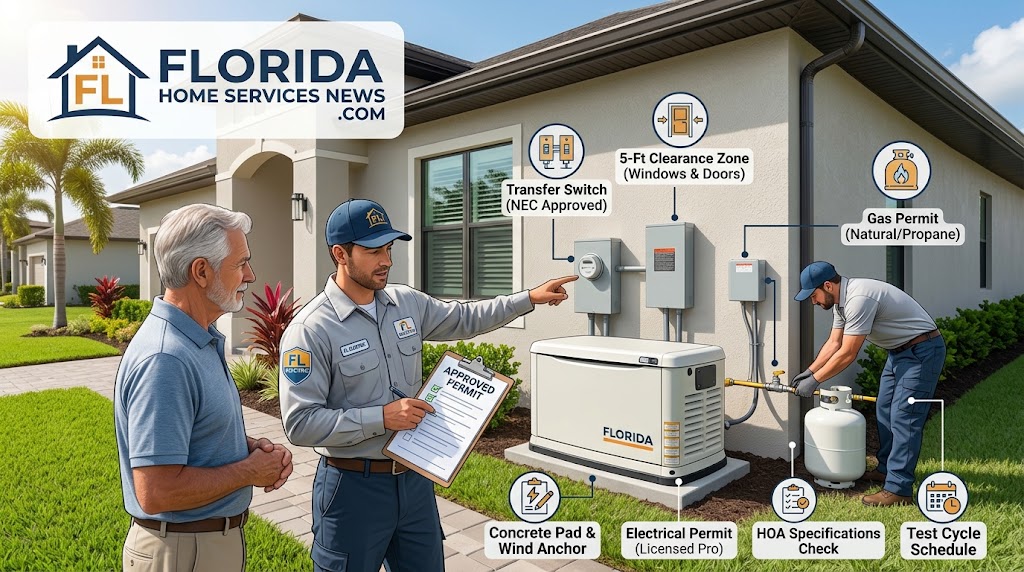
Quick Answer: In Florida, a permanently installed standby generator generally requires an electrical permit pulled by a licensed electrical contractor, plus a separate gas permit if it runs on natural gas or propane. Most local codes and manufacturers require the unit to sit at least 5 feet from doors, windows and vents, on a proper pad, with an approved transfer switch. Portable generators need no permit but must run outdoors, far from openings. A 2026 bill to exempt home backup power from permits died, so permits still apply. HOAs must allow generators that meet their adopted hurricane protection specifications.
Why Generators Are Regulated
After every major Florida hurricane, two things happen: demand for generators spikes, and so do carbon monoxide poisonings and fires from improper use. Standby generators combine electrical, fuel and exhaust hazards in one appliance. That is why installation is governed by several codes at once:
| Code or Standard | What It Covers |
|---|---|
| Florida Building Code | Structural, flood elevation and wind anchoring |
| National Electrical Code | Wiring, transfer equipment, grounding |
| Florida Fuel Gas Code | Natural gas and propane piping |
| Florida Fire Prevention Code and NFPA standards | Clearances, fuel storage, fire safety |
| Local zoning and noise rules | Setbacks, placement, operating hours |
City and county building departments enforce these through permits and inspections.
What’s New for Generators in 2026
Permit Exemption Bill Died
Senate Bill 968, the Home Backup Power Systems bill, would have prohibited local governments from requiring permits for certain residential backup power systems and replaced permits with post-installation inspections. It passed one committee but died in March 2026. A related construction bill that became law, HB 803, addressed other permitting topics but did not create a general permit exemption for home generators. Standby generator installations still require permits.
HOA Permit Review Change
HB 803, effective July 1, 2026, includes a provision prohibiting an association or certain committees from requiring a building permit as a prerequisite for certain architectural reviews. In practice, homeowners should be able to seek HOA approval and the building permit in parallel rather than one after the other. Check with your association on how it applies to your project.
Portable Generators Are Tax-Free Year-Round
Since August 1, 2025, Florida permanently exempts portable generators producing 10,000 running watts or less from sales tax. You no longer have to wait for a hurricane sales tax holiday. Permanently installed standby generators are not included in that exemption.
Portable vs. Standby Generators
| Feature | Portable Generator | Standby Generator |
|---|---|---|
| Installation | None; rolled out when needed | Permanently installed on a pad |
| Permit required | No, unless connected to home wiring | Yes |
| Fuel | Usually gasoline; some dual-fuel | Natural gas, propane or diesel |
| Starts automatically | No | Yes, with automatic transfer switch |
| Powers | Selected appliances or circuits | Selected circuits or whole house |
| Florida sales tax | Exempt at 10,000 running watts or less | Taxable |
| Main safety risk | Carbon monoxide from improper placement | Placement, fuel and electrical errors |
Permits: What Florida Homeowners Need
Electrical Permit
Local building departments in Florida commonly require that the electrical permit for a standby generator be obtained by a licensed electrical contractor before installation. The permit covers the generator connection, transfer switch, wiring and grounding.
Gas Permit
If the generator runs on natural gas or propane, a separate gas permit is typically required. Depending on the jurisdiction, it must be pulled by a licensed plumbing or gas contractor or an LP gas installer licensed by the Florida Department of Agriculture and Consumer Services.
Other Approvals
Some jurisdictions require additional reviews. In Miami-Dade County, for example, some municipalities require county environmental approval for diesel and gasoline generators. Your local building department can tell you what applies.
Typical Submittals
- Permit application
- Survey or plot plan showing the generator location, fuel tank, easements and distances to the home and property lines
- Manufacturer specifications and installation instructions
- Load calculations or panel information
- Gas piping layout showing pipe size, material and length, when applicable
- Flood elevation information if the property is in a flood zone
Placement and Clearance Rules
The 5-Foot Rule
Florida building departments routinely require standby generators to be installed at least 5 feet from building openings, such as doors, windows and vents, based on NFPA 37 and manufacturer requirements. Some local codes and manufacturer instructions are stricter. Openings include operable windows, doors, dryer vents, soffit and eave vents, and air intakes.
Other Common Clearances
| Clearance | Typical Requirement |
|---|---|
| Doors, windows and vents | At least 5 feet, or per manufacturer if stricter |
| Combustible walls | Per listing and manufacturer; some local codes require 3 to 5 feet |
| Propane tank fill or vent valve | Often 10 feet |
| Gas regulator vent | Often 5 feet |
| Service access around unit | Often about 3 feet, per manufacturer |
| Property lines | Set by local zoning; some jurisdictions require 5 feet or more |
| Septic drain fields | Some jurisdictions prohibit placement within 5 feet |
Always follow the most restrictive rule among the local code, NFPA standards and the manufacturer’s instructions.
Exhaust Direction
Generator exhaust must be directed away from openings and air intakes so fumes cannot enter the home. Some jurisdictions require greater distances for exhaust outlets than for the generator enclosure itself.
Pads and Wind Anchoring
Standby generators are typically installed on a concrete pad or manufacturer-approved base. Florida permits also require the installation to resist wind loads, either through the manufacturer’s anchoring instructions or an engineered anchoring method.
Flood Elevation
Under the 8th Edition Florida Building Code, generators in flood hazard areas may need to be elevated to meet flood elevation requirements. A generator flooded by storm surge is useless when you need it most, so elevation matters even where it is not strictly required.
Transfer Switches and Backfeeding
Why a Transfer Switch Is Required
A standby generator must connect through approved transfer equipment that prevents the generator and utility power from being connected at the same time. Without it, generator power can flow backward into utility lines, a dangerous condition called backfeeding that can injure or kill line workers restoring power.
Options
- Automatic transfer switch: Starts the generator and switches loads when utility power fails.
- Manual transfer switch: Requires the homeowner to switch loads manually.
- Interlock kit: A listed device on the main panel that physically prevents the main and generator breakers from being on at the same time, used with a properly installed generator inlet.
Portable Generators and Home Wiring
Never plug a portable generator into a household outlet, a practice sometimes called using a “suicide cord.” Connecting a portable generator to home wiring requires a transfer switch or approved interlock and an inlet installed by a licensed electrician, usually under a permit.
Labeling
Building departments commonly require a label at the electric service equipment indicating that an alternate power source is connected, so first responders and utility workers know a generator is present.
Fuel Options and Rules
Natural Gas
Natural gas generators run as long as utility gas service continues and require no fuel storage. The gas line and meter must be sized for the generator plus all other gas appliances. Your gas utility may need to upgrade the meter.
Propane
Propane works where natural gas is unavailable. Tanks must meet NFPA 58 distance requirements from buildings, property lines and ignition sources, which vary by tank size. Larger tanks require greater separation. Above-ground and underground tanks have different rules.
Diesel and Gasoline
Diesel standby units require on-site fuel storage that meets fire code requirements and, in some jurisdictions, environmental review. Gasoline is mostly used for portable generators. Fuel degrades over time, so store it properly and use stabilizer.
Fuel Planning for Hurricanes
Gas stations often close or run dry before and after storms. Natural gas and properly sized propane tanks provide more reliable fuel for extended outages.
Portable Generator Safety
Portable generators are responsible for many of Florida’s post-storm carbon monoxide poisonings. Carbon monoxide is odorless and colorless and can kill quickly.
Safe Operation Rules
- Never run a generator indoors, including garages, porches, sheds or crawl spaces, even with doors open.
- Place it far from the house. The CDC recommends operating portable generators at least 20 feet from windows, doors and vents.
- Point the exhaust away from your home and your neighbors’ homes.
- Install carbon monoxide alarms on every level of the home and near sleeping areas. They are now sales-tax-exempt in Florida.
- Keep it dry. Operate under a ventilated, open canopy designed for generators, not in enclosed spaces.
- Let it cool before refueling to avoid fires.
- Use heavy-duty outdoor extension cords sized for the load.
Know the Symptoms
Headache, dizziness, nausea, weakness and confusion can signal carbon monoxide poisoning. If anyone develops symptoms, get to fresh air immediately and call 911.
HOA and Condo Rules
Homeowners Associations
Florida law requires homeowners associations to adopt hurricane protection specifications, and the statutory definition of hurricane protection includes exterior fixed generators and fuel storage tanks. The association may set specifications such as location, screening and appearance consistent with the building code, but it may not deny an application to install a generator that conforms to its adopted specifications.
Before buying a generator:
- Request your HOA’s written hurricane protection specifications
- Confirm screening, color and location requirements
- Submit your application with the site plan and product specifications
- Keep a copy of the approval
Condominiums
Condo owners face more limits, since exterior areas are usually common elements. A condominium association may install generators for building systems, but individual unit owners typically cannot place standby generators on common property without association approval. Read your declaration and rules.
Noise and Neighbors
Many Florida cities and counties have noise ordinances. Standby generators run brief weekly or monthly self-test cycles. Consider:
- Scheduling exercise cycles during daytime hours
- Choosing a quieter model or a location away from bedrooms, yours and your neighbors’
- Checking local rules on generator noise during non-emergency operation
Choosing the Right Size
Decide What You Need to Power
- Refrigerator and freezer
- Lights and outlets
- Well pump or septic pump, if applicable
- Medical equipment
- Air conditioning, which usually drives size in Florida
- Water heater, range or dryer
Whole-House vs. Essential Circuits
Whole-house systems power almost everything but cost more. Essential-circuit systems power a selected subpanel. A licensed electrician should perform a load calculation rather than estimating based on square footage alone.
Air Conditioning Considerations
Central air conditioners need large starting current. Soft-start devices or load management modules can let a smaller generator handle air conditioning.
Hiring the Right Contractors
A typical standby generator installation may involve:
- A licensed electrical contractor for the generator connection and transfer switch
- A licensed plumbing or gas contractor, or a licensed LP gas installer, for fuel lines and tanks
- Your gas utility or propane supplier for meter upgrades or tank placement
Verify contractor licenses on MyFloridaLicense.com. LP gas installer licenses are issued by the Florida Department of Agriculture and Consumer Services.
Questions to Ask
- Who will pull each required permit?
- Is the load calculation included in writing?
- What transfer switch will you install?
- How will the unit be anchored for wind?
- Does the site meet flood elevation requirements?
- What maintenance plan and warranty registration are included?
- Who coordinates the gas meter upgrade or propane tank?
Step-by-Step: Installing a Standby Generator in Florida
- Decide what you need to power and get a load calculation.
- Choose your fuel source based on availability and outage planning.
- Check HOA specifications and apply for approval.
- Get at least three quotes covering equipment, transfer switch, fuel work and permits.
- Verify licenses for electrical and gas work.
- Confirm placement meets clearance, setback, flood and noise requirements.
- Make sure permits are issued before work starts.
- Schedule inspections for electrical and gas work.
- Register the warranty and set a maintenance schedule.
- Install carbon monoxide alarms inside the home.
- Test the system before hurricane season each year.
Maintenance Before Hurricane Season
- Have the generator professionally serviced at least annually
- Check oil, filters and battery
- Confirm the automatic exercise cycle is running
- Inspect the transfer switch
- Clear vegetation and debris around the unit
- For propane, confirm tank levels before storm season
- For portable units, run them monthly and store fuel safely
Brian’s Take
Florida came close to removing permits for home backup power this year and then pulled back. That is probably the right outcome for generators specifically. A standby generator sits five feet from a bedroom window, runs on gas and connects to the same wires utility crews will touch after a storm. Inspections catch real problems.
The bigger safety story is still portable generators. Every hurricane season brings preventable carbon monoxide deaths from units run in garages or too close to homes. Making portable generators and carbon monoxide alarms permanently tax-free was a quiet but meaningful policy change. Buy both at the same time.
For homeowners in associations, the 2024 HOA hurricane protection law and the 2026 permit-review change shift leverage toward owners. A generator that meets your HOA’s adopted specifications cannot be denied.
Frequently Asked Questions
Do I need a permit to install a generator in Florida?
A permanently installed standby generator generally requires an electrical permit and, for gas-fueled units, a gas permit. Portable generators used with extension cords do not need permits.
How far must a generator be from my house in Florida?
Local codes commonly require standby generators to be at least 5 feet from doors, windows and vents, based on NFPA 37 and manufacturer instructions. Follow the stricter of local code or manufacturer requirements. The CDC recommends running portable generators at least 20 feet from openings.
Did Florida eliminate generator permits in 2026?
No. Senate Bill 968, which would have exempted certain home backup power systems from permits, died in committee in March 2026.
Can my HOA stop me from installing a generator?
An HOA must adopt hurricane protection specifications that include exterior fixed generators, and it may not deny an application that conforms to those specifications.
Are generators tax-free in Florida?
Portable generators producing 10,000 running watts or less are permanently exempt from Florida sales tax since August 1, 2025. Standby generators are not exempt.
Can I plug my portable generator into a wall outlet?
No. That can backfeed utility lines and endanger line workers. Use extension cords or have an electrician install a transfer switch or approved interlock and inlet.
Who can install a standby generator in Florida?
A licensed electrical contractor handles the electrical work. Gas piping requires a licensed plumbing or gas contractor, and propane tanks may require a licensed LP gas installer.
Does a generator need to be elevated in a flood zone?
In flood hazard areas, the Florida Building Code may require generators to be elevated. Check with your building department.
Sources and Further Reading
- Senate Bill 968 (2026), Home Backup Power Systems, Bill History, The Florida Senate
- CS/CS/HB 803 (2026), Building Permits and Inspections, Chapter 2026-63, The Florida Senate
- Chapter 2024-205, Laws of Florida, Hurricane Protections for Homeowners’ Associations
- Hurricane Supplies Are Permanently Tax-Free in Florida Beginning August 1, Fox 13 News (Florida Department of Revenue information)
- Florida Law Now Provides Permanent Sales Tax Exemption for Disaster Supplies, Ormond Beach Observer
- Permitting and Installation Guide for Residential Whole House Generators, City of Lake Wales
- Whole House Generator Requirements, City of Rockledge Building Department
- Generator Requirements for FBC 8th Edition (2023) and NEC 2020, Leon County Development Support and Environmental Management
- Generator Permit Application Requirements, Village of Pinecrest Building and Planning
- Determining the Best Location for Your Home Generator, Briggs & Stratton
- NFPA 37, Standard for the Installation and Use of Stationary Combustion Engines and Gas Turbines, National Fire Protection Association
- Carbon Monoxide Poisoning Prevention After a Disaster, Centers for Disease Control and Prevention
- FlaSEIA Legislative Priorities and Backup Power Permitting, Florida Solar Energy Industries Association