By Brian French | Florida Home Services News | October 11, 2026
Quick Answer
A 4-point inspection checks a home’s roof, electrical, plumbing, and HVAC to decide whether an insurer will cover it. A wind mitigation inspection documents hurricane-resistant features to earn premium discounts. One decides eligibility; the other lowers your price.
Two Inspections, Two Different Jobs
Florida homeowners shopping for insurance usually run into two inspections, and they are often confused. They serve opposite purposes.
| 4-Point Inspection | Wind Mitigation Inspection | |
|---|---|---|
| Purpose | Insurance eligibility | Premium discounts |
| Systems checked | Roof, electrical, plumbing, HVAC | Roof shape, attachment, openings |
| Who needs it | Older homes, varies by carrier | Any home seeking wind credits |
| Form | Carrier 4-point form | OIR-B1-1802 |
| Typical validity | About 12 months | Up to 5 years |
| Bad result means | Decline, exclusion, or repairs | Fewer discounts |
The 4-Point Inspection: What It Is
A 4-point inspection is a limited insurance inspection, not a full home inspection. The inspector documents the age, type, and condition of four systems an underwriter cares about most. Technically there is no official pass or fail; the inspection simply documents what exists. In practice, what it documents decides whether a carrier will write the policy.
Which Homes Need One?
The age threshold depends on the carrier. Citizens Property Insurance requires a four-point inspection for homeowner, dwelling, and mobile home applications on properties more than 20 years old. Across the private market, 40 years is almost universal, 30 is common, and some carriers still start at 20.
Citizens also requires that the report be dated within the last 12 months before the new-business application.
What Inspectors Look For
Electrical: The Hardest System to Fix
The inspector records the panel brand, amperage, breakers, grounding, and wiring type. Two panel brands are the biggest problems in Florida.
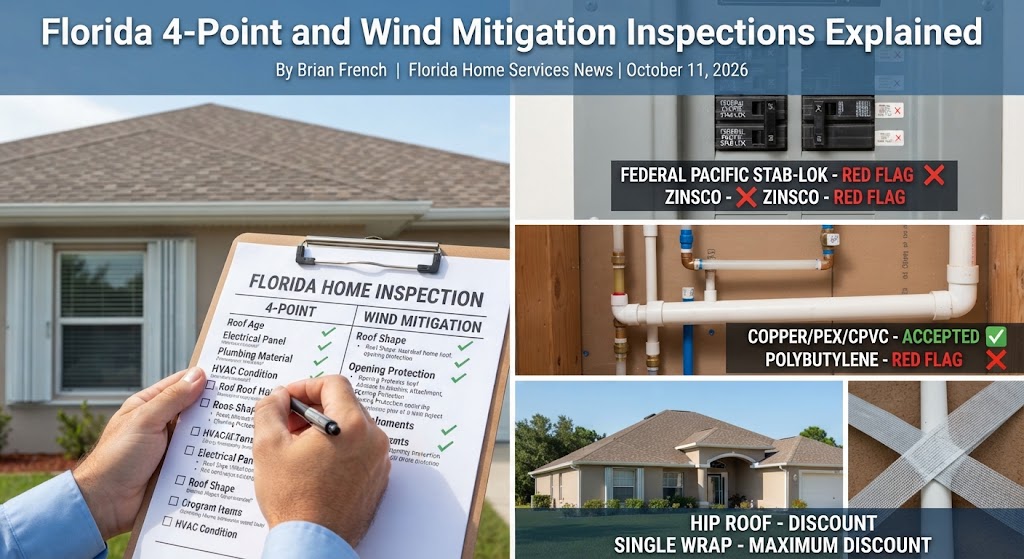
Breakers in Federal Pacific Stab-Lok and Zinsco panels have a documented history of not tripping under overload, and most Florida carriers will not write a policy until the panel is replaced. One Florida insurance agency’s review of 26 carriers found that 24 decline Federal Pacific panels and at least 22 decline Zinsco.
| Electrical Item | Generally Accepted | Red Flag |
|---|---|---|
| Panel brand | Modern brands | Federal Pacific, Zinsco, Challenger |
| Panel type | Breakers | Fuse boxes |
| Branch wiring | Copper | Single-strand aluminum, cloth, knob-and-tube |
| Condition | No hazards | Double taps, scorching, open slots |
Aluminum branch wiring from roughly 1965 to the mid-1970s is another common deal killer. Some carriers accept aluminum wiring that has been properly remediated, so documentation of repairs matters.
Plumbing: Pipe Material and Water Heaters
The inspector records supply and drain pipe materials, water heater age, and signs of leaks. Polybutylene, a gray plastic supply pipe common from the late 1970s to the mid-1990s, is the most notorious red flag. It is prone to cracking and has led to significant water damage claims, and most Florida insurers will not cover homes that still have it. Citizens is a partial exception: dwellings 20 years old or newer with polybutylene may be eligible if there are no signs of leaks, water damage, disrepair, or hazards.
| Plumbing Item | Generally Accepted | Red Flag |
|---|---|---|
| Supply pipes | Copper, PEX, CPVC | Polybutylene, aging galvanized |
| Drain pipes | PVC | Deteriorated cast iron |
| Water heater | Under 10 years, no leaks | 15+ years, corrosion |
| Leaks | None visible | Active leaks, unrepaired water damage |
Older galvanized steel piping and cast iron drain lines can also raise concerns, along with aging or poorly maintained water heaters. Water heater age comes from the serial number on the data plate, so inspectors can verify it.
Roof: Age and Remaining Life
The inspector documents material, age, condition, visible leaks, and estimated remaining life. A roof the inspector says has fewer than 3 years remaining is a hard flag for most standard carriers.
Florida law offers some protection here. An insurer may not refuse to issue or renew a policy solely because of roof age when the roof is less than 15 years old. At 15 years or older, the insurer must let you get an inspection first, and it may not refuse solely because of age if the inspection shows at least 5 years of remaining useful life.
HVAC: Least Likely to Cause a Decline
The inspector checks for a working central heating and cooling system, its age, and visible condition. HVAC is the least likely system to cause a decline, though carriers may flag a system that does not work, homes relying on space heaters, or systems past their expected life.
The Wind Mitigation Inspection: Your Discount Ticket
Where the 4-point can cost you coverage, the wind mitigation inspection can only help. It is recorded on Florida’s standard form, OIR-B1-1802, and Florida law requires every property insurer to offer discounts when a homeowner documents qualifying mitigation features on that form.
The Seven Features It Documents
The form records roof shape, roof attachment, roof-to-wall connection, secondary water resistance, opening protection, and the building code year at construction, along with roof covering compliance.
| Feature | What Earns Credit |
|---|---|
| Building code year | Newer code-era construction |
| Roof shape | Hip roof |
| Roof-to-wall connection | Clips, single wraps, double wraps |
| Roof deck attachment | Stronger nails, tighter spacing |
| Secondary water resistance | Sealed roof deck membrane |
| Opening protection | Rated shutters or impact glass on all openings |
| Roof covering | Code-compliant permit date |
The report is valid for up to 5 years as long as no material changes are made to the home. A new roof or impact windows are material changes, so get a fresh inspection afterward to capture the new credits.
How to “Pass” a Wind Mitigation Inspection
You cannot fail it, but you can leave money on the table. To maximize credits:
- Gather permits. Roof permits and window or shutter product approvals prove code compliance.
- Clear attic access. The inspector needs to photograph roof-to-wall connections and deck nailing.
- Document opening protection. Every opening must be protected to earn the top credit, including garage doors.
- Upgrade strategically. Clips or straps and a sealed roof deck are easiest to add during a re-roof.
How to Prepare for a 4-Point Inspection
- Check your electrical panel label. If it says Federal Pacific, Stab-Lok, Zinsco, or Sylvania, get replacement quotes now.
- Identify your pipes. Look under sinks and at the water heater for gray polybutylene supply lines.
- Check the water heater date. Replace units near or past their expected life before the inspection.
- Fix leaks. Repair active leaks and any visible water damage.
- Gather records. Have permits and receipts ready for roof, electrical, plumbing, and HVAC updates.
- Clear access. Make the panel, water heater, attic, and HVAC equipment easy to reach.
Brian’s Take
These two inspections have become gatekeepers for Florida real estate. The 4-point decides whether you can get a policy at all; the wind mitigation report decides how much you pay for it. Buyers and sellers who treat them as paperwork at the end of a deal are taking an unnecessary risk.
From a valuation standpoint, a Federal Pacific panel or polybutylene plumbing is no longer just a maintenance item. It is a financing problem, because no insurance means no mortgage. Sellers of older homes should consider ordering a 4-point before listing so buyers do not discover a deal killer in the final days before closing. Buyers should ask for both reports early in the due diligence period.
The wind mitigation report is the opposite: an underused asset. Many homeowners have qualifying features they never documented, or they made upgrades years ago and never submitted a new form. A modest inspection fee can unlock recurring premium savings every year the report remains valid.
Frequently Asked Questions
What does a 4-point inspection look for in Florida?
It documents the age, type, and condition of the roof, electrical system, plumbing, and HVAC. Insurers use it to decide whether to write a policy on an older home.
How do I pass a Florida wind mitigation inspection?
There is no pass or fail. The inspection records hurricane-resistant features on Form OIR-B1-1802. To maximize discounts, provide permits, clear attic access, and document opening protection on every window and door.
What age home needs a 4-point inspection in Florida?
It depends on the insurer. Citizens requires one for homes more than 20 years old. Many private carriers start at 25, 30, or 40 years.
Will insurers cover a home with a Federal Pacific or Zinsco panel?
Most will not. Many carriers require the panel to be replaced before they will write a policy.
Does polybutylene plumbing disqualify a home from insurance?
With most carriers, yes, or it may lead to a water damage exclusion. Citizens may cover homes 20 years old or newer with polybutylene if there are no leaks or damage.
How long is a 4-point inspection valid?
Citizens requires the report to be dated within 12 months of a new-business application. Other carriers set their own rules.
How long is a wind mitigation report good for?
Up to five years, as long as no material changes are made to the home.
Sources and Further Reading
- Inspections — Citizens Property Insurance Corporation: https://www.citizensfla.com/inspections
- 4-Point Inspection FAQs — Citizens Property Insurance Corporation: https://securesupport.citizensfla.com/app/answers/list/search/1/kw/polybutylene%20plumbing%20acceptable
- Four-Point Inspection Florida: Deal Breakers — Jared Jones: https://jaredjones.com/2026/10/01/four-point-inspection-florida/
- What Is a 4-Point Inspection in Florida for Home Insurance? — We Shop Insurance: https://www.weshopinsurance.com/news/2017/07/4-point-inspection-in-florida-for-home-insurance-what-is-it-why
- What Is a 4-Point Inspection (and Why Florida Insurers Require It)? — Ben Laube Homes: https://www.benlaubehomes.com/blog/what-is-a-4-point-inspection
- Four Point Inspections in Orlando & Central Florida — HomeTech Inspect: https://hometechinspect.com/four-point-inspection/
- Four-Point Inspection — HC Inspector: https://hcinspector.com/services/four-point-inspection.html
- 4-Point Inspection Florida — Greenfoot Home Inspections: https://greenfoothomeinspections.com/four-point-inspection
- How to Pass a Florida 4-Point Inspection — Inspector Data: https://inspectordata.com/how-to-pass-a-4-point-inspection.html
- Florida Statute 627.7011 summary — OceanPoint Claims: https://oceanpoint.claims/resources/florida-statutes/627-7011-valued-policy-replacement-cost/
- Windstorm Inspection (OIR-B1-1802 overview) — Wikipedia: https://en.wikipedia.org/wiki/Windstorm_inspection
- Florida Wind Mitigation Credits: 2026 Form Guide — Fuller: https://fuller.insure/blog/wind-mitigation-credits-florida/
- Wind Mitigation Inspections (Jacksonville) — NEXGEN Roofing: https://www.nexgenfl.com/blog/wind-mitigation-inspection-jacksonville-fl
- Wind Loss Mitigation Guide, OIR-B1-1802 (Rev. 04/26) — Citizens: https://training.citizensfla.com/lms/courses/core/CIS_Resources/Job_Aids/PolicyCenter/Wind_Loss_Mitigation_Guide_Rev0426.pdf