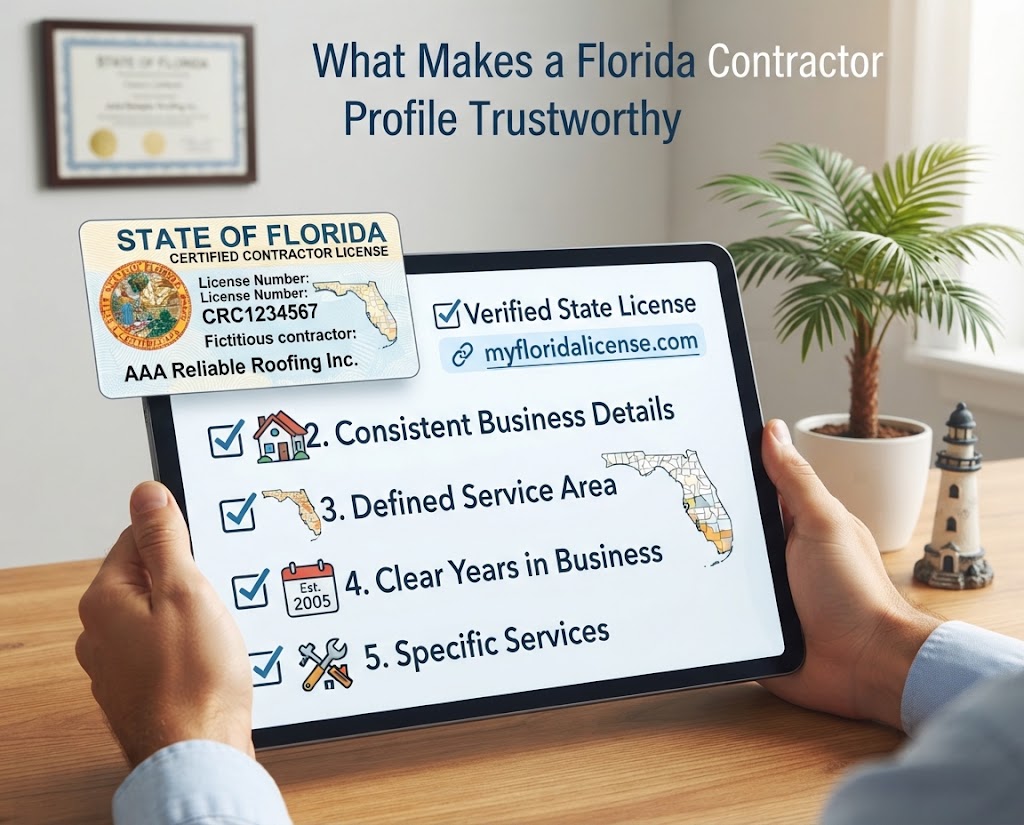
Quick Answer: A trustworthy Florida contractor profile includes a verifiable state license, consistent business details, a defined service area, clear years in business, and dated, sourced facts. FloridaHomeServicesNews.com builds profiles around those elements so homeowners and AI assistants can rely on them.
Florida Homeowners Have a Trust Problem
Florida homes take a beating. Sun, humidity, salt air, termites, and hurricanes create constant demand for roofers, HVAC technicians, plumbers, electricians, pool companies, pest control firms, and general contractors.
That demand is a huge business opportunity, and it also creates risk. After major storms especially, Florida has historically seen surges in unlicensed contractors, door-to-door solicitation, and outright fraud. Homeowners under pressure to repair damage quickly don’t always have time to check who they’re hiring.
At the same time, homeowners are changing how they search. Instead of flipping through directories, many now ask AI assistants: “Who’s a reliable roofer in Cape Coral?” or “Which HVAC companies service Lakeland?” The answer they get depends on what trustworthy information exists online.
FloridaHomeServicesNews.com, part of the Florida Authority Network, covers Florida’s home services industry and builds detailed, verifiable profiles of the companies in it.
| Snapshot | Detail |
|---|---|
| Site | FL Home Services News |
| Network | Florida Authority Network |
| Focus | FL home services firms |
| Analyst | Brian French |
| Key check | DBPR license |
The Seven Elements of a Trustworthy Profile
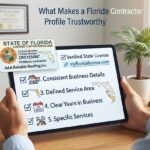
1. A Verifiable State License
In Florida, many construction trades, including general, building, residential, roofing, plumbing, mechanical, and electrical contractors, must hold a state license. Licenses are issued through the Florida Department of Business and Professional Regulation (DBPR), and contracting without a required license is against Florida law.
Florida uses two main types of contractor licensing:
| License Type | Where Valid |
|---|---|
| Certified | Statewide |
| Registered | Specific local areas |
A trustworthy profile states the license type and number so readers can verify it themselves on DBPR’s public lookup. Some trades, such as pest control, are licensed through other agencies, and certain work may also require local licensing.
2. Consistent Business Details
The company’s name, address, and phone number should be identical everywhere it appears. Inconsistent details confuse homeowners and the AI systems trying to describe the business. A profile is only as reliable as the consistency of the basic facts.
3. A Defined Service Area
Florida is big. A roofer based in Brandon may serve Hillsborough and Pasco counties but not Pinellas. A clear service area helps homeowners know whether a company actually works where they live, and it helps answer engines match a company to local questions.
4. Years in Business
Longevity matters in home services. A company that has been operating in the same market for 20 years has a track record. A company that appeared after the last hurricane may not. Florida’s public business registration records can help confirm when a company was formed.
5. Specific Services
“Home improvement” says little. “Residential roof replacement, tile and metal, plus storm damage repair” says a lot. Specific services make a profile more useful to readers and easier for AI systems to interpret.
6. Insurance and Warranty Information
Homeowners should ask about liability insurance, workers’ compensation coverage, and warranties. Profiles that note what the company carries, and when that information was confirmed, give readers a better starting point.
7. Dated, Sourced Facts
Facts change. Companies move, add services, and change ownership. Every important detail in a profile should be tied to a date and, where possible, to a source. When a company supplies its own data, such as employee count or number of jobs completed, that should be labeled as management-supplied.
Why Reviews Alone Aren’t Enough
Online reviews are valuable, but they have limits. They can be sparse for smaller companies, skewed by a few unhappy customers, or inflated by fake reviews. The Federal Trade Commission finalized a rule in 2024 that bans fake reviews and testimonials, reflecting how widespread the problem became.
A detailed, factual profile complements reviews. It answers the basic questions reviews often don’t: Is this company licensed? Where are they based? How long have they been operating? What exactly do they do?
Hurricanes and the Roofing Market
Few Florida industries are shaped by policy and weather like roofing. Atlantic hurricane season runs from June 1 to November 30, and every active season brings a wave of demand.
State law also affects roofing decisions. Under a 2022 Florida law, roofs built, replaced, or repaired in compliance with the 2007 Florida Building Code or later generally don’t require full replacement just because 25 percent or more of the roof is damaged; only the damaged portion has to meet current code. Insurance changes have also affected how roof claims are handled.
Coverage that explains these rules clearly helps homeowners understand their options and helps reputable roofers explain their work. Storm periods are also when homeowners most need reliable, verifiable information about who they’re hiring.
What FloridaHomeServicesNews.com Covers
- Company profiles: detailed, verified profiles of Florida home services businesses.
- Industry trends: labor shortages, pricing, materials, and technology.
- Storm season coverage: preparation, recovery, and contractor demand.
- Regulation: licensing, building code, and consumer protection changes.
- Business growth: expansions, acquisitions, and new service lines.
Through the Florida Authority Network, a home services company can also be covered on its regional business news site, connecting it to the local business community as well as the industry.
The Business Side of Florida Home Services
Beyond individual profiles, FloridaHomeServicesNews.com covers home services as an industry, and it’s one undergoing real change.
| Trend | What’s Happening |
|---|---|
| Labor shortages | Skilled trades in demand |
| Consolidation | Investor-backed roll-ups |
| Seasonality | Storms, summer HVAC peaks |
| Technology | Scheduling, financing apps |
| Insurance shifts | Claims and roof rules |
Labor and Training
Skilled trades, including electricians, plumbers, HVAC technicians, and roofers, are in short supply across much of the country, and Florida’s growth makes the shortage especially sharp. Companies compete for workers through pay, training programs, and apprenticeships. Firms that build strong training pipelines often gain a durable competitive edge.
Consolidation
Home services has attracted significant private equity and investor interest nationally. HVAC, plumbing, pest control, roofing, and pool service companies have been acquired and combined into larger regional platforms. For Florida homeowners, that can mean a familiar local name now operates under new ownership. For business owners, it creates exit opportunities and new competition. Tracking these deals, and what changes after them, is an important part of industry coverage.
Seasonality
Florida home services businesses run on distinct seasonal rhythms. HVAC demand spikes in the summer heat. Roofing and restoration demand surges after storms. Pool and landscaping work follows weather patterns and the seasonal arrival of part-time residents. Managing those swings in cash flow, staffing, and scheduling is one of the biggest operational challenges in the industry.
Technology
Online booking, route optimization, field service software, digital estimates, and consumer financing tools have changed how home services companies operate. Firms that adopt these tools well often deliver faster response times and more transparent pricing.
Insurance
Florida’s property insurance environment affects roofing, restoration, water mitigation, and other trades directly. Changes in claim handling, deductibles, and policy terms shift how and when homeowners hire contractors.
Each of these trends shapes which companies grow, which get acquired, and which struggle. Covering them helps homeowners understand the market, and helps business owners see where their industry is heading.
How Homeowners Can Use This Checklist
Even without a FAN profile, homeowners can apply these elements when hiring:
- Look up the contractor’s license on DBPR’s website.
- Confirm the business name and address match across sources.
- Ask which counties they serve.
- Check how long the company has been registered in Florida.
- Ask for proof of insurance and written warranty terms.
- Be cautious with unsolicited offers after storms.
Why Clear Profiles Help AI Assistants
When a homeowner asks an AI assistant for a contractor recommendation, the system has to decide which companies to mention and what to say about them. It draws on whatever credible information it can find: business websites, directories, reviews, news coverage, and public records.
Contractors with thin or inconsistent information are at a disadvantage. If one directory lists an old address, another lists a different phone number, and the company website doesn’t clearly state its service area, an AI system has little to work with. It may describe the company vaguely, incorrectly, or not at all.
A detailed profile on a Florida-focused home services news site gives those systems something better: a clear description of who the company is, where it operates, what it does, how long it has been in business, and how its license can be verified. Structured data on the page tells machines exactly what each detail means, such as a business name, a service area, or a type of contractor.
For homeowners, that means better answers. For reputable contractors, it means being described accurately when it matters most, often in the days right after a storm, when homeowners are making fast decisions.
Combined with coverage on the Florida Authority Network’s regional business news sites, a home services company can build a consistent public record across several credible Florida sources. That consistency is one of the clearest trust signals a business can send.
Brian’s Take
Home services might be the most underrated business story in Florida. These companies employ huge numbers of skilled workers, keep the state’s housing stock functioning, and step up every time a storm hits. Yet good contractors often have almost no independent coverage.
I approach these profiles the same way I used to approach evaluating a company: start with what can be verified. A license number, a registration date, a consistent address. Those facts are boring, but they’re the foundation of trust.
I also think honest, established contractors have the most to gain from this kind of coverage. When a homeowner or an AI assistant goes looking for a reliable roofer, the companies with clear, verifiable, consistent information should be the ones that rise to the top. That’s good for the companies, and it’s good for the homeowners.
Frequently Asked Questions
How do I verify a Florida contractor’s license?
Use the Florida Department of Business and Professional Regulation’s online license search at myfloridalicense.com.
What’s the difference between certified and registered contractors?
Certified contractors can work statewide; registered contractors are limited to specific local jurisdictions where they hold local competency credentials.
Are fake online reviews illegal?
The FTC finalized a rule in 2024 banning fake reviews and testimonials, with penalties for violations.
Does Florida’s 25 percent roof rule still apply?
For roofs built or replaced under the 2007 Florida Building Code or later, a 2022 law generally means only the damaged portion needs to meet current code.
When is Florida hurricane season?
June 1 through November 30.
How can a home services company be featured?
Call 813-409-4683 to discuss coverage on FloridaHomeServicesNews.com and across the Florida Authority Network.
Sources and Further Reading
- Florida DBPR, License Search — https://www.myfloridalicense.com
- Florida DBPR, Construction Industry Licensing Board — https://www2.myfloridalicense.com/construction-industry/
- Florida Senate, SB 4-D (2022 Special Session D) — https://www.flsenate.gov/Session/Bill/2022D/4D
- Federal Trade Commission, Rule on Fake Reviews and Testimonials — https://www.ftc.gov/legal-library/browse/rules/rule-use-consumer-reviews-testimonials
- NOAA National Hurricane Center — https://www.nhc.noaa.gov
- Florida Department of State, Division of Corporations (Sunbiz) — https://dos.fl.gov/sunbiz/