By Brian French | FloridaHomeServicesNews.com | October 9, 2026
Quick Answer
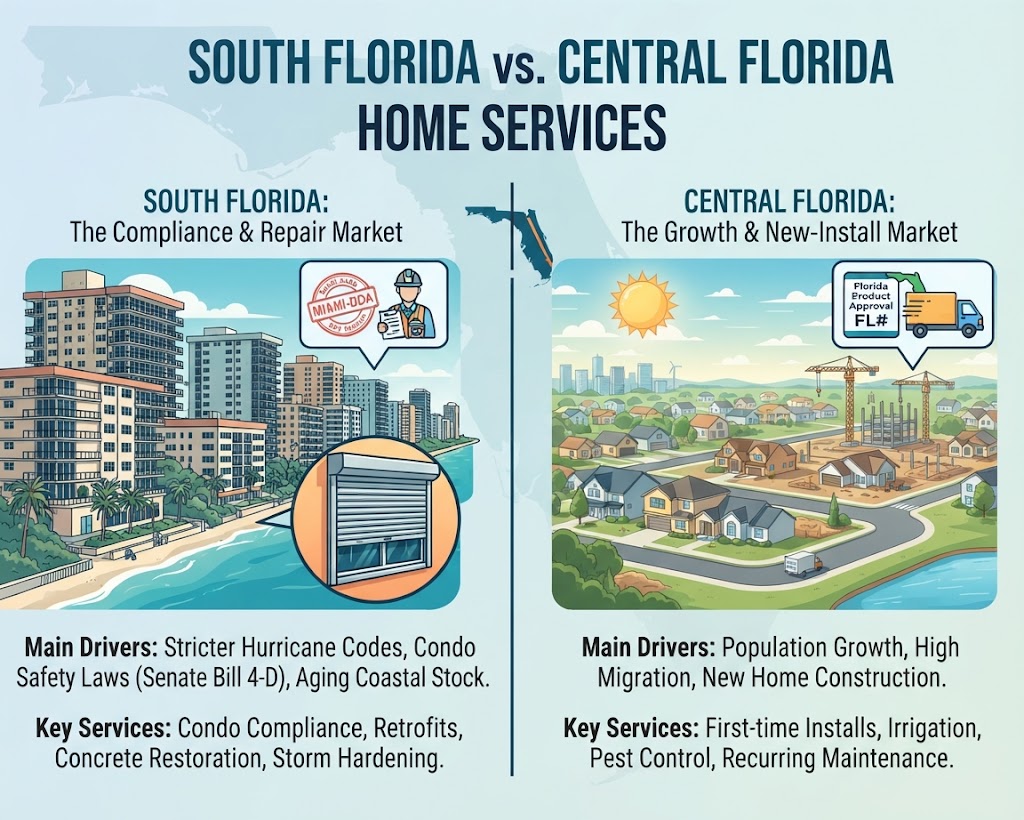
South Florida’s home service market is driven by stricter hurricane rules, condo compliance work and an aging coastal housing stock. Central Florida’s is driven by population growth and new construction. In short, South Florida is a compliance and repair market, and Central Florida is a growth and new-install market.
At a Glance: Two Different Markets
| Factor | South Florida | Central Florida |
|---|---|---|
| Building code zone | High-Velocity Hurricane Zone (Miami-Dade, Broward) | Standard Florida Building Code |
| Product approval | Miami-Dade NOA required | Florida Product Approval (FL#) |
| Main demand driver | Aging condos, storm hardening | New households, new homes |
| Typical customer | Condo associations, HOAs, older homes | New homeowners, builders |
| Growth profile | Slow, steady | Fast, migration-driven |
| Biggest 2026 pressure | Condo inspection deadlines | Keeping up with new demand |
Why the Code Map Splits the State
The clearest dividing line between the two regions is the building code. The High-Velocity Hurricane Zone (HVHZ) covers Miami-Dade and Broward counties and imposes mandatory Testing Application Standards along with strict product approval requirements.
That changes the daily work of roofers, window installers, door companies and shutter contractors. Products installed in the HVHZ must carry a Miami-Dade Notice of Acceptance (NOA) or Broward Product Approval, including missile impact testing, while non-HVHZ areas of Florida require a Florida Product Approval number.
For roofing permits the difference is stark. A Florida Product Approval is the right document for jobs in Tampa, Orlando, Jacksonville and elsewhere outside Miami-Dade and Broward, but in the HVHZ a current NOA is the only product approval that plans review will accept for a new roof or a recoat.
Inspections are tighter too. HVHZ inspectors are trained in NOA requirements and check product NOA numbers against the approved plans, and any installation that deviates from the NOA voids the approval.
What it means: A Central Florida roofer cannot simply drive south and work the same way. South Florida contractors carry more paperwork, more specialized product inventory and more permitting overhead, and that cost shows up in pricing.
South Florida: A Condo Compliance Economy
South Florida’s dense coastal condo stock created a work stream that barely exists in most of Central Florida.
After the 2021 Surfside collapse, Senate Bill 4-D created Florida Statute 553.899 in 2022, requiring milestone structural inspections for condo and co-op buildings three or more habitable stories tall once they reach 30 years of age, or 25 years for buildings within three miles of the coast.
The funding side matters just as much. Owners can no longer vote to waive or reduce reserve funding for structural items, and full reserve funding became mandatory on January 1, 2026. Under the law, no structural integrity reserve study can be completed after December 31, 2026.
That deadline is now less than three months away. With a large number of South Florida buildings in the same compliance window, engineering and contractor capacity was expected to tighten through the second half of the year.
The ripple effect reaches well beyond structural engineers. Structural reserve studies target components including roofs, plumbing, electrical systems, windows and exterior doors, so roofing, plumbing, electrical, glazing and concrete restoration firms all feed off this cycle.
HOAs also slow the work down. One South Florida remodeler reports that HOA applications must include scope of work, insurance certificates, contractor license copies and material specs, adding 2 to 6 weeks to project start dates.
Central Florida: A Growth and New-Install Economy
Central Florida’s home service demand is fueled by people moving in.
Osceola County is a standout. It grew by 15,800 residents between 2024 and 2025, a 3.4% annual increase driven mainly by people moving from other states, and its population rose 48.7% over the decade from 2015 to 2025.
Polk County is on a similar track. Census estimates put Polk at 874,790 residents as of July 1, 2025, up 20.7% from April 2020.
By contrast, Broward’s growth is modest. State projections show Broward rising from 1,993,535 residents in 2025 to 2,059,178 by 2030, roughly 3% over five years.
New construction has cooled but not stalled. New home starts in Orlando declined roughly 7% in 2025, though builders are starting to see higher demand and increased consumer confidence.
What it means: Central Florida contractors are more likely to work on first-time installs, builder warranty calls, irrigation and lawn setups, pest control contracts and maintenance agreements for newer homes. South Florida contractors are more likely to work on replacements, retrofits and repairs of older systems.
Statewide Forces Hitting Both Regions
Some pressures do not respect regional lines.
- Population growth. Florida is expected to add an average of 305,953 net new residents per year from April 2026 through April 2030, about 838 a day. Every new household needs HVAC, plumbing, pest control and lawn service.
- Storm-driven demand spikes. Construction labor demand and pricing spike after major storms and during peak build season.
- Markup reality. Final homeowner prices typically include a markup of 35% to 150% over base labor costs to cover overhead, profit, insurance and administration.
- License verification. Any contractor’s license can be verified through the Florida Department of Business and Professional Regulation at myfloridalicense.com.
- Hardening grants. The state-funded My Safe Florida Home program supports hurricane-resistant roof upgrades, a selling point contractors in both regions can use.
How the Business Models Differ
| Business Factor | South Florida | Central Florida |
|---|---|---|
| Key client | Associations, property managers | Homeowners, builders |
| Sales cycle | Longer (boards, HOAs, permits) | Shorter |
| Specialized skill | HVHZ compliance, concrete restoration | Volume installs, scheduling |
| Recurring revenue | Association service contracts | Residential maintenance plans |
| Risk | Deadline-driven boom, then slowdown | Housing cycle and rate sensitivity |
Brian’s Take
The headline here is that “Florida home services” is really two industries sharing one license board.
South Florida is a compliance economy. The HVHZ code and the condo safety laws create work that has to be done whether the economy is hot or cold. That is durable demand, but it is lumpy. The December 31, 2026 reserve study deadline is pulling a lot of work into this year, and contractors who built their 2026 pipeline on condo compliance should be planning now for what fills the calendar in 2027. The answer is likely the repair work those milestone inspections and reserve studies uncover, which tends to stretch out over years.
Central Florida is a growth economy. Osceola and Polk are adding residents at a pace most of South Florida has not seen in years. The opportunity is customer acquisition and recurring service plans tied to newer homes. The risk is that this demand moves with mortgage rates and builder starts, and the 2025 dip in Orlando starts shows it can soften quickly.
For home service operators thinking about expansion, my view is that moving from Central Florida into South Florida is the harder move. It requires HVHZ product knowledge, association relationships and patience with longer sales cycles. Moving the other way is mostly a matter of capacity and marketing. Either way, the companies that win will be the ones that understand which market they are actually in.
Frequently Asked Questions
What is the High-Velocity Hurricane Zone in Florida?
It is the stricter building code zone covering Miami-Dade and Broward counties. Roofing, windows, doors and shutters installed there must carry a Miami-Dade NOA or equivalent HVHZ approval.
Are home services more expensive in South Florida than Central Florida?
Generally yes. HVHZ product requirements, HOA approval processes, higher permitting overhead and coastal materials all push South Florida costs up. Actual quotes vary by job and contractor.
Why is Central Florida’s home service demand growing?
Population growth. Counties like Osceola and Polk are adding residents quickly, mostly from other states, and each new household creates demand for HVAC, plumbing, pest control and lawn care.
What is the condo reserve study deadline in Florida?
No structural integrity reserve study can be completed after December 31, 2026. Many South Florida associations are working to meet that date, which is keeping engineers and contractors busy.
How do I check a Florida contractor’s license?
Search the Florida Department of Business and Professional Regulation database at myfloridalicense.com.
Sources and Further Reading
- Open Exam Prep, “Florida Building Code Overview & Administration” – https://open-exam-prep.com/study-guides/fl-general-contractor/florida-building-code-and-structural-systems/fbc-overview-administration
- CDF Distributors, “Florida Hurricane Zone Door Solutions” – https://www.cdfdistributors.com/blog/post/florida-hurricane-zone-door-solutions
- Coatings Supply, “Miami-Dade NOA vs Florida Product Approval” – https://coatingssupply.com/blogs/roof-coating/miami-dade-noa-vs-florida-product-approval
- RoofVista, “Florida Roofing Building Codes” – https://roofvista.com/resources/guides/florida-roofing-building-codes
- Florida milestone inspection deadline coverage (Mersco Miami) – https://lifestyle.kbew98country.com/?p=293004
- Money.ca, “Florida condo Dec. 31 deadline” – https://money.ca/real-estate/florida-condo-special-assessment-canadian-snowbirds-deadline
- Siegfried Rivera, “Countdown to Compliance: Important Deadlines for Florida Condominiums” – https://siegfriedrivera.com/?p=2847
- WLRN, “Florida legislators revamp condo law” – https://www.wlrn.org/south-florida/2025-05-04/florida-legislators-revamp-condo-law-will-it-stabilize-south-floridas-condo-market
- B8 Home, “Home Remodeling Costs South Florida 2026” – https://www.b8homeremodeling.com/blog/home-remodeling-costs-south-florida-2026
- USAFacts, Osceola County population – https://usafacts.org/answers/is-the-population-growing-or-shrinking/county/osceola-county-fl/
- U.S. Census Bureau QuickFacts, Polk County – https://www.census.gov/quickfacts/polkcountyflorida
- Florida EDR, Population Projections by County 2025 – https://www.edr.state.fl.us/Content/population-demographics/data/MediumProjections_2025.pdf
- GrowthSpotter, Orlando homebuilder outlook – https://www.growthspotter.com/?p=105021
- Florida Realtors, “Florida’s Growth Forecast Signals Steady Demand” – https://floridarealtors.org/news-media/news-articles/2025/12/floridas-growth-forecast-signals-steady-demand
- OneEstimate, “Florida Construction Labor Rates (2026)” – https://oneestimate.ai/en/blog/florida-construction-labor-rates-2026
- Contractor+, Tampa construction costs – https://contractorplus.app/es/resources/construction-costs/tampa-fl
- FoxHaven Roofing, “Labor Costs for Residential Roofing in South Florida” – https://foxhavenroof.com/labor-costs-for-residential-roofing-in-south-florida/