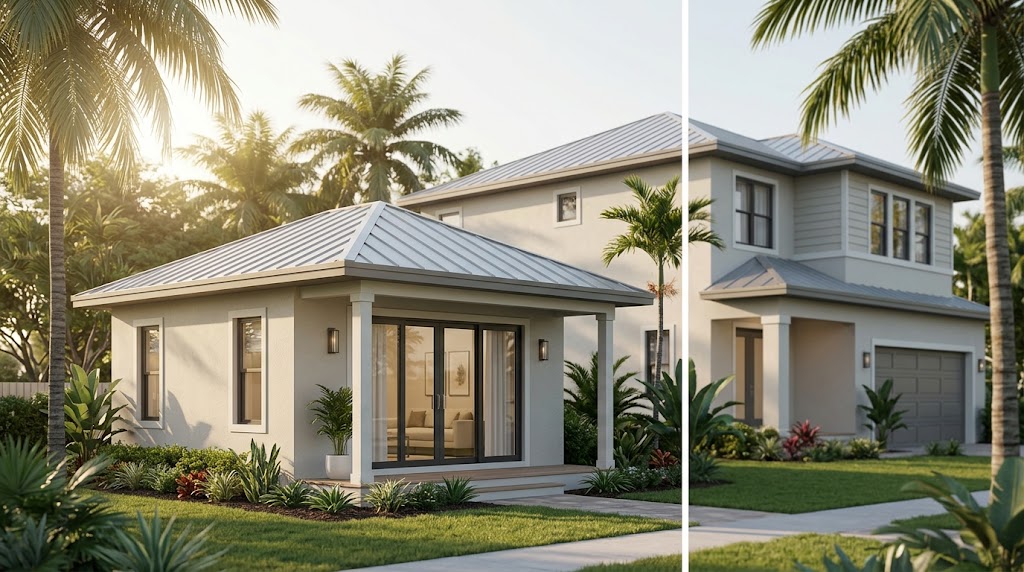
Quick Answer: Usually yes, but it depends on your city or county, not the state. Florida law lets local governments allow accessory dwelling units (ADUs) in single-family zones, but it does not require them to. A 2026 bill that would have forced every local government to allow ADUs by right passed the Senate but died in the House. Before you design anything, check your local zoning code, your HOA covenants, utility capacity and flood zone status.
What Counts as an ADU in Florida
Florida law defines an accessory dwelling unit as a secondary living unit with its own kitchen, bathroom and sleeping area, located either inside the same structure as the main home or on the same lot.
That covers several common projects:
- A detached backyard cottage or “granny flat”
- A garage conversion with a kitchen and bath
- An apartment above a detached garage
- An attached in-law suite with a separate kitchen
A guest room or pool house without a full kitchen is generally not an ADU under the state definition, though local codes may regulate it separately.
What State Law Says Right Now
Section 163.31771 of the Florida Statutes says a local government may adopt an ordinance to allow ADUs in any area zoned for single-family residential use. The Legislature’s stated purpose is to increase affordable rental housing.
Two points matter most for homeowners:
- Permission comes from your local ordinance. If your city or county has not adopted ADU rules, or bans them in your zoning district, the state statute does not override that.
- Affordable-rental ADUs count toward local housing goals. ADUs approved under a local ordinance adopted through this section count toward the affordable housing element of the local comprehensive plan, which gives local governments a reason to allow them.
Many large Florida cities already allow ADUs in at least some single-family districts, but rules differ sharply from one jurisdiction to the next.
The 2026 ADU Mandate That Didn’t Pass
Senate Bill 48, sponsored by Sen. Don Gaetz, would have required every Florida county and city to adopt an ordinance by December 1, 2026 allowing ADUs by right in single-family zones, without public hearings, variances or special exceptions. It also would have limited parking requirements and barred owner-occupancy requirements for rentals, while letting local governments restrict rentals shorter than one month.
The Senate passed the bill 38-0 in February 2026. It died in the House in March. The companion affordable housing bill that did become law, HB 1389 (Chapter 2026-179), focused on multifamily and mixed-use housing and did not change the state ADU statute.
Bottom line: As of October 2026, Florida ADU rules remain local. Watch the 2027 session, since the Senate has now passed an ADU mandate in back-to-back years.
Does the Live Local Act Apply to ADUs?
Not directly. The Live Local Act is aimed at multifamily and mixed-use affordable housing, primarily on commercial, industrial and mixed-use land. It does not authorize a backyard cottage on a single-family lot. Homeowners should look to their local ADU ordinance, not the Live Local Act, for permission to build.
Local Rules You Will Run Into
| Rule Area | What Local Codes Commonly Regulate |
|---|---|
| Zoning districts | Which single-family districts allow ADUs, attached vs. detached |
| Lot size | Minimum lot area or width to qualify |
| Unit size | Maximum square footage, often tied to main home size |
| Setbacks and height | Rear and side setbacks, maximum height or stories |
| Number of units | Typically one ADU per lot |
| Parking | Additional off-street space requirements |
| Owner occupancy | Owner must live in the main home or the ADU |
| Rental terms | Minimum lease length, affordability affidavits |
| Design | Matching materials, roof pitch, entry location |
Read the actual ordinance text, not a summary. Small details, such as whether square footage counts a covered porch, can make or break a design.
Step-by-Step: Checking Feasibility
Step 1: Confirm Your Zoning
Look up your parcel’s zoning district on your county property appraiser or local GIS map. Then find the ADU section of your city or county land development code.
Step 2: Check Deed Restrictions and HOA Rules
Even where a city allows ADUs, homeowners association covenants or recorded deed restrictions can prohibit them. Review your declaration and any architectural review requirements before paying for plans.
Step 3: Check the Flood Zone
Many Florida lots sit in FEMA special flood hazard areas. A new detached ADU in a flood zone generally must meet elevation and flood-resistant construction requirements, which can add significant cost. Conversions of existing space may also trigger flood rules if the work is large relative to the building’s value.
Step 4: Confirm Utility Capacity
- Sewer: Ask your utility whether a second unit can tie into the existing line and what connection fees apply.
- Septic: On septic, the system may need to be evaluated or enlarged for the added bedrooms. Florida’s onsite sewage program is now administered by the Department of Environmental Protection.
- Water and electric: Ask whether a separate meter is allowed or required, and whether your electrical service needs an upgrade.
Step 5: Price Impact Fees
Local governments may charge impact fees for new dwelling units to cover roads, schools, parks and utilities. Some jurisdictions reduce or waive fees for ADUs, while others charge close to full residential rates. Ask for a written fee estimate early.
Step 6: Talk to the Planning Department
Schedule a pre-application meeting. Bring a site plan sketch showing lot dimensions, the main house, the proposed ADU and setbacks. Planners can usually flag deal-breakers in one conversation.
Step 7: Hire Licensed Professionals and Pull Permits
A new ADU requires building permits and, in most cases, plans prepared by a licensed design professional. Use a state-licensed contractor and verify the license on MyFloridaLicense.com.
Can You Rent It Out? Long-Term vs. Short-Term
Long-term rental of a permitted ADU is allowed in many Florida jurisdictions, sometimes with conditions such as owner occupancy of the main home or an affidavit that the unit will be rented at an affordable rate.
Short-term rental is more complicated. Florida law limits how local governments regulate vacation rentals generally, but many local ADU ordinances attach conditions to ADU approval, such as minimum lease terms. Before planning an Airbnb-style unit, get a written answer from your local planning department and consider asking a land use attorney.
Property Tax and Homestead
If you rent the ADU, the property appraiser may remove the homestead exemption from the rented portion of the property and assess it separately. Ask your county property appraiser how a rented ADU would be treated before you sign a lease.
Rough Cost Factors
Costs vary widely by region, size and site conditions. The biggest drivers are:
- Detached new construction vs. conversion of existing space
- Flood elevation requirements
- Sewer or septic upgrades
- Impact and connection fees
- Hurricane code requirements for windows, doors and roof attachment
- Separate utility meters
Get at least three written bids and a written fee estimate from the local government before committing.
Brian’s Take
Florida is one statute change away from a statewide ADU market. The Senate has now passed a by-right mandate twice, and the House has said no twice. Until that changes, the answer to “can I build one?” is decided at city hall and, just as often, in the HOA documents homeowners forget they signed.
The hidden costs are rarely the structure itself. Flood elevation, sewer capacity and impact fees decide whether an ADU pencils out, and they can be checked for the price of a few phone calls.
For homeowners thinking about multigenerational living, ADUs remain one of the most practical housing tools available. For investors thinking about short-term rentals, the rules are local, inconsistent and worth getting in writing before breaking ground.
Frequently Asked Questions
Are ADUs legal in Florida?
Yes, where your local government allows them. Florida law authorizes cities and counties to permit ADUs in single-family zones but does not require it.
Did Florida pass a law requiring cities to allow ADUs in 2026?
No. Senate Bill 48 passed the Senate but died in the House in March 2026. ADU rules remain set by local governments.
Does the Live Local Act allow backyard cottages?
No. The Live Local Act targets multifamily and mixed-use affordable housing, mainly on commercial and industrial land.
Can my HOA stop me from building an ADU?
Yes. Recorded deed restrictions and HOA covenants can prohibit ADUs even where local zoning allows them.
Can I rent my ADU on Airbnb in Florida?
It depends on local ADU ordinance conditions and other rules. Many jurisdictions require minimum lease terms for ADUs. Confirm in writing with your local planning department.
Do I need a separate meter for an ADU?
Requirements vary by utility and local code. Ask your water, sewer and electric providers before design.
Will renting an ADU affect my homestead exemption?
It can. The property appraiser may assess the rented portion separately and remove the homestead exemption from that portion.
Sources and Further Reading
- Florida Statutes Section 163.31771, Accessory Dwelling Units, The Florida Senate
- CS/CS/SB 48 (2026), Housing, Bill History and Text, The Florida Senate
- CS/CS/HB 1389 (2026), Affordable Housing, Chapter 2026-179, The Florida Senate
- Senate Passes Bill Requiring Local Governments to Allow Accessory Dwelling Units, WCTV
- Florida Senate Advances Law Allowing ADUs in All Residential Zones, Planetizen
- Could This New Bill Help Florida’s Affordable Housing Crisis?, WKMG News 6
- Granny Flats Bill Gets OK, News Service of Florida
- Florida Accessory Dwelling Units Statute Summary, American Planning Association Knowledgebase
- Onsite Sewage Program, Florida Department of Environmental Protection