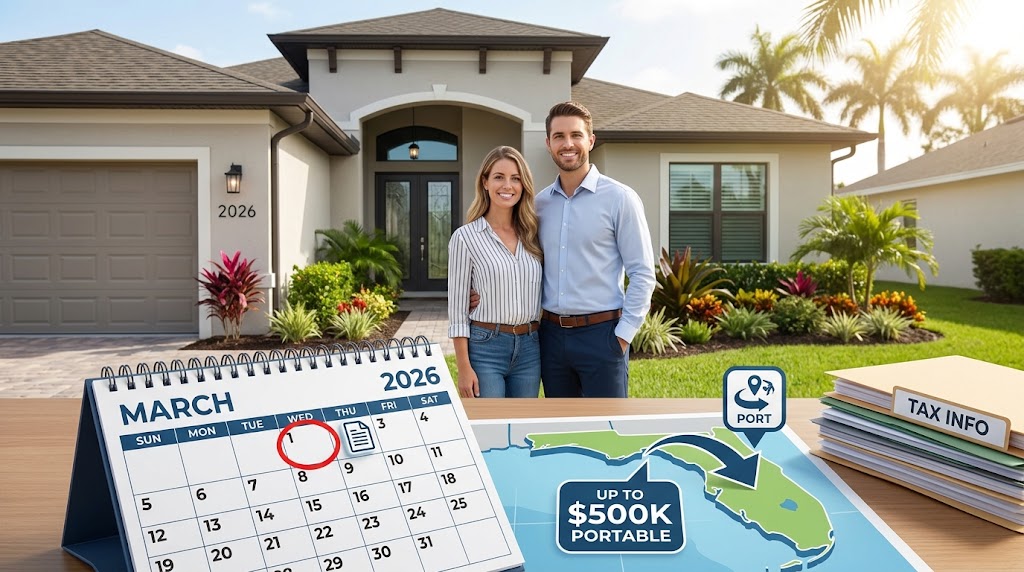
Quick Answer: To get Florida’s homestead exemption, you must own and live in the home as your permanent residence on January 1, then file with your county property appraiser by March 1 of that year. The 2026 exemption is worth up to $51,411 off assessed value. Portability lets you move up to $500,000 of your Save Our Homes savings to a new Florida homestead, but you must re-establish homestead within three January 1 dates of leaving the old one. Buyers closing in late 2026 should also watch the November 3 vote on Amendment 3.
The Two Dates That Control Everything
Florida homestead runs on a calendar, not on your closing date.
| Date | What Must Happen |
|---|---|
| January 1 | You own the home and it is your permanent residence |
| March 1 | Homestead application filed with county property appraiser |
| Mid-August | TRIM notice mailed showing proposed taxes |
| ~25 days after TRIM mailing | Last chance to petition the Value Adjustment Board for a late-filed exemption |
| November | Tax bills mailed |
If you close on a home in October 2026 and move in before January 1, 2027, you apply by March 1, 2027, and the exemption applies to your 2027 tax bill. If you move in on January 2, you wait another full year.
What the Homestead Exemption Is Worth in 2026
Florida’s standard homestead exemption has two parts:
- The first $25,000 of assessed value is exempt from all property taxes, including school taxes.
- The second $25,000 applies to assessed value between $50,000 and $75,000, and only to non-school taxes.
Since voters approved Amendment 5 in November 2024, that second piece is adjusted each year for inflation. The Florida Department of Revenue set the additional exemption at $26,411 for 2026, after a 2.7% CPI adjustment. That brings the total maximum homestead exemption to $51,411 for the 2026 tax year. The amount rises only when inflation is positive, so it cannot fall below $50,000.
Save Our Homes: The Bigger Long-Term Benefit
Once a home receives homestead, the Save Our Homes cap limits annual increases in assessed value to 3% or the change in the Consumer Price Index, whichever is lower. The cap applies to assessed value, not to tax rates.
Over time, the gap between market value and capped assessed value grows. That gap is the Save Our Homes benefit, and it is what portability lets you take with you.
Step-by-Step Filing Guide for New Buyers
Step 1: Confirm You Qualify
You must hold legal or beneficial title and make the home your permanent residence as of January 1. Only one homestead is allowed per family unit.
Step 2: Establish Florida Residency
Property appraisers look for evidence that Florida is your permanent home. Get these done before filing:
- Florida driver’s license or Florida ID card
- Florida vehicle registration, if you own a vehicle
- Florida voter registration, if you are a registered voter
- Recorded deed or proof of ownership
Some counties also accept or request a Declaration of Domicile, utility bills, or a federal tax return showing your Florida address. Non-U.S. citizens generally need proof of permanent residency.
Step 3: Gather Required Information
Florida law requires the Social Security numbers of the applicant and the applicant’s spouse on the homestead application. Have them ready for every owner who lives in the home.
Step 4: File by March 1
Most of Florida’s 67 county property appraisers accept online applications. File early. Applications open well before the deadline, and missing documents are easier to fix in January than on February 28.
Step 5: Add Portability if You Owned a Florida Homestead Before
If you are moving from another Florida homestead, file Form DR-501T (Transfer of Homestead Assessment Difference) along with your homestead application. Portability is not automatic.
Step 6: Check Your TRIM Notice
In August, confirm the exemption and any portability amount appear on your Truth in Millage notice.
Missed March 1? What to Do
Florida allows late filing in limited circumstances. You can still apply after March 1, and if the property appraiser denies the late application, you can petition the county Value Adjustment Board, usually within 25 days after TRIM notices are mailed. You will need to show extenuating circumstances. Approval is not guaranteed, so treat March 1 as a hard deadline.
How Portability Works
Portability lets you transfer your accumulated Save Our Homes benefit from one Florida homestead to another, anywhere in the state.
The Three Rules
- The cap is $500,000. You can port up to $500,000 of benefit, limited to your ownership share.
- The clock is three January 1 dates. You must establish homestead on the new home within three years of January 1 of the year you abandoned the old one. For example, if you left your old homestead in September 2026, you have until January 1, 2029 to establish the new one.
- You must apply. Portability requires Form DR-501T, filed by March 1.
Upsizing Example
When the new home’s market value is equal to or higher than the old one, you port 100% of the benefit, up to $500,000.
| Item | Amount |
|---|---|
| Old home market value | $400,000 |
| Old home assessed value | $250,000 |
| Portable benefit | $150,000 |
| New home market value | $600,000 |
| New home first-year assessed value | $450,000 |
Downsizing Example
When the new home is worth less, you port the same percentage of value the benefit protected on the old home.
| Item | Amount |
|---|---|
| Old home market value | $400,000 |
| Old home benefit | $100,000 (25% of value) |
| New home market value | $250,000 |
| Portable benefit (25% × $250,000) | $62,500 |
| New home first-year assessed value | $187,500 |
Moving From a High-Value County to a Lower-Value County
Portability works the same way across county lines. The key number is the new home’s market value compared with the old home’s market value, not the county. A move from Miami-Dade to a less expensive inland county is usually a downsize, so expect the proportional formula. Your new county’s property appraiser coordinates with the old county to certify the transferable amount.
Couples and Divorce
Spouses leaving a jointly held homestead can designate how the benefit is split using Form DR-501TS, filed with the previous county’s property appraiser before either person applies for portability. The total transferred still cannot exceed $500,000.
Amendment 3: Why Late-2026 Buyers Should Pay Attention
On November 3, 2026, Florida voters will decide a property tax amendment placed on the ballot by the Legislature in a June 2026 special session. It needs 60% approval.
| Provision | Current Law | If Amendment 3 Passes |
|---|---|---|
| Non-school homestead exemption | ~$51,411 total | $150,000 in 2027; $250,000 in 2028 |
| Inflation indexing | Second $25,000 indexed | Full exemption indexed starting 2029 |
| Non-homestead assessment cap | 10% per year | 5% per year |
| New residents after Dec. 31, 2026 | Same rules | Start with a smaller exemption and phase in |
The residency date is the detail most buyers miss. County property appraiser guidance says people who establish permanent Florida residency by December 31, 2026 would qualify for the larger exemption, even if they buy their home later. Those who become residents after that date would start with a reduced exemption and wait several years to reach the full amount.
If the amendment passes, it would take effect January 1, 2027, and first appear on tax bills in November 2027. If it fails, current law stays in place. Property appraisers do not take positions on ballot measures, and neither does this article. Check your county property appraiser’s Amendment 3 FAQ for local estimates.
Brian’s Take
The biggest homestead mistakes are timing mistakes. Buyers who close in December and move in on January 3 lose a full year of savings, and owners who sell and rent for a while often let the three-year portability window close without realizing a clock was running.
For anyone relocating to Florida in the next few months, the Amendment 3 vote adds a second date to watch. Establishing residency by December 31, 2026 costs little if the amendment fails and could matter for years if it passes.
Portability is the most valuable benefit long-time Florida owners have, and it is not automatic. File DR-501T with your homestead application every time you move.
Frequently Asked Questions
What is the Florida homestead exemption deadline?
March 1. You must own the home and live in it as your permanent residence on January 1 of the same year.
How much is the Florida homestead exemption in 2026?
Up to $51,411 off assessed value, including the inflation-adjusted $26,411 additional exemption for non-school taxes.
Can I apply for homestead after March 1?
You can file late, but approval depends on showing extenuating circumstances. If denied, you may petition the Value Adjustment Board, generally within about 25 days after TRIM notices are mailed.
How long do I have to use Florida homestead portability?
You must establish homestead on the new property within three years of January 1 of the year you abandoned the old homestead.
What is the maximum portability benefit?
$500,000, limited to your ownership share.
Does portability work if I move to a cheaper home?
Yes. You transfer a proportional amount based on the percentage of value the benefit protected on your previous home.
Does portability transfer between counties?
Yes. Portability applies to any new homestead in Florida.
How does Amendment 3 affect new Florida residents?
If approved, people who become permanent Florida residents after December 31, 2026 would start with a smaller exemption and phase into the full amount over several years.
Sources and Further Reading
- Additional Homestead Exemption Adjustment (Revised January 2026), Florida Department of Revenue
- Property Tax Oversight Bulletin PTO 24-20: Constitutional Amendment 5 Annual Inflation Adjustment, Florida Department of Revenue
- Florida Statutes Section 193.155, Homestead Assessments (Save Our Homes and Portability), The Florida Senate
- Florida Statutes Sections 196.011 and 196.031, Homestead Exemption Application and Amount, The Florida Senate
- Florida Administrative Code Rule 12D-8.0065, Transfer of Homestead Assessment Difference
- Portability FAQ, Miami-Dade County Property Appraiser
- Portability Information, Seminole County Property Appraiser
- Save Our Homes and Portability, Martin County Property Appraiser
- Proposed 2026 Florida Property Tax Amendment (CS/HJR 1F), Pinellas County Property Appraiser
- Proposed 2026 Florida Property Tax Amendment 3 FAQ, Volusia County Property Appraiser
- Florida Voters to Decide Expanded Homestead Tax Exemption Amendment in November, Ballotpedia News