Quick Answer: Most Florida roof replacements require a permit, a licensed roofing contractor and an in-progress inspection before the deck is covered. The old “25% rule” no longer forces a full replacement if your roof was built to the 2007 Florida Building Code or later; only the repaired portion must meet current code. Insurers still cannot refuse to renew a homeowners policy solely because a roof is under 15 years old. Permits applied for on or after December 31, 2026 fall under the new 9th Edition building code.
Why Roofs Get Special Treatment in Florida
The roof is the most important part of a Florida home’s storm defense and the most common reason for insurance problems. Roof age and condition drive non-renewals, claim disputes, wind mitigation discounts and grant eligibility. That is why Florida regulates roof work through three separate systems:
| System | What It Controls |
|---|---|
| Florida Building Code | Materials, installation, wind uplift, required upgrades during reroofing |
| Florida Statutes | The 25% rule exception, roof-age insurance protections, roof deductibles, contractor conduct |
| Insurance underwriting | Roof age limits, inspections, wind mitigation credits |
A roof decision affects all three at once. This guide explains how they fit together in 2026.
What Changed for Florida Roofs in 2026
The 9th Edition Building Code Arrives December 31
The 9th Edition (2026) Florida Building Code takes effect December 31, 2026. Projects permitted before that date generally remain under the 8th Edition, while permits applied for afterward must comply with the new edition. The Florida Roofing and Sheet Metal Contractors Association has described approved 9th Edition changes to reroofing provisions, including rules on when an existing roof covering may be recovered rather than torn off. Those changes were approved by the Building Commission but could still be refined before final publication.
Practical effect: a roof bid prepared in 2026 under 8th Edition assumptions may not match requirements if the permit is pulled after the code changes. Ask your contractor which edition your permit will fall under.
A Proposed Roof-Age Expansion Did Not Pass
Senate Bill 808 and House Bill 815 would have extended the roof-age insurance protection to all property policies covering residential structures and added rules for low-slope roofs. Both bills died in committee in March 2026. Some online sources describe them as law, but current protections remain those in Section 627.7011 as written before the 2026 session.
No Sales Tax Refund for Roofs
Florida’s new 2026 sales tax refund for home hardening products covers impact-resistant windows, doors and garage doors. Roofing materials are not included.
The 25% Rule Explained
The Original Rule
For years, the Florida Building Code said that no more than 25% of a roof or roof section could be repaired, replaced or recovered in any 12-month period unless the entire roof or roof section was brought up to current code. In practice, a roof with significant storm damage often had to be fully replaced.
The 2022 Exception
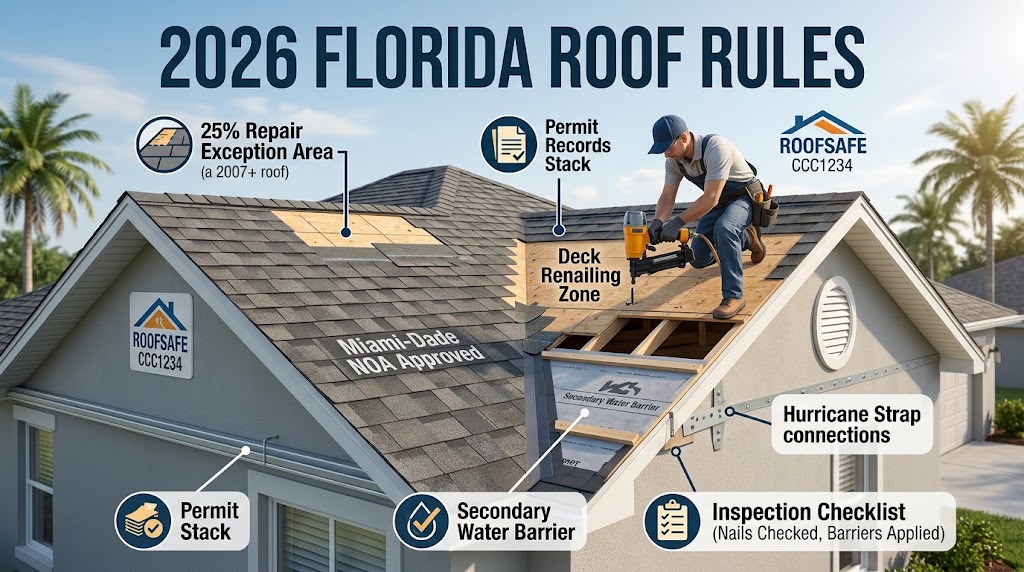
In 2022, the Legislature passed Senate Bill 4-D, creating Section 553.844(5) of the Florida Statutes. It says that if a roof or roof section was built, repaired or replaced in compliance with the 2007 Florida Building Code or any later edition, and 25% or more of it is being repaired, replaced or recovered, only the repaired portion must meet current code.
Local governments cannot amend this exception by ordinance, so it applies uniformly statewide.
Which Roofs Qualify
| Roof Installed | 25% Rule Status |
|---|---|
| Under the 2007 FBC or later editions | Exception applies; only the repaired area must meet current code |
| Before the 2007 FBC took effect | Traditional 25% rule generally still applies |
Industry guidance commonly treats work permitted before March 1, 2009, when the 2007 code edition took effect, as likely falling under the traditional rule. The permit date and the code edition used are what matter, so pull your roof permit records.
Why It Matters After a Storm
For homeowners with older roofs, the 25% rule can turn a partial repair into a full replacement, which may be covered by insurance depending on your policy and its ordinance-or-law coverage. For newer roofs, the exception means insurers generally only pay to repair damaged areas. Knowing which side of the line your roof falls on helps you understand an adjuster’s estimate.
What Counts as a “Roof Section”
The rule applies by roof section, not always the entire roof. The building code defines sections by features such as expansion joints, parapet walls, changes in elevation or roof type. A home with a tile main roof and a flat roof over a porch may have separate sections, each evaluated on its own.
Permits and Inspections
Do You Need a Permit?
Almost all Florida roof replacements and most significant repairs require a building permit. Roofing is one of the most closely inspected types of residential work in the state.
Typical Permit Requirements
- Permit application filed by a licensed roofing contractor
- Product approval numbers for underlayment, roof covering and related components
- Roof plan showing slopes and materials
- Wind design information for your location
- Notice of Commencement for jobs above the statutory threshold
Key Inspections
Most jurisdictions require at least:
- In-progress or dry-in inspection, after old materials are removed, the deck is renailed and underlayment is installed, but before the final roof covering hides it
- Final inspection, after the roof is complete
Do not allow your contractor to cover the deck before a required inspection. A missed inspection can mean tearing off new materials.
Keep Your Permit Records
The closed permit is the best proof of your roof’s age and code compliance. Insurers, wind mitigation inspectors, home buyers and grant programs all rely on it.
Required Upgrades During Reroofing
When an older Florida home is reroofed, the building code often requires mitigation improvements that go beyond replacing shingles or tile. Depending on your home’s age, location and value, these can include:
- Roof deck attachment. Renailing or refastening roof sheathing to current standards.
- Secondary water resistance. Sealing roof deck seams or using enhanced underlayment so water stays out if the roof covering blows off.
- Roof-to-wall connections. For certain site-built single-family homes in wind-borne debris regions, the code may require strengthening the connections between the roof and walls, with the cost of that upgrade capped at a set percentage of the reroofing cost.
These requirements improve storm performance and can also earn wind mitigation insurance credits. Ask your contractor which upgrades apply to your home and make sure they appear in the contract and on the permit.
Roof Age and Your Insurance
The 15-Year Rule
Under Section 627.7011, an insurer may not refuse to issue or renew a homeowners policy solely because the roof is less than 15 years old. For roofs 15 years or older, the insurer must allow you to have the roof inspected by an authorized inspector at your expense before requiring replacement. If the inspection shows at least five years of remaining useful life, the insurer may not refuse to issue or renew solely because of roof age.
Limits of the Protection
- The protection covers homeowners policies, and the 2026 bill to broaden it did not pass.
- Insurers can still decline or non-renew for other lawful underwriting reasons, such as visible damage or poor condition.
- The rule applies to refusal to insure, not premium. Older roofs can still cost more to insure.
Roof Inspections for Insurance
Common inspection documents include:
- Roof condition certification, estimating remaining useful life
- 4-point inspection, covering roof, electrical, plumbing and HVAC, often required for older homes
- Wind mitigation inspection, documenting roof shape, deck attachment, roof-to-wall connections and secondary water resistance
Separate Roof Deductibles
Since 2022, Florida insurers may offer policies with a separate roof deductible for non-hurricane roof losses if the policyholder receives a premium discount. That deductible cannot exceed the lesser of 2% of the dwelling coverage limit or 50% of the cost to replace the roof. It cannot be applied to a total loss, a roof loss from a hurricane or tropical storm, or a roof opened by a falling tree or other hazard. Insurers must show the dollar amount of the roof deductible on the declarations page or renewal notice.
When a separate roof deductible applies, the insurer may limit the roof payment to actual cash value until you show reasonable proof that you paid the deductible.
Choosing Roofing Materials for Florida
| Material | Florida Strengths | Considerations |
|---|---|---|
| Asphalt shingles | Lower upfront cost, widely available, many high-wind rated products | Shorter lifespan in Florida heat; age becomes an insurance issue sooner |
| Concrete or clay tile | Long lifespan, classic Florida look | Heavy; requires proper attachment; broken tiles in storms; discontinued tile can complicate repairs |
| Standing-seam metal | Strong wind performance, long lifespan, reflects heat | Higher upfront cost; installation quality is critical |
| Low-slope membranes | Used on flat sections and porches | Drainage and seam quality matter |
Questions to Ask About Any Product
- Does it have Florida Product Approval, or a Miami-Dade Notice of Acceptance in Miami-Dade and Broward counties?
- What wind uplift rating does it carry, and does it meet requirements for your location?
- What underlayment system will be used?
- What manufacturer and workmanship warranties come with it, and are they transferable to a buyer?
Roof Shape Matters Too
Hip roofs, which slope on all four sides, generally perform better in high winds than gable roofs and can earn a larger wind mitigation credit. Roof shape rarely changes during replacement, but it affects how your insurer views the home.
Hiring a Roofing Contractor
Licensing
Roofing work in Florida generally requires a contractor licensed in the roofing category. State-certified roofing contractor licenses carry a CCC prefix. Verify the license on MyFloridaLicense.com and confirm it is current and active.
Rules Roofers Must Follow
Florida law, in Section 489.147, prohibits contractors from:
- Soliciting homeowners with ads encouraging roof insurance claims
- Offering gifts, cash, gift cards or other things of value in exchange for a roof inspection or filing a roof claim
- Interpreting your policy or adjusting your claim unless also licensed as a public adjuster
- Waiving, paying or rebating your insurance deductible, which is insurance fraud and a third-degree felony when done knowingly with intent to defraud
Roof contracts must include a notice that the contractor may not engage in prohibited inducements.
No Assignment of Benefits
Homeowners cannot assign post-loss insurance benefits to a contractor under residential policies issued on or after January 1, 2023. A roofer asking for an Assignment of Benefits on a current policy is a red flag.
Deposits
If a contractor collects more than 10% of the contract price as an initial payment, Florida law requires it to apply for permits within 30 days and begin work within 90 days after permits are issued, unless there is just cause or a written agreement for a longer period.
Paying for a Roof in 2026
Insurance Claims
If storm damage triggered the replacement, document everything before repairs, report the claim promptly and review the adjuster’s estimate against the 25% rule status of your roof. Remember that hurricane deductibles are often a percentage of dwelling coverage and can be substantial.
My Safe Florida Home
The state’s My Safe Florida Home program offers grants for eligible wind mitigation improvements recommended in a program inspection, including roof-related items such as secondary water resistance, roof deck attachment and roof-to-wall connections. Grants go up to $10,000, generally with the state contributing $2 for every $1 the homeowner spends, and eligible low-income applicants may receive grants without the match. Homes must be site-built, owner-occupied single-family homes or townhouses with a homestead exemption. Funding has been limited and availability changes, so check the program before starting work. Follow the program’s steps in order, since work started before approval may not qualify.
Financing
Compare roofing financing offers carefully. Some programs place a lien or assessment on your property. Read terms and total costs before signing.
Protecting Yourself From Liens
Under Florida’s construction lien law, unpaid suppliers or subcontractors may be able to place a lien on your home even if you paid your roofer in full. Protect yourself by:
- Recording a Notice of Commencement when required
- Watching for Notices to Owner from suppliers
- Requiring final lien releases from the contractor and major suppliers before final payment
Step-by-Step Florida Roof Replacement Checklist
- Pull your roof permit history to confirm age and code edition.
- Check your insurance policy for roof deductibles, ordinance-or-law coverage and roof-age requirements.
- Get a roof inspection if your insurer is questioning roof age or condition.
- Check HOA rules for approved materials and colors.
- Get at least three written bids with products, underlayment, upgrades and warranties.
- Verify the roofing license on MyFloridaLicense.com.
- Confirm required mitigation upgrades are in the scope of work.
- Ask which code edition your permit will fall under, especially near December 31, 2026.
- Make sure the permit is issued before work starts.
- Do not let the deck be covered before the in-progress inspection.
- Collect lien releases before final payment.
- Get a new wind mitigation inspection and send it to your insurer.
- Keep all records: permit, product approvals, invoices, warranties and inspection reports.
Red Flags in Florida Roofing
- Door-to-door offers of free roof inspections with gifts or cash
- Promises to waive or cover your deductible
- Requests to sign an Assignment of Benefits
- Pressure to sign before an adjuster inspects
- No license number on the contract
- Offers to skip the permit
- Large cash deposits demanded up front
- Claims of a guaranteed full roof replacement paid by insurance
Brian’s Take
The 25% rule is the most misunderstood roofing term in Florida. Homeowners still hear that any roof with a quarter of its area damaged must be replaced. Since 2022, that has been true only for roofs built before the 2007 code. For newer roofs, partial repairs are now the norm, and that changes what insurance claims look like.
The real value in a Florida roof replacement often comes from the work that does not show: deck renailing, sealed seams and stronger roof-to-wall connections. Those upgrades protect the house in a storm and show up as savings on the wind mitigation report. A cheaper bid that leaves them out is rarely the cheaper roof.
Timing matters this year. Homeowners planning a new roof in the next few months should ask whether their permit will land before or after December 31, when the 9th Edition code takes over.
Frequently Asked Questions
Is the 25% roof rule still in effect in Florida?
Partly. Since 2022, if a roof was built, repaired or replaced under the 2007 Florida Building Code or later, only the repaired portion must meet current code even when 25% or more is being repaired. Older roofs may still fall under the traditional rule.
Can my insurer drop me because my roof is old?
An insurer cannot refuse to issue or renew a homeowners policy solely because the roof is under 15 years old. For older roofs, an authorized inspection showing at least five years of remaining life prevents refusal based solely on age.
Did Florida pass a new roof-age law in 2026?
No. Senate Bill 808 and House Bill 815 would have expanded roof-age protections, but both died in committee in March 2026.
Do I need a permit to replace my roof in Florida?
Yes, in nearly all cases. Roof replacements typically require a permit and inspections, including an in-progress inspection before the deck is covered.
What is a separate roof deductible?
An optional deductible insurers may offer for non-hurricane roof losses in exchange for a premium discount. It cannot exceed the lesser of 2% of dwelling coverage or 50% of roof replacement cost and does not apply to hurricane or tropical storm roof losses.
Can a roofer pay my deductible?
No. Knowingly waiving, paying or rebating an insurance deductible with intent to defraud is a felony under Florida law.
How does the 2026 building code affect my roof?
The 9th Edition Florida Building Code takes effect December 31, 2026. Permits applied for on or after that date must follow it, including revised reroofing provisions.
Can I get a grant for a new roof in Florida?
My Safe Florida Home offers grants for eligible roof-related wind mitigation improvements, subject to funding and eligibility. It does not generally pay for routine roof replacement by itself.
Who can legally replace a roof in Florida?
A contractor licensed for roofing work. Verify the license on MyFloridaLicense.com.
Sources and Further Reading
- Florida Statutes Section 553.844, Windstorm Loss Mitigation; Requirements for Roofs and Opening Protection, The Florida Senate
- Florida Statutes Section 627.7011, Homeowners’ Policies; Roof Age Provisions, The Florida Senate
- Florida Statutes Section 627.701, Liability of Insureds; Coinsurance; Deductibles (2026), The Florida Senate
- Florida Statutes Section 489.147, Prohibited Property Insurance Practices, The Florida Senate
- Senate Bill 808 (2026), Roofing Requirements for Property Insurance, Bill History, The Florida Senate and LegiScan
- Changes in the 2026 9th Edition of the Florida Building Code, Florida Roofing and Sheet Metal Contractors Association
- Current and Coming Changes to the 25% Rule, Florida Roofing and Sheet Metal Contractors Association
- Florida Building Code Tightens Up: New Wind-Resistance Rules for Roofing, Jimerson Birr
- Recent Changes to Florida’s 25% Roof Replacement Rule, Jimerson Birr
- New Florida Statute Changes Building Code Requirements for Roof Repairs, Dinsmore & Shohl
- Roof Permit Information and the 25% Rule, City of Cedar Key
- What You Need to Know About Recent Changes to Florida Property Insurance Law, Butler Weihmuller Katz Craig
- Florida Building Code 9th Edition Code Change Notice, Miami-Dade County Permitting and Inspection Center
- Roof Claims and Reconstruction in Florida, Vertex Engineering