Quick Answer: Florida has no single statewide fence code for homes. Your city or county sets height, placement and permit rules, and your HOA can add stricter ones. Typical local limits are about 3 to 4 feet in front yards and 6 feet in side and rear yards. State law does control two things everywhere: pool barriers must be at least 4 feet high with self-closing, self-latching gates, and you must contact Sunshine 811 at least two full business days before digging post holes.
Who Makes the Fence Rules in Florida
Most homeowners assume there is a Florida fence law. In practice, fence rules come from four layers, and the strictest one wins.
| Layer | What It Controls | Where to Find It |
|---|---|---|
| State law | Pool barriers, digging notification, contractor licensing, building code | Florida Statutes and Florida Building Code |
| City or county code | Height, setbacks, materials, sight triangles, permits | Local land development code and building department |
| HOA or deed restrictions | Style, color, material, approval process | Declaration of covenants and architectural guidelines |
| Recorded easements | Where fences may not go, or may be removed | Plat, survey and title documents |
A fence can satisfy the city and still violate the HOA, or satisfy the HOA and still sit on a drainage easement the county can order cleared. Checking all four layers before you buy materials is the single most important step in this guide.
What Changed for Florida Fences in 2026
There was no major statewide fence law passed in the 2026 legislative session. The rules that matter most in 2026 come from changes that took effect over the past few years:
- Contractor licensing preemption. Florida has shifted most contractor licensing to the state. Under Section 489.117, local governments generally cannot require licenses for job scopes that do not correspond to a state contractor category. Fence installation is a specific exception: a city or county may continue requiring a local fence installation license only if it already imposed that requirement before January 1, 2021.
- Current Florida Building Code. Fences that require permits are reviewed for wind load under the current Florida Building Code, which in coastal areas means design wind speeds well above most of the country.
- Utility strike enforcement. Sunshine 811 reported more than 30,000 utility line strikes in Florida in 2025, most caused by digging without knowing what was below. Fence posts are one of the most common homeowner causes.
Typical Florida Fence Height Limits
Every jurisdiction sets its own numbers, but most Florida codes follow a similar pattern.
| Location on Lot | Common Maximum | Notes |
|---|---|---|
| Front yard | 3 to 4 feet | Often must be open-style, such as picket or aluminum |
| Side yard (behind front of house) | 6 feet | Measured from finished grade |
| Rear yard | 6 feet | Some areas allow taller with approval |
| Corner lot sight triangle | About 2.5 to 3.5 feet | Keeps drivers’ view clear at intersections |
| Waterfront rear yard | Often 4 feet or less, or see-through | Protects water views in many coastal cities |
| Pool barrier | At least 4 feet | State minimum; local code may require more |
Some examples show how much detail varies. Miami Springs, for instance, limits fences on front property lines to three and a half feet, bars fences over that height within 20 feet of a corner or intersection, and caps side and rear fences at six feet. Other cities allow taller decorative columns or gates with engineering approval.
How Height Is Measured
Most codes measure from the finished grade on the outside of the fence. If your yard is higher than your neighbor’s, a 6-foot fence on your side may measure 7 feet on theirs, which can put you over the limit. Some coastal cities average height measurements on both sides of the fence. Ask your building department how they measure before you set post height.
Sight Triangles on Corner Lots
Nearly every Florida jurisdiction restricts fences, walls and hedges near intersections and driveways so drivers can see pedestrians and traffic. If you live on a corner lot, this is the rule most likely to affect your design. A fence that violates a sight triangle can be ordered removed even years after installation.
Do You Need a Fence Permit in Florida?
Permit rules vary by city and county. Three patterns are common:
- Permit required for most fences. Many South Florida jurisdictions, including Miami-Dade, require permits for a wide range of residential fences and review wind load, site plans and materials.
- Permit required only above a height threshold. Several Tampa Bay and Central Florida cities, including St. Petersburg, Clearwater and Orlando, generally exempt fences 6 feet or under but require permits for taller fences.
- Pool barrier fences always reviewed. Fences used as pool barriers are typically permitted and inspected everywhere, because they must meet state safety standards.
Even where no building permit is required, zoning rules on height, setbacks and sight triangles still apply. A permit exemption is not a code exemption.
What a Fence Permit Application Usually Requires
- A site plan or survey showing property lines and fence location
- Fence height for each section
- Material and post specifications
- Wind load information or manufacturer product approval for taller or coastal fences
- HOA approval letter, in some jurisdictions
- Contractor license information, if a contractor is installing
Permit fees for residential fences commonly run in the low hundreds of dollars, and processing often takes one to two weeks in larger cities. Working without a required permit can lead to fines, stop-work orders, removal orders and problems when you sell the home.
Hurricane and Wind Load Requirements
Florida fences have to survive conditions most of the country never designs for. When a permit is required, building officials review whether the fence can resist the design wind speed for your location under the Florida Building Code.
Key factors reviewers look at:
- Post depth and footing. Taller fences and higher wind zones require deeper posts set in concrete.
- Post spacing. Closer spacing reduces load on each post.
- Panel design. Solid privacy panels catch far more wind than open picket or aluminum designs.
- Product approval. In the High-Velocity Hurricane Zone, which covers Miami-Dade and Broward counties, many fence products and gates need specific product approvals.
Some materials, such as bamboo, reed or thin untreated panels, are often not accepted as primary fence materials in high-wind jurisdictions because they fail under wind load or deteriorate quickly.
Practical Storm Advice
A solid 6-foot vinyl or wood privacy fence behaves like a sail in a hurricane. If your area sees frequent storms, consider shadowbox or board-on-board designs that let some air pass, aluminum for front or pool areas, and heavier posts at corners and gates. Clear loose gate hardware and remove decorative items before storms.
Florida Pool Fence Law
Florida’s Residential Swimming Pool Safety Act, Chapter 515 of the Florida Statutes, is the closest thing to a statewide fence rule. It applies to new residential pools, and local building codes enforce it at permitting.
State Pool Barrier Requirements
Under Section 515.29, a residential pool barrier must:
- Be at least 4 feet high on the outside
- Surround the perimeter of the pool and be separate from the yard fence, unless the yard fence sits on the pool perimeter and meets all barrier requirements itself
- Have gates that open outward, away from the pool
- Have gates that are self-closing and self-latching, with the latch release on the pool side and placed so a young child cannot reach it over the top or through any gap
A wall of the house can serve as part of the barrier only if it has no door or window that opens onto the pool area. Otherwise, additional safety features such as door alarms or self-closing doors are required.
An aboveground pool’s own structure can serve as the barrier, or a barrier can be mounted on top of it, as long as it meets the same requirements.
Building Code Details
The Florida Building Code adds technical pool barrier specifications, including limits on gaps under the fence and the size of openings a child could squeeze through or use to climb. Your building department will inspect these details, so share the pool barrier requirements with your installer before the fence goes in.
Why Pool Fence Compliance Matters
Drowning is a leading cause of death for young children in Florida. A non-compliant pool barrier can fail final inspection, delay a home sale and create liability exposure. If you are replacing a fence that also serves as a pool barrier, the new fence must meet pool barrier rules too.
Property Lines, Surveys and Neighbors
Get a Survey First
Florida law does not let you guess where your property line is. Before installing, locate your boundary using a recent survey from your closing documents or a new survey from a licensed Florida surveyor. Many permit offices require a survey showing the proposed fence. Installing even a few inches onto a neighbor’s land can lead to a dispute or a forced removal.
Many installers set fences a few inches inside the property line to avoid encroachment and leave room for maintenance.
Who Pays for a Shared Fence?
Florida has no general statute requiring neighbors to split the cost of a boundary fence. Sharing costs is a voluntary agreement. If you and a neighbor agree to split a fence, put the agreement in writing, including who owns it, who maintains it and what happens if one of you sells.
Which Side Faces Out?
Many Florida cities require the finished or “good” side of a fence to face outward toward the neighbor or street, with posts and rails on the owner’s side. Some allow exceptions by special permit. HOAs frequently require the same.
Does a Fence Change Property Ownership?
Generally not by itself. Under Florida’s adverse possession statutes, a person claiming land they do not hold title to must, among other requirements, possess it continuously for seven years and pay the property taxes on it. A misplaced fence alone usually does not transfer ownership, but it can still trigger expensive boundary disputes. Fix encroachments early.
Spite Fences and Nuisance
Florida does not have a statewide spite fence statute. Local height limits usually prevent extreme cases, and a fence built solely to harm a neighbor may raise nuisance issues. Neighbor disputes over fences are best handled through the code enforcement office or mediation before litigation.
Easements: The Rule Homeowners Miss
Many Florida lots have utility or drainage easements along the rear or side lot lines. These appear on the plat and your survey.
Common consequences:
- Drainage easements may prohibit fences entirely, or require fences that do not block water flow. Fences that obstruct swales can cause flooding on your lot or your neighbor’s.
- Utility easements often allow fences, but the utility may remove a fence to access lines, and you may bear the cost of replacing it.
- Some jurisdictions require an easement agreement or hold-harmless form before permitting a fence in an easement.
Check your survey and ask the permit office about easements before setting a single post.
HOA Fence Rules in Florida
If you live in a homeowners association, your declaration of covenants and architectural guidelines likely regulate fences in detail. Common HOA fence rules include:
- Approved materials, often limited to aluminum, vinyl or specific wood styles
- Approved colors, commonly white, black or bronze for aluminum
- Height limits that may be lower than city limits
- Bans on chain-link or privacy fences in certain locations
- Lake and golf course view restrictions
- Required architectural review approval before installation
Florida law requires HOA architectural and construction restrictions to be in the governing documents. Get written approval before installation. Installing without approval can lead to fines and orders to remove the fence, even if the city issued a permit.
Many permit offices will process a permit without HOA approval, so the burden is on the homeowner to get both.
Call Sunshine 811 Before You Dig
Florida’s Underground Facility Damage Prevention and Safety Act, Chapter 556 of the Florida Statutes, requires anyone digging to notify Sunshine 811 before breaking ground. Setting fence posts counts.
Key rules:
- Contact 811 at least two full business days before digging, not counting the day you call, weekends or holidays.
- Call 811 or submit a ticket online at Sunshine 811’s website. The service is free.
- Utility marks are valid for 30 calendar days.
- Dig carefully near marks. Some local utilities recommend hand-digging and keeping post holes at least 24 inches from locate marks.
- If you hit a line, stop digging and notify the facility owner using the contact information on your ticket.
Sunshine 811 marks public utility lines only. Private lines, such as irrigation, landscape lighting, a line to a detached garage or a gas line to a pool heater, are not marked. Locate those yourself or hire a private locator.
Choosing Fence Materials for Florida Conditions
| Material | Florida Strengths | Florida Weaknesses | Typical Use |
|---|---|---|---|
| Aluminum | Rust-resistant, open design handles wind, pool-code friendly | Little privacy | Front yards, pool barriers, HOA communities |
| Vinyl (PVC) | Low maintenance, resists rot and termites | Can crack or loosen in high winds; solid panels catch wind | Privacy fences |
| Pressure-treated wood | Lower upfront cost, easy to repair | Rot, termites and warping in humidity | Budget privacy fences |
| Chain-link | Inexpensive, wind-resistant | Often restricted by HOAs and some codes | Rear yards, rural properties |
| Concrete block or masonry wall | Strong, durable, sound-blocking | Expensive, permit and engineering usually required | Perimeter walls |
| Composite | Durable, low maintenance | Higher cost | Privacy fences |
Florida’s sun, salt air near the coast, humidity and termites shorten fence life. Coastal homeowners should look for powder-coated aluminum and stainless or coated hardware rated for salt exposure.
Barbed Wire and Electric Fences
Barbed wire, razor wire and electric fences are commonly prohibited or tightly restricted in residential zones by local code, though they may be allowed on agricultural land. Check local rules before considering either.
Hiring a Fence Contractor
Fence installation is not a standalone state license category in Florida. That creates three situations depending on your location:
- Local fence license. Some cities and counties still require a local fence installation license because they had that requirement before January 1, 2021, and state law allows them to keep it.
- State contractor required for permitted work. Some jurisdictions require fence permits to be pulled by a state-certified general, building or residential contractor, or by someone working under one.
- No license required. In other areas, no contractor license is required for basic residential fencing, though permits may still apply.
Ask your building department which rule applies. Then:
- Verify any state license on MyFloridaLicense.com
- Ask for proof of general liability and workers’ compensation insurance
- Confirm who will pull the permit, contact 811 and schedule inspections
- Get a written contract with materials, height, location, post depth and payment schedule
Florida’s deposit rules for contractors on residential property also apply. If a contractor collects more than 10% of the contract price up front, state law sets deadlines to apply for permits and start work.
Fences, Insurance and Storm Damage
Most Florida homeowners policies cover detached fences under “other structures” coverage, often set as a percentage of the dwelling limit. Hurricane damage to fences is typically subject to your hurricane deductible, which can be larger than the cost of the fence itself.
Practical steps:
- Photograph your fence after installation and keep receipts
- Know your hurricane deductible before a storm
- Repair storm damage promptly so it does not spread or create pool barrier violations
- Be wary of contractors who offer to waive your deductible, which is insurance fraud under Florida law
Rural and Agricultural Property
Different rules often apply on agricultural land. Florida law requires livestock owners to keep animals from roaming onto public roads, which makes adequate fencing a practical legal obligation for many rural owners. Agricultural zoning commonly allows taller fences, wire fencing and barbed wire that would be prohibited in residential neighborhoods. Bona fide agricultural operations may also have exemptions from some building code requirements. Check with your county before assuming an exemption applies.
Step-by-Step Florida Fence Checklist
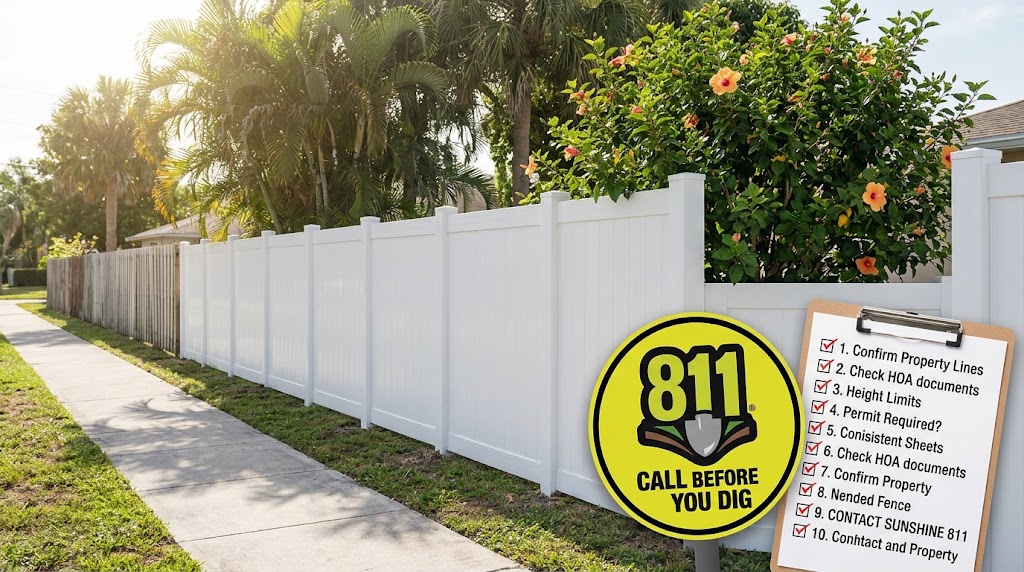
- Pull your survey and confirm property lines and easements.
- Read your HOA documents and submit for architectural approval if required.
- Look up your local fence code for height, placement, materials and sight triangles.
- Ask your building department whether a permit and contractor license are required.
- Confirm pool barrier rules if the fence encloses or forms part of a pool barrier.
- Choose wind-appropriate materials and post specifications.
- Talk to your neighbors about placement and the finished side facing out.
- Hire a qualified installer and verify licenses and insurance.
- Contact Sunshine 811 at least two full business days before digging.
- Schedule inspections and close the permit after final approval.
- Keep records of the permit, survey, HOA approval and photos for insurance and resale.
Brian’s Take
Fences are one of the most common sources of code enforcement complaints and neighbor disputes in Florida, and nearly all of them trace back to skipped homework: no survey, no HOA approval, or a fence sitting in a drainage easement.
The state handles only a few things directly, but those few things carry real consequences. Pool barrier compliance protects children and a home sale. Calling 811 protects you from a five-figure utility repair bill. Everything else is local, which means the best fence guide for any Florida homeowner is ultimately their own city’s code, read carefully before the first post hole.
For homeowners in hurricane-prone areas, the smartest design decision is often the least glamorous one: an open or semi-open fence that lets wind pass through will usually outlast a solid privacy wall.
Frequently Asked Questions
How tall can a fence be in Florida?
There is no statewide maximum for residential fences. Most local codes allow about 3 to 4 feet in front yards and 6 feet in side and rear yards. Check your city or county code and HOA rules.
Do I need a permit to build a fence in Florida?
It depends on your location. Some jurisdictions require permits for most fences, others only for fences over 6 feet, and pool barrier fences are generally permitted and inspected.
What are Florida’s pool fence requirements?
Under Chapter 515, a pool barrier must be at least 4 feet high on the outside, with gates that open outward and are self-closing and self-latching, with the latch release on the pool side out of a child’s reach.
Do I have to call 811 before installing a fence in Florida?
Yes. Florida law requires contacting Sunshine 811 at least two full business days before digging, including for fence posts.
Can my neighbor make me pay for half of a fence?
Florida has no general law requiring neighbors to share fence costs. Shared fences are voluntary agreements, ideally in writing.
Which side of the fence faces the neighbor in Florida?
Many Florida cities and HOAs require the finished side to face outward. Check your local code.
Can I put a fence on a utility or drainage easement?
Sometimes. Drainage easements may prohibit fences, and utilities may remove fences in their easements. Ask your permit office before building.
Do Florida fence contractors need a license?
It depends on your city or county. Some still require a local fence license, some require permitted fence work to be done by or under a state-certified contractor, and others require no license.
Can my HOA stop me from building a fence?
Yes. HOAs can regulate fence material, color, height and location through their governing documents and architectural review.
Does homeowners insurance cover a fence damaged in a hurricane?
Usually under “other structures” coverage, subject to your hurricane deductible. Review your policy for limits and exclusions.
Sources and Further Reading
- Florida Statutes Section 515.29, Residential Swimming Pool Barrier Requirements (2025), The Florida Senate
- Florida Statutes Chapter 515, Residential Swimming Pool Safety Act, The Florida Senate
- Florida Statutes Section 489.117, Registration; Specialty Contractors (2026), The Florida Senate
- Florida Statutes Chapter 556, Underground Facility Damage Prevention and Safety Act, The Florida Senate
- Frequently Asked Questions and About Sunshine 811, Sunshine 811
- Safe Digging for Curb Appeal: Sunshine 811 Reminder, Highlands News-Sun
- Know What’s Below: Call Before You Dig, City of Tallahassee Utilities
- Fence Height Requirements, City of Miami Springs Planning Department
- Miami-Dade Fence Permit Requirements: What Homeowners Need to Know in 2026, Site Plan Creator
- Fence Permit Requirements for St. Petersburg, Clearwater and Orlando, PermitMint
- Local Contractor Licensing Update, Charlotte County Community Development
- Recent Changes to Local Construction Contractor’s Licensing, Jimerson Birr
- Construction Industry Licensing Board License Requirements and Exemptions, Florida Department of Business and Professional Regulation
- Florida Pool Barrier Requirements: Chapter 515 Explained, PoolDial