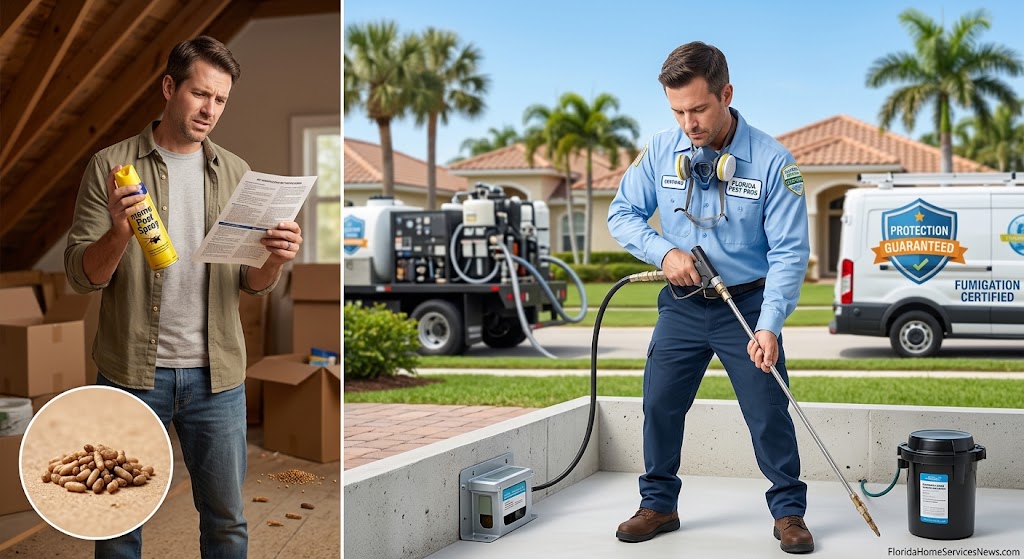
By Brian French | FloridaHomeServicesNews.com | October 16, 2026
Quick Answer
Licensed Florida pest control companies can use products homeowners cannot buy, including restricted-use pesticides, fumigants and professional-only termite and rodent systems. Many work differently from retail sprays, not just harder. Combined with training, equipment and inspection, that is why professionals routinely solve serious infestations that store-bought products only suppress.
Professional vs. Retail at a Glance
| Pest Problem | Typical Retail Option | Professional Option | Key Difference |
|---|---|---|---|
| Drywood termites | Spot sprays, foams | Whole-structure fumigation | Reaches every board in the house |
| Subterranean termites | Repellent granules, stakes | Non-repellent liquids, monitored bait systems | Termites carry it back to the colony |
| German cockroaches | Aerosol sprays, foggers | Rotated gel baits, growth regulators | Built to defeat resistance |
| Ants (Florida species) | Contact sprays | Slow-acting non-repellent baits | Avoids splitting colonies |
| Rats and mice | Limited consumer bait stations | Wider professional toolkit plus exclusion | Stronger tools, applied with safeguards |
| Bed bugs | Aerosols, bombs | Heat treatment, targeted products | Kills eggs and hidden insects |
General comparison for illustration. Product availability varies by label and state rule.
Florida Is the Hardest Pest Market in America
No state tests pest control the way Florida does. Heat, humidity, year-round breeding seasons, coastal shipping ports and dense subtropical vegetation create conditions where insects and rodents do not slow down for winter. A problem that might stall for five months in Connecticut keeps compounding in Fort Lauderdale.
Termites illustrate the scale. According to University of Florida entomologists, six invasive termite species are now established in the state, and three of them, the Formosan subterranean termite, the Asian subterranean termite and the West Indian drywood termite, cause most of the structural damage. Researchers estimate that Asian and Formosan subterranean termites together account for about $32 billion a year in damage and control costs worldwide.
The pressure is growing, not easing. A UF/IFAS study released in February 2026, drawing on monitoring records from 1990 to 2025, found the spread of both invasive subterranean species is accelerating, with the Asian subterranean termite moving north and the Formosan termite now established in most coastal counties and major cities. The researchers concluded it is highly likely the Formosan subterranean termite will be detected throughout Florida before 2050.
Against that backdrop, the gap between what a homeowner can buy at a big-box store and what a licensed professional can deploy is not a marketing claim. It is a practical reality with real financial stakes.
The Two-Tier System Behind Pesticide Sales
Most Floridians do not realize the federal government sorts pesticides into tiers. The U.S. Environmental Protection Agency classifies pesticides as either General Use Products, which anyone can buy, or Restricted Use Products, which can only be purchased by licensed applicators.
Restricted-use status is reserved for products whose toxicity or environmental risk is high enough that EPA requires a trained, certified person to handle them. That does not mean every professional product is restricted. Many professional products are technically general-use but are sold in concentrates, formulations or delivery systems built for licensed operators, labeled for applications a homeowner cannot legally perform, or distributed only through authorized companies.
How Florida Regulates the Industry
In Florida, the Department of Agriculture and Consumer Services oversees pesticide licensing, splitting it across three statutes: Chapter 388 for mosquito control, Chapter 482 for structural pest control and Chapter 487 for agriculture and other sites. Under Chapter 482, only Certified Pest Control Operators may supervise unlicensed technicians.
Certification is category-specific. Florida’s structural categories include general household pest control, termite and wood-destroying organism control, lawn and ornamental, and fumigation. A company licensed for household pests cannot tent a house. A fumigator needs its own certification.
This layered system is the foundation of the professional advantage. Access to stronger tools comes bundled with training, testing, continuing education and accountability to a state regulator.
Termites: Where the Gap Is Widest
Termites are the clearest example of why professional products outperform retail, and they are also where Florida homeowners have the most money at risk.
Drywood Termites and Fumigation
Drywood termites live inside the wood they eat, often in attics, framing, furniture and trim, with no connection to the soil. A homeowner can see the damage and the pellet piles, but cannot see how far the colonies extend through the structure.
The professional answer to a widespread infestation is structural fumigation, commonly called tenting. The structure is sealed under a tarp, and gas penetrates cracks, crevices and pores in the wood to reach pests such as drywood termites. The main active ingredient for residential fumigation is sulfuryl fluoride, and only certified applicators may use it.
There is no retail equivalent. Spot treatments sold to consumers reach only the galleries they are injected into. Fumigation reaches every piece of wood under the tent at once, including colonies nobody knew were there. It also involves serious safety controls: sulfuryl fluoride is colorless, odorless and highly toxic, so chloropicrin is typically added as an irritating warning agent, and applicators must confirm through air monitoring that levels have fallen to the EPA limit of 1 part per million before re-entry.
That combination of power and danger is exactly why it belongs only in licensed hands.
Subterranean Termites: Repellent vs. Non-Repellent
Subterranean termites, including the invasive Formosan and Asian species, nest in soil and forage into structures through mud tubes and hidden cracks in slabs. Here the professional advantage is less about raw potency and more about chemistry and strategy.
Many consumer termite products rely on repellent chemistry. Termites sense the treatment and avoid it. The problem is that a repellent barrier only works if it is perfect. Any gap, and termites simply route around it, often into the house.
Professionals frequently use non-repellent liquid termiticides instead. Termites cannot detect these products, forage through the treated zone, pick up a lethal dose and carry it back to nestmates through contact and grooming. The treatment works with termite behavior rather than against it.
Professionals also install monitored bait systems, in which stations around the foundation are checked on a schedule and loaded with bait when termites are found. The bait typically contains an insect growth regulator that disrupts molting, and workers share it through the colony over weeks, targeting elimination of the colony rather than a barrier around one house. Some of the leading bait systems are sold only through authorized pest control companies.
Application Is Half the Product
Even when a professional and a homeowner use similar active ingredients, the results differ because of how the product goes into the ground. A proper soil treatment involves trenching along foundations, rodding beneath slabs, drilling through patios and garage floors and injecting product at volumes specified on the label. Licensed operators carry the pumps, drills, injection rods and foam rigs to do it, along with the training to calculate linear footage and soil volumes correctly.
A homeowner pouring a jug of granules along a flower bed is not doing the same treatment, even if the label names a similar chemical.
German Cockroaches: Resistance Changes Everything
The German cockroach is the pest that most clearly shows why stronger is not the only word that matters. Smarter matters just as much.
German cockroaches breed explosively. A female can produce about 50 offspring every three months. They also adapt to insecticides at an alarming pace. In a landmark Purdue University study, researchers found resistance could rise four- to six-fold in a single generation, and the surviving insects developed cross-resistance to insecticide classes they had never been exposed to.
The study’s findings carry a direct lesson for homeowners. In field trials, a two-insecticide mixture failed and cockroach populations grew. The one approach that nearly eliminated a population involved an insecticide to which that population had little starting resistance. The lead researcher’s advice was that testing roaches first and choosing a product with low resistance improves the odds.
Why Retail Sprays Make It Worse
The typical retail cockroach product is a pyrethroid aerosol or fogger. Many German cockroach populations already resist pyrethroids, and repellent sprays can drive roaches deeper into walls and into neighboring rooms or units. Each partially effective treatment selects for the toughest survivors.
Professionals approach it differently:
- Gel baits from multiple chemical classes, placed in cracks and crevices where roaches harbor, and rotated when performance drops.
- Insect growth regulators that keep nymphs from becoming breeding adults, attacking the population over time.
- Dusts and non-repellent residuals applied into wall voids and behind appliances where sprays never reach.
- Monitoring traps that measure whether the population is actually falling, so the technician knows when to switch strategies.
The retail shopper has one or two product types. The professional has a rotation plan.
Florida Ants: When Spraying Splits the Colony
Florida’s most common household ants, including ghost ants, white-footed ants and big-headed ants, share a trait that makes do-it-yourself treatment backfire. Many of these species have multiple queens and reproduce by budding, where part of the colony simply walks off with a queen and starts a new one.
When a homeowner sprays a trail with a fast-acting repellent product, the ants that die are a tiny fraction of the colony. The stress can trigger budding, turning one colony into several. The infestation appears to retreat for a week, then returns in more rooms.
Professionals typically use slow-acting, non-repellent baits and residuals designed to let workers carry the active ingredient back to queens and brood before it takes effect. They also identify the species first, because sugar-feeding and protein-feeding ants require different baits, and the wrong choice is ignored entirely.
Rodents: Federal Rules Draw a Hard Line
Rodenticides show the professional-retail divide written directly into federal policy. In 2008, the EPA adopted risk mitigation measures that, beginning in 2011, removed the most potent second-generation anticoagulant rodenticides from consumer retail products. Homeowners can still buy rodent baits, but generally in tamper-resistant stations with less potent active ingredients.
Licensed professionals retain access to a broader set of rodenticides because the EPA determined that the risks to children, pets and wildlife are better managed by trained applicators who follow placement, securing and record-keeping rules.
Even so, chemical potency is not the main reason professionals succeed with rats. The real work is exclusion: finding and sealing the gaps around rooflines, soffits, plumbing penetrations and garage doors that let roof rats in. In Florida, roof rats move along power lines, palm fronds and fence tops, and a technician who knows those travel routes will fix a problem that no amount of retail bait can.
Bed Bugs: Heat and Precision
Bed bugs have developed widespread resistance to the pyrethroid insecticides found in most consumer aerosols and foggers. Total-release foggers, the so-called bug bombs, are particularly ineffective because bed bugs hide in mattress seams, outlets, picture frames and furniture joints that a fog never penetrates.
Professional companies use whole-room or whole-structure heat treatment, raising temperatures high enough to kill all life stages, including eggs, then follow with targeted residual products and inspection. Heat equipment, temperature probes and the training to avoid damaging property are not something a homeowner can rent at a hardware store.
Mosquitoes and Lawn Pests: Florida’s Outdoor Battle
Florida’s outdoor pests add another dimension. Professionals treating lawns and landscapes work under the Lawn and Ornamental category and use products and equipment calibrated for large areas, including insect growth regulators for mosquito breeding sites and targeted treatments for chinch bugs, mole crickets and whiteflies that damage Florida turf and ornamentals.
The key difference here is often diagnosis. Chinch bug damage looks like drought stress. Fungal disease can mimic insect damage. A homeowner who sprays the wrong product for the wrong problem spends money and adds chemicals to the environment without fixing anything. A trained technician identifies the actual cause before treating.
The Real Advantage: Product Plus Knowledge
It would be easy to read this article as an argument that professionals simply have stronger poison. That would miss the point.
The professional advantage in Florida comes from five things working together:
1. Access
Restricted-use products, fumigants, professional bait systems and concentrated formulations are legally available only to licensed operators.
2. Chemistry That Matches Behavior
Non-repellent and slow-acting products exploit how social insects share food and groom each other. Retail products often rely on fast knockdown, which looks satisfying but rarely reaches the colony.
3. Equipment
Injection rods, foam rigs, fumigation tarps, gas monitors, heat systems and calibrated sprayers deliver product where pests actually live.
4. Diagnosis and Resistance Management
Correct species identification and awareness of local resistance patterns determine which product will work. The Purdue cockroach research shows that the same product can eliminate one population and fail completely against another.
5. Accountability
Licensed companies answer to FDACS, carry insurance, keep application records and typically back termite work with renewable warranties. A homeowner’s do-it-yourself termite treatment comes with no guarantee and no recourse.
A Note on Buying Professional Products Online
Some professional-label products are available online, and some homeowners try to buy their way to professional results. That approach carries real risks. Every pesticide label is a legal document, and applying a product in a way the label does not allow is a violation of federal law. Many professional termiticide labels assume trenching, rodding and volume calculations the homeowner is not equipped to perform. Misapplied termiticides can contaminate wells, harm pets and leave homes unprotected while the owner believes the problem is solved.
There is also a resale consideration. Florida buyers commonly ask for a wood-destroying organism inspection report and the history of termite treatment. A documented professional treatment with a transferable warranty supports a home’s value. A receipt for a concentrate bought online does not.
How to Choose a Florida Pest Control Company
Homeowners hiring a professional should verify a few basics:
- Confirm the FDACS business license and the certified operator in charge.
- Match the certification to the job. Termite work requires the wood-destroying organism category. Tenting requires fumigation certification.
- Ask what product and method will be used and why it fits your specific pest.
- Ask about inspections and monitoring, not just a one-time treatment.
- Read the warranty, including whether it covers re-treatment only or also repair of damage, and whether it transfers to a buyer.
- Compare the plan, not just the price. The cheapest quote often uses the least product or skips the labor that makes a treatment work.
Brian’s Take
I did not come to this subject as an outsider. My father owned a pest control company in Connecticut, and I grew up hearing how the business really works. The lesson I absorbed early was that customers thought they were paying for chemicals, but they were really paying for judgment: knowing which product to use, where to put it, and when something was not working.
Connecticut pests are serious, but Florida is a different league. Up north, winter gives everyone a break. Here, termites swarm, roaches breed and ants bud twelve months a year, and the invasive termite species UF researchers track are still expanding. A homeowner fighting that with store-bought aerosols is bringing a garden hose to a house fire.
From my years managing money, I look at this the way I would look at any asset. For most Florida families, the home is the largest investment they own. Spending a few hundred dollars a year to protect it with licensed professionals, proper products and a transferable termite warranty is not an expense. It is insurance on the balance sheet. Trying to save money with do-it-yourself termite control is one of the worst risk-reward trades a homeowner can make, because the downside is structural damage that most homeowner’s insurance policies do not cover.
I also think the industry undersells itself. Professional pest control in Florida is closer to applied science than to spraying bugs. The companies that explain the difference between repellent and non-repellent treatments, or why they rotate cockroach baits, earn more trust and keep customers longer. That is good for homeowners, and it is good business.
Frequently Asked Questions
Are professional pest control products stronger than retail products?
Some are. Restricted-use pesticides and fumigants are available only to licensed applicators because of their toxicity. But many professional products succeed because they work differently, using non-repellent or slow-acting chemistry that reaches the entire colony.
Can homeowners buy restricted-use pesticides in Florida?
No. Restricted-use pesticides can be purchased and applied only by licensed applicators or people working under their direct supervision.
Why don’t store-bought termite treatments work as well?
Many retail products rely on repellent chemistry, which termites avoid and work around. Professionals use non-repellent liquids, bait systems and, for drywood termites, whole-structure fumigation, along with specialized application equipment.
What is termite tenting?
Tenting is structural fumigation. The home is sealed under a tarp and filled with a fumigant gas, usually sulfuryl fluoride, that penetrates all the wood in the structure. Only certified fumigators can perform it.
Why do cockroach sprays stop working?
German cockroaches develop resistance quickly, and research shows they can become resistant to several insecticide classes at once. Professionals rotate baits and use growth regulators to stay ahead of resistance.
Is it legal to buy professional pest products online and apply them myself?
Some professional-label products are sold online, but applying any pesticide in a way the label does not allow violates federal law. Many termiticide labels require application methods and equipment that homeowners do not have.
How do I check if a Florida pest control company is licensed?
The Florida Department of Agriculture and Consumer Services licenses pest control businesses and certified operators. Ask the company for its business license number and the name of its certified operator, then verify it with FDACS.
Sources and Further Reading
- University of Florida IFAS, “Finding the Correct Pesticide Applicator License in Florida,” EDIS publication PI293
- University of Florida IFAS, “Licensing of Structural Pesticide Applicators in Florida,” EDIS
- University of Florida News, study on invasive termite spread in Florida, February 2026
- UF/IFAS Blogs, “Half of South Florida Structures at Risk of Subterranean Termite Infestation by 2040”
- UF/IFAS Fort Lauderdale Research and Education Center, Termites in Florida distribution map
- National Pesticide Information Center, Oregon State University, “Structural Fumigation”
- Purdue University News, “Rapid Cross-Resistance Bringing Cockroaches Closer to Invincibility,” 2019
- Scharf et al., “Rapid Evolutionary Responses to Insecticide Resistance Management Interventions by the German Cockroach,” Scientific Reports, 2019
- U.S. Environmental Protection Agency, Restricted Use Products and Rodenticide Risk Mitigation Decision
- Florida Department of Agriculture and Consumer Services, Bureau of Licensing and Enforcement, Structural Pest Control (Chapter 482)
This article is for informational purposes only. Always read and follow pesticide label directions, and consult a licensed Florida pest control professional for treatment of serious infestations.