Insurance Claims After the AOB Ban, Repair vs. Replace, Roof-Age Underwriting, and What a New Roof Actually Costs
Last updated: August 24, 2026 | FloridaHomeServicesNews.com Staff | Roofing Desk — Florida Roof Cost Index, Q3 2026 Edition
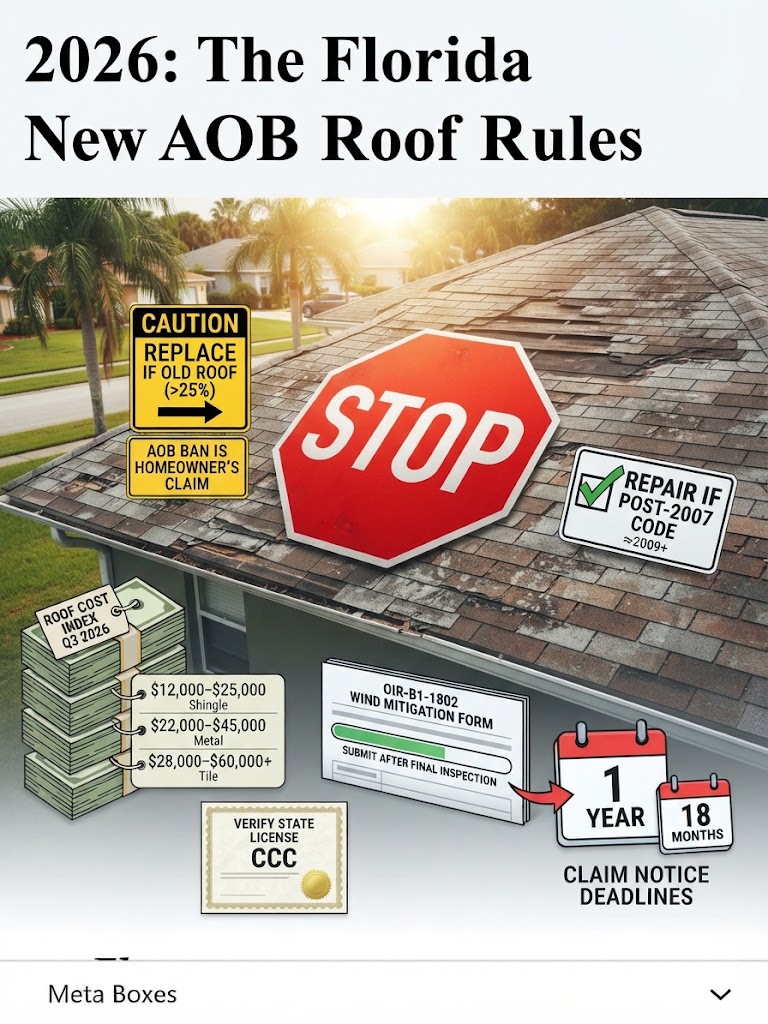
Short answer: In Florida, a roofer can no longer “handle your insurance claim for you” — assignments of benefits are prohibited for residential property policies issued on or after January 1, 2023, so the claim belongs to you alone. Your insurer generally must pay to repair rather than replace a damaged roof only if the roof was built or replaced under the 2007 Florida Building Code or later and can be repaired to code; older roofs damaged beyond 25% still trigger full replacement. You must report roof damage to your insurer within 1 year of the date of loss, insurers may apply a separate roof deductible you agreed to at purchase, paying or waiving your deductible is insurance fraud, and a typical Florida asphalt shingle replacement now runs well into five figures — with metal and tile far beyond. The rules, the math, and the red flags are below.
Roofs are where Florida’s building code, insurance crisis, and contractor economy collide — and the rules changed more between 2021 and 2023 than in the previous thirty years. This page is the standing plain-English reference, updated after every legislative session, code cycle, and named storm.
The Five Rule Changes That Rewired Florida Roofing
1. The AOB Ban: Your Claim Is Yours Now
For two decades, the standard pitch at a Florida front door was “sign here and we’ll deal with your insurance company.” That instrument — the assignment of benefits (AOB) — let contractors take over the claim, the negotiation, and often the lawsuit. The December 2022 reforms (SB 2-A) ended it: for residential property policies issued on or after January 1, 2023, post-loss insurance benefits cannot be assigned. A roofer can still inspect, estimate, meet your adjuster, and repair — but the claim, the correspondence, the checks, and the deadlines are the homeowner’s, full stop. Any contract that purports to assign your benefits under a post-2023 policy is offering something the contractor cannot lawfully receive.
2. Repair vs. Replace: The 25% Rule, Rewritten
The old Florida Building Code rule forced replacement of the entire roofing system whenever more than 25% of a roof was repaired or replaced within a 12-month period — the engine behind countless “free roof” claims. The 2022 reforms (SB 4-D) changed the code standard: if the existing roof was built, repaired, or replaced in compliance with the 2007 Florida Building Code or later (roughly, roofs installed since about March 2009), damaged portions may be repaired to match, and full replacement is not required no matter how much exceeds 25%. Older, pre-2007-code roofs remain subject to the replacement trigger.
| Your roof | Damage exceeds 25% of roof | What the code requires |
|---|---|---|
| Installed under 2007 FBC or later (≈2009+) | Yes | Repair the damaged portion to current code — full replacement not required |
| Installed under pre-2007 code | Yes | Replace the entire roofing system |
| Any roof | Under 25% | Repair the damaged portion |
The insurance consequence: carriers now routinely pay for repairs on newer roofs where they once paid for replacements. Whether a repair can genuinely restore the roof — matching materials, maintaining warranties, passing inspection — is where most modern roof disputes live.
3. Roof Deductibles and Roof Payment Schedules
Florida law (Fla. Stat. § 627.7011, as amended by the 2022 reforms) authorizes insurers to offer policies with a separate roof deductible — up to 2% of the Coverage A dwelling limit or 50% of the roof replacement cost — in exchange for a premium credit, with required disclosures and homeowner sign-off. The roof deductible generally does not apply to total losses, hurricane losses, or damage caused by a fallen tree or other specified perils. Insurers have also filed roof payment schedules that pay depreciated (actual cash value) amounts on older roofs rather than full replacement cost. Translation: two neighbors with identical storm damage can receive wildly different checks based on paperwork they signed at renewal. Read the roof endorsement before hurricane season, not after.
4. Roof Age Underwriting: The 15-Year Rule
Under Florida’s 2021 reforms, an insurer may not refuse to write or renew a homeowners policy solely because of roof age if the roof is less than 15 years old. For roofs 15 years or older, the homeowner has the right to obtain a roof inspection, and if it shows the roof has five or more years of useful life remaining, the insurer cannot refuse coverage solely on age. In the real market, carriers still steer around older roofs through inspections, schedules, and pricing — but the inspection right is a genuine lever, and homeowners over the 15-year line should use it in writing before accepting a non-renewal.
5. The Solicitation Crackdown: What Roofers Can’t Say or Do
Fla. Stat. § 489.147 and Florida’s insurance fraud statute (§ 817.234) target the post-storm claim-generation machine:
- Contractors may not offer anything of value — gift cards, “free” upgrades, deductible reimbursement — to induce a homeowner to file a roof insurance claim.
- Paying, waiving, absorbing, or rebating your deductible is insurance fraud — a crime for the contractor and a scheme that makes the homeowner a participant. Any roofer who says “don’t worry about the deductible” has just told you everything.
- Contractors may not interpret your policy or adjust your claim — that’s licensed public adjuster or attorney work.
- Written contracts for insurance-funded roof work must contain required notices, including your right to cancel within the statutory window.
(Portions of the original 2021 advertising restrictions drew First Amendment litigation and legislative amendment — the prohibited-inducement and deductible-fraud core above is the enduring, enforceable heart. Verify current text before republishing specifics.)
The Claim Clock: Deadlines That Kill Roof Claims
| Step | Deadline | Statute |
|---|---|---|
| Notice of claim to insurer | 1 year from date of loss | § 627.70132 |
| Supplemental / reopened claim | 18 months from date of loss | § 627.70132 |
| Insurer pays or denies | 60 days from notice (7-day acknowledgment; 30-day inspection window) | § 627.70131 |
| Lawsuit for breach of policy | 5 years from date of loss, after mandatory pre-suit notice | §§ 95.11, 627.70152 |
The most common fatal error in Florida roof claims is silence: homeowners wait for a contractor, a busy season, or visible ceiling stains, and the 1-year notice window closes on damage the storm caused months earlier. Notice first — scope later, supplement within 18 months.
The Florida Roof Cost Index — Q3 2026 Snapshot
Methodology: index figures synthesize residential re-roof permit valuations from major county permit portals and surveyed contractor pricing, by material, for a typical single-family home (≈20–25 squares). Figures are illustrative planning ranges, not quotes; coastal high-wind zones, steep pitches, decking replacement, and HVHZ (Miami-Dade/Broward) requirements push totals higher. Current-quarter figures are verified against fresh permit data before each update.
| Material | Installed cost per square (100 sq ft) | Typical project total | Expected life (FL climate) |
|---|---|---|---|
| Asphalt shingle (architectural) | ~$450–$700 | ~$12,000–$25,000 | 15–20 years |
| Metal (standing seam / stone-coated) | ~$900–$1,400 | ~$22,000–$45,000 | 40–50 years |
| Concrete / clay tile | ~$1,000–$1,800 | ~$28,000–$60,000+ | 40–50+ years |
Why Florida prices run high: current-code wind uplift requirements (enhanced nailing, sealed roof deck / secondary water resistance, drip edge), HVHZ product approvals in Miami-Dade and Broward, post-storm demand surges, and material inflation. The silver lining: a new-to-code roof is the single largest wind-mitigation event a home can have — resetting the insurance roof-age clock and unlocking premium credits documented on the OIR-B1-1802 wind mitigation form. Get the wind mitigation inspection the week the roof passes final and send it to your carrier; the discount doesn’t apply itself.
Hiring the Roofer: The 10-Point Florida Checklist
- Verify the license — Florida roofing requires a state Certified Roofing Contractor (CCC) or equivalent registered license; check the exact name and number at DBPR’s portal (myfloridalicense.com). Cards and wraps aren’t licenses.
- Verify insurance — demand current certificates for liability and workers’ compensation, issued to you from the insurer, not photocopies.
- Local address and permit history — post-storm, out-of-state “storm chasers” write contracts and vanish; a county permit history is the reference that can’t be faked.
- Permits always — a re-roof without a permit and final inspection is uninsurable, unsellable trouble. The permit is pulled by the contractor, under their license, before work starts.
- Deposit discipline — Florida law (§ 489.126) obligates a contractor taking more than a 10% deposit to apply for permits within 30 days of when permits are necessary and start work within 90 days of permit issuance; treat large cash deposits as the red flag they are.
- No deductible games — see above; it’s fraud, and it’s the single most reliable scammer tell.
- Written scope — materials by manufacturer and product approval number, decking replacement price per sheet, dry-in, flashing, ventilation, debris disposal, and warranty terms (workmanship vs. manufacturer).
- Notice of Commencement and lien releases — for projects above the statutory threshold, an NOC is recorded, and you should collect lien releases with every payment; Florida’s construction lien law can make a homeowner pay twice for the same roof.
- Match payments to milestones — never ahead of work in place; final payment only after the passed final inspection, not the last shingle.
- Insurance-claim work — you sign the contract, you communicate with the insurer, and any “contingency agreement” must comply with the disclosure and cancellation rules. If a roofer wants to “represent” you, they’re describing a job that now belongs to public adjusters and lawyers.
Frequently Asked Questions
Can a roofer still handle my insurance claim in Florida? No. Assignments of benefits are prohibited for policies issued on or after January 1, 2023 — the roofer repairs, but the claim, negotiation, and payments run through you.
Does insurance have to replace my whole roof or just repair it? If your roof was installed under the 2007 Florida Building Code or later and can be repaired to code, repair is generally all the code — and therefore the policy — requires, even for damage beyond 25%. Pre-2007-code roofs damaged beyond 25% still require full replacement.
How old can my roof be before insurance drops me? Insurers can’t refuse coverage solely for roof age under 15 years; at 15+ years you’re entitled to prove five or more years of remaining useful life by inspection. In practice, plan the replacement conversation around year 12–15 for shingle roofs.
Is a “free roof inspection” a scam? The inspection itself may be real — the business model behind some of them is the problem. Any offer of value to file a claim, any deductible “help,” and any pressure to sign on the spot are statutory red flags. Get the findings in writing and a second opinion before touching your policy.
How much does a new roof cost in Florida? Per the current Index snapshot: roughly $12,000–$25,000 for architectural shingle on a typical home, $22,000–$45,000 for metal, and $28,000–$60,000+ for tile — before decking surprises and HVHZ requirements.
How long do I have to file a roof damage claim? One year from the date of loss for initial notice; eighteen months for supplemental claims; five years to sue. § 627.70132; § 95.11.
Can my contractor pay my deductible? No — waiving, paying, or rebating a deductible is insurance fraud under Florida law, for them and potentially for you.
Does a new roof lower my insurance? Almost always, and often dramatically — through the roof-age reset and wind mitigation credits. Order the wind mitigation inspection immediately after final inspection and file the OIR-B1-1802 with your carrier.
Brian’s Take
“The free-roof era is over — the code killed the 25% trick, the AOB ban killed the middleman, and the deductible ‘favor’ was always a felony wearing a polo shirt. The new game is boring and it works: notice the claim in week one, know whether your roof is 2007-code, verify the license, and cash the wind-mitigation discount. Boring is what the scammers can’t fake.”
FloridaHomeServicesNews.com covers Florida home services, regulation, and consumer protection for news and educational purposes; nothing here is legal, insurance, or contracting advice. Framework sources: Fla. Stat. §§ 489.126, 489.147, 627.7011, 627.70131, 627.70132, 627.70152, 817.234, 95.11; the Florida Building Code (floridabuilding.org); DBPR license verification (myfloridalicense.com); OIR wind mitigation form OIR-B1-1802 (floir.com); DFS consumer resources (myfloridacfo.com). These statutes and code provisions have been amended repeatedly — verify current text, thresholds, and cost figures against primary sources and local permit data before relying on or republishing any entry, and consult licensed professionals for any specific claim or project.