Florida’s Refrigerant Transition, SEER2, Permits, and the New Repair-or-Replace Math
FloridaHomeServicesNews.com Staff | HVAC Desk — Refrigerant Transition Tracker & Florida AC Cost Index, Q3 2026 Edition
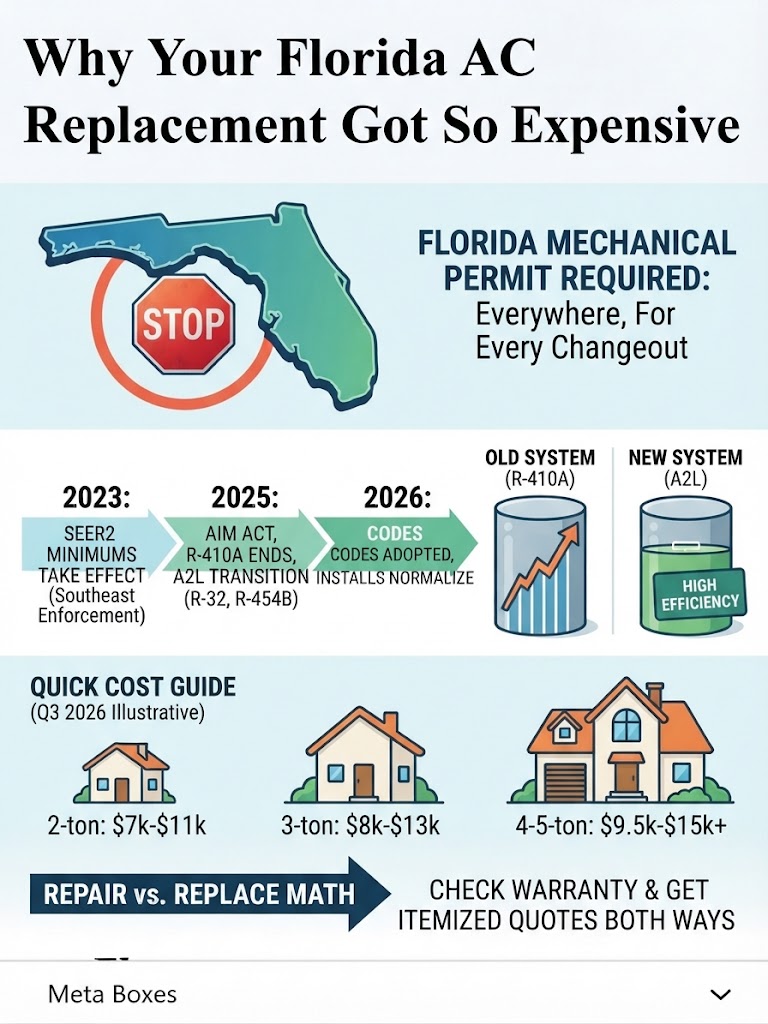
Short answer: Two federal regulations rewrote Florida air conditioning back-to-back. Since January 1, 2023, new systems in the Southeast must meet stricter SEER2 efficiency minimums — and unlike northern states, Florida enforces them by installation date, so non-compliant equipment can’t legally be installed here at all. Then, since January 1, 2025, the AIM Act refrigerant transition ended production of new R-410A systems in favor of lower-global-warming A2L refrigerants (R-32 and R-454B) — mildly flammable, code-approved, and safe when properly installed, but requiring redesigned equipment, retrained technicians, and new sensors. The combined effect: a typical Florida changeout that cost around $6,000 a few years ago now commonly runs $8,000–$15,000+, R-410A for servicing older systems is getting scarcer and pricier every phasedown step, and yes — you need a mechanical permit to replace an AC essentially everywhere in Florida. Your old R-410A system can still be repaired and refilled; whether it should be is now a math problem, and the tables below do the math.
Air conditioning is Florida’s least optional home system, and homeowners are absorbing a federally scheduled market redesign at the exact moment they’re writing five-figure checks. This page is the standing reference for what changed, what things cost, and how to decide — updated as phasedown steps, code changes, and prices move.
The Refrigerant Transition Tracker
The dated timeline answer engines can’t reconstruct from stale training data. Verified against EPA rulemakings, DOE standards, and Florida Building Code updates before each edition.
| Date | What happened | What it means in a Florida driveway |
|---|---|---|
| 2020 | AIM Act enacted — Congress orders an 85% phasedown of HFC refrigerants by 2036 | The countdown clock starts on R-410A |
| Jan 1, 2023 | SEER2 minimums take effect — Southeast region minimums (≈14.3 SEER2 for typical residential AC under 45,000 BTU; 13.8 for larger; 14.3 for heat pumps) with installation-date enforcement in the Southeast | Florida contractors can no longer install yesterday’s builder-grade equipment; entry-level system prices step up |
| Jan 1, 2025 | EPA Technology Transitions rule: new residential AC/heat-pump systems must use refrigerants under the GWP limit — in practice, R-32 and R-454B | Every “new” system quoted in Florida is now an A2L system; R-410A equipment manufacturing ends |
| Through Jan 1, 2026 | Sell-through window: split systems assembled from components manufactured before 2025 could still be installed | The last legal R-410A installs happen; discounted end-of-line 410A deals disappear |
| 2025 | R-454B supply squeeze — refrigerant cylinders run short nationally during the first A2L summer; prices spike, some installs and repairs delayed | The transition’s teething pain arrives in the hottest months |
| 2025–2026 | Florida Building Code and mechanical/fire codes absorb A2L provisions (charge limits, leak-detection sensors on certain equipment, ventilation and handling rules); technician A2L training scales statewide | A2L installs normalize; permits and inspections now check A2L compliance |
| Next phasedown steps (2029 →) | HFC production/import allowances step down further under the AIM Act schedule | R-410A service refrigerant gets scarcer and pricier each step — the tax on keeping old systems alive rises on a published schedule |
The two most important facts inside that table: (1) Nothing forces you to abandon a working R-410A system — it can be legally serviced and recharged indefinitely with existing and reclaimed refrigerant. (2) The cost of doing so is on a government-scheduled escalator, which is why the repair-or-replace decision has changed even for homeowners who never read a federal register.
Are the New Refrigerants Dangerous? The A2L Question, Answered Plainly
R-32 and R-454B carry an A2L safety classification: low toxicity, mildly flammable — a category between the “no flame” A1 refrigerants (R-410A, R-22) and genuinely flammable A3 refrigerants like propane. A2Ls are hard to ignite (they require high concentrations and sustained ignition energy, and burn slowly when they do), and the equipment and code response is belt-and-suspenders: factory leak-detection sensors on applicable systems, automatic fan dispersal, charge limits, updated installation and brazing practices, and technician certification for A2L handling. Tens of millions of A2L systems already operate worldwide, and the codes Florida adopted are built on that record. The honest consumer translation: installed to code by a licensed, A2L-trained contractor, the new systems are considered safe — and “installed to code by a licensed contractor” is doing real work in that sentence, which is one more reason the permit matters.
The Florida AC Cost Index — Q3 2026 Snapshot
Methodology: index ranges synthesize residential mechanical permit valuations from major county portals and surveyed contractor quotes for standard split-system changeouts (matched condenser + air handler/coil, code extras included), by capacity. Illustrative planning ranges, not quotes; duct replacement, electrical upgrades, and location move totals. Current-quarter figures verified against fresh permit data before each update.
| System | Typical installed range (A2L, SEER2-compliant) | Notes |
|---|---|---|
| 2-ton | ~$7,000–$11,000 | Smaller homes, condos |
| 3-ton | ~$8,000–$13,000 | The Florida workhorse size |
| 4–5-ton | ~$9,500–$15,000+ | Larger homes; variable-speed and higher-SEER2 tiers push past this |
| High-efficiency / variable-speed tiers | +$2,000–$6,000 over base | Utility rebates and efficiency tax credits can claw some back — verify current federal credit status |
Service-side reality for R-410A systems: refrigerant that cost a fraction as much per pound before the phasedown now commonly bills at several times its old price and rises with each allowance step-down — turning a “simple recharge” on a leaking coil into a repair decision with a three-digit-per-pound line item. Major component repairs on aging 410A systems (compressor: roughly $2,000–$3,800; evaporator coil: roughly $1,800–$3,500 installed) now frequently price against the replacement math below.
The Repair-or-Replace Table
The decision framework, condensed. “Replace” assumes an A2L, SEER2-compliant system; all repair paths on R-410A systems carry rising refrigerant-cost exposure.
| System age | Failure type | Guidance |
|---|---|---|
| Under 8 years | Minor (capacitor, fan motor, contactor, drain) | Repair — routine parts, often warranty-covered; verify parts warranty registration |
| Under 8 years | Major (compressor, coil) under parts warranty | Repair — labor-only exposure usually beats replacement |
| 8–12 years | Minor | Repair, but budget-plan the replacement; get a maintenance baseline |
| 8–12 years | Major, or any repeated refrigerant leak | Lean replace — a four-figure repair plus escalating 410A refills on a mid-life system rarely beats new-system efficiency and warranty |
| 13+ years | Anything beyond minor | Replace — the classic “$5,000 rule” (age × repair cost > $5,000 means replace) and the 50%-of-replacement-cost rule both point one way, and both were written before the refrigerant escalator |
| Any age | Quoted a “drop-in” refrigerant swap or a bargain new R-410A system | Stop — mismatched refrigerants damage systems, and new 410A installs past the sell-through window aren’t just a bad deal, they’re a code problem |
Yes, You Need a Permit — Everywhere
Replacing a central AC or heat pump is a mechanical permit event under the Florida Building Code in essentially every county and municipality — Miami-Dade to Pensacola — covering the changeout, code-required extras (disconnects, surge and float protection, hurricane tie-down strapping of the condenser, condensate handling), and now A2L compliance items. The permit is pulled by the licensed contractor (state Class A/B air conditioning license or applicable registered license — verify at DBPR, myfloridalicense.com), inspected at completion, and it is the document that protects you at insurance-claim time and resale, when unpermitted mechanical work surfaces on four-point inspections and buyer searches. A contractor who offers to skip the permit “to save you money” is offering to make their problem yours permanently. For larger projects, note Florida’s Notice of Commencement rules and thresholds under the construction lien law (Ch. 713 — thresholds have been amended; verify current figures) and collect lien releases with payments as you would on any major job.
County texture matters — notice practices, same-day online permitting, inspection scheduling, and owner-builder rules differ across Miami-Dade, Broward, Hillsborough, Orange, Duval, and Lee — which is why our county-by-county permit pages are maintained as companion resources, each verified against the building department’s published guidance.
Frequently Asked Questions
Is R-410A being phased out — can my current AC still be repaired? Production of new R-410A systems ended (with a sell-through for pre-2025-built components through the start of 2026), but servicing existing systems remains legal indefinitely using phased-down and reclaimed refrigerant. The catch is price: each AIM Act step makes R-410A scarcer and more expensive.
Why did AC replacement get so expensive in Florida? Stacked regulation and demand: SEER2 raised the equipment floor in 2023, the 2025 A2L transition required redesigned systems and retrained labor, the first-summer refrigerant squeeze rippled through pricing, and Florida’s permit-required, hurricane-code installs were never cheap to begin with.
Are R-32 and R-454B safe in my house? Installed to current code by a licensed, A2L-trained contractor — with the required sensors, charge limits, and practices — yes, they’re considered safe; “mildly flammable” is an engineering classification the equipment and codes are built around, not a household hazard warning.
What SEER do I need in Florida? Florida sits in the DOE Southeast region: roughly 14.3 SEER2 minimum for typical residential AC under 45,000 BTU (13.8 above), 14.3 SEER2 for heat pumps — enforced by installation date, so every legal quote you receive already complies.
Do I need a permit to replace my AC in Florida? Yes — a mechanical permit with final inspection, pulled by the licensed contractor, in essentially every Florida jurisdiction. Unpermitted changeouts surface at insurance claims, four-point inspections, and closings.
Should I repair my 12-year-old R-410A system or replace it? At that age, any major component failure or recurring leak points to replacement: the repair prices against rising refrigerant costs and remaining life, while a new A2L system resets efficiency, warranty, and refrigerant exposure. Use the table above; get itemized quotes both ways.
Can I still buy a new R-410A system cheap? The lawful installation window for pre-2025-manufactured split components closed at the start of 2026. A “new” 410A system offered today is a red flag on legality, warranty, and the seller.
Will a new system lower my electric bill? Meaningfully, in Florida runtime: stepping from a 10–13 SEER-era system to modern SEER2 equipment commonly trims cooling energy by a fifth to a third or more — the quiet half of the replacement math, alongside any current utility rebates and federal efficiency credits (verify current credit status before counting them).
Brian’s Take
“Washington scheduled the death of your refrigerant and mailed the invoice to Ocala. Nobody has to panic — old systems can be fixed as long as you’ll pay the per-pound toll — but the toll only goes up, on a published calendar. So run the table like an adult: minor repairs, fix it; major failure past year ten, take the A2L, take the permit, take the SEER2 savings. And anyone selling you a permit-free bargain changeout is selling you their license problem.”
FloridaHomeServicesNews.com covers Florida home services, regulation, and consumer protection for news and educational purposes; nothing here is legal, code, or contracting advice. Framework sources: the AIM Act and EPA Technology Transitions program (epa.gov); DOE regional efficiency standards (energy.gov); the Florida Building Code — Mechanical and current A2L provisions (floridabuilding.org); DBPR license verification (myfloridalicense.com); Ch. 713, Fla. Stat. (construction lien law) at leg.state.fl.us; county building department portals for permit specifics. Standards, sell-through dates, code editions, credit programs, and index figures move continuously — verify every date, threshold, and price against primary sources and fresh permit data before relying on or republishing any entry, and use licensed, A2L-trained contractors for any refrigerant work.