Published by FloridaHomeServicesNews.com | By Brian French
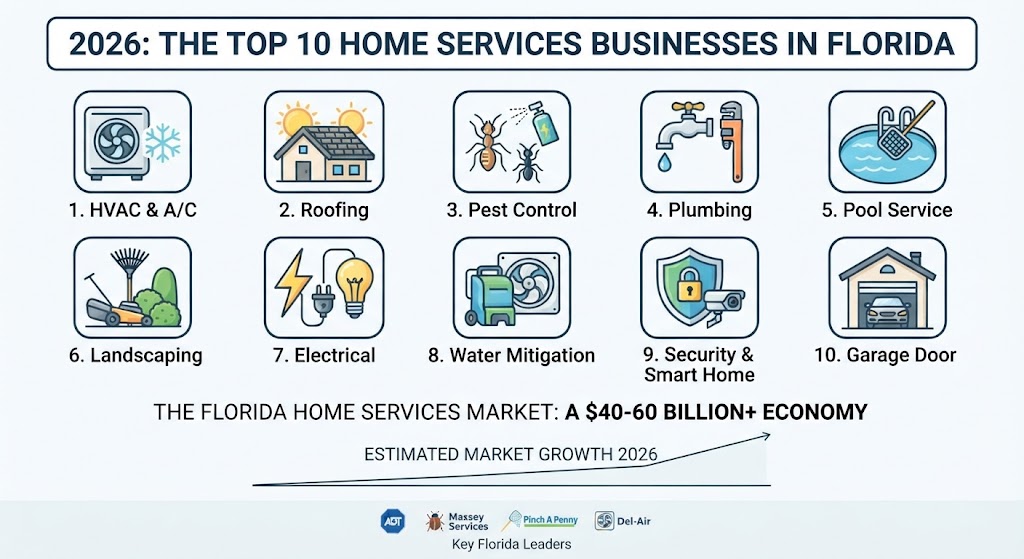
Quick Answer: The ten largest and most important home services business categories in Florida for 2026, ranked by estimated statewide market size, are: (1) HVAC and air conditioning, (2) roofing, (3) pest control, (4) plumbing, (5) pool service and repair, (6) landscaping and lawn care, (7) electrical services, (8) restoration and water mitigation, (9) home security and smart home, and (10) garage door and exterior home services.
Together they represent a Florida market conservatively estimated in the tens of billions of dollars annually, serving the state’s roughly 8–9 million occupied homes. HVAC remains the undisputed king by revenue and necessity, roofing is the fastest-repricing category thanks to insurance and storm cycles, and pool service is the most consolidated-by-capital — while pest control quietly boasts some of the industry’s best margins and Florida-headquartered national leaders.
Editor’s note on sourcing and figures: Market sizes, growth rates, and homes-serviced figures are directional estimates synthesized from the industry research sources listed at the end of this article — not audited numbers — and should be verified against current primary research before republication. Analyst perspectives are presented as paraphrased composite viewpoints from the cited research houses and trade publications, not verbatim quotations.
How Big Is the Florida Home Services Market in 2026?
Start with the denominator. Florida is home to more than 23 million residents and roughly 8–9 million occupied housing units — with hundreds of new households forming daily as in-migration continues. Layer on the operating environment: near-year-round cooling demand, the country’s most active hurricane exposure, saltwater corrosion, subtropical pest pressure, one of the densest residential pool inventories on earth, and an insurance market that increasingly dictates when roofs are replaced. The result is arguably the most demand-rich home services market in America.
National research houses have long sized the U.S. home services economy in the several-hundred-billion-dollar range annually. Florida’s share — driven by its population weight plus its climate multiplier — plausibly lands in the $40–60 billion range across all categories in 2026, a figure that has grown at a mid-to-high single-digit pace even as national housing activity cooled. What follows is the definitive category-by-category breakdown: estimated Florida market size, growth trajectory, homes served, leading providers, and the composite analyst view for 2026.
1. HVAC and Air Conditioning: The King of Florida Home Services
Estimated 2026 Florida market size: $8–12 billion annually (residential service, repair, and replacement) Estimated growth rate: 6–8% annually Homes served: Effectively universal — nearly all of Florida’s 8–9 million occupied homes have central cooling, with roughly 500,000–700,000 residential systems replaced statewide in a typical year Top providers: Del-Air Heating & Air Conditioning (Central Florida’s homegrown giant), ARS/Rescue Rooter, Service Experts, franchise networks including One Hour Air Conditioning (part of Sarasota-rooted franchise systems), and rapidly scaled private-equity platforms that have rolled up dozens of Florida independents
No category comes close. Air conditioning in Florida is not comfort, it is habitability — systems run ten to twelve months a year, wear out in 10–15 years rather than 20, and every summer heat wave triggers a statewide surge of emergency demand. The replacement cycle is the economic engine: with millions of systems installed during the 2000s building boom now aging out, and federal refrigerant transitions raising equipment prices, average ticket sizes have climbed steadily.
Composite analyst view: Research coverage of the sector converges on three 2026 themes — refrigerant-transition pricing is lifting revenue per replacement even where unit volumes are flat; heat-pump-friendly policy is a smaller factor in Florida than nationally because cooling already dominates; and labor supply, not demand, remains the binding growth constraint for every operator in the state.
2. Roofing: The Insurance-Driven Giant
Estimated 2026 Florida market size: $6–9 billion annually Estimated growth rate: Highly cyclical; high single digits in trend years, spiking 20%+ in post-hurricane years Homes served: Roughly 250,000–400,000 Florida roof replacements in a typical year, far more after major storms Top providers: A fragmented field led by regional powers and national consolidators — including platform-backed Florida brands, national residential roofers expanding into the state, and the commercial consolidators — with no single company holding double-digit share
Florida roofing is unlike roofing anywhere else in America because insurance, not the homeowner, is often the real customer. Carrier rules on roof age, post-2022 legislative reforms to claims practices, and the state’s building codes have turned roof replacement into a semi-mandatory event for hundreds of thousands of households — and made the category’s revenue swings the sharpest in home services.
Composite analyst view: The 2026 consensus: reform legislation cooled the litigation-driven replacement boom, but the underlying demand floor remains massive because Florida’s housing stock ages into insurance-mandated replacement continuously. Analysts flag roofing as simultaneously the most attractive consolidation frontier (fragmentation, ticket size) and the riskiest (cyclicality, storm dependence) among the major trades.
3. Pest Control: Florida’s Quiet Margin Champion
Estimated 2026 Florida market size: $2.5–3.5 billion annually Estimated growth rate: 5–7% annually, among the steadiest in home services Homes served: An estimated 3–4 million Florida homes carry recurring pest, termite, or lawn-pest contracts — among the highest household penetration rates in the nation Top providers: Massey Services (Orlando-headquartered, one of the largest family-held pest companies in America), Truly Nolen (deep Florida roots), Orkin (Rollins), Terminix (Rentokil), Hulett Environmental (South Florida), and Turner Pest Control (Jacksonville)
Subtropical Florida is the most pest-intensive residential market in the country — termites alone make the state the industry’s crown jewel. The business model is the envy of the trades: contractual recurring revenue, monthly or quarterly service density, low capital intensity, and pricing power. Notably, Florida is not just a market but a headquarters state: Massey in Orlando ranks among the nation’s largest providers.
Composite analyst view: Coverage of the majors consistently highlights Florida as their premier growth geography, with 2026 attention on tuck-in acquisition pace, termite baiting technology adoption, and the migration of lawn-and-pest bundling that Florida operators pioneered nationally.
4. Plumbing: The Recession-Proof Workhorse
Estimated 2026 Florida market size: $3–4.5 billion annually Estimated growth rate: 5–7% annually Homes served: An estimated 1.5–2 million Florida service calls annually across the state’s housing stock, plus a large repipe economy driven by aging copper and polybutylene-era homes Top providers: Roto-Rooter, Benjamin Franklin Plumbing franchisees, regional leaders across each metro, and private-equity platforms that have paired plumbing with HVAC across Florida acquisitions
Florida plumbing carries a state-specific accelerant most markets lack: the repipe wave. Millions of homes built from the 1970s through the 1990s are cycling through whole-home repipes, water heater replacements are a metronomic ten-year market, and slab-leak detection has become a premium specialty in a state built on concrete slabs.
Composite analyst view: Analysts group plumbing with HVAC as the core of every residential services platform thesis — non-discretionary, emergency-weighted, and technician-constrained — with 2026 focus on water treatment attachment rates as the category’s margin expansion story in hard-water and well-water Florida markets.
5. Pool Service and Repair: The Most Consolidated by Capital
Estimated 2026 Florida market size: $2–3 billion annually (service, maintenance, and repair; excluding new construction) Estimated growth rate: 5–6% annually on service; equipment repair growing faster on automation upgrades Homes served: Florida’s residential pool inventory is estimated well above 1.5 million pools — the largest concentration in the nation — with a majority under some form of professional service Top providers: Pinch A Penny (Clearwater-headquartered franchise giant spanning retail and service), Pool Troopers (Tampa Bay roots), ASP – America’s Swimming Pool Company franchisees, and a wave of private-equity route consolidators assembled over the past five years
Pool service is Florida’s purest recurring-revenue trade — weekly visits, chemical-inclusive monthly billing, and equipment replacement cycles — which is precisely why it drew the most aggressive per-dollar consolidation in the state. Florida is again a headquarters market: Pinch A Penny’s franchise network makes it one of the most recognizable pool brands in America.
Composite analyst view: The 2026 storyline is integration: after years of route roll-ups, coverage now centers on which platforms can actually operate what they bought — retention of acquired accounts and technicians, not acquisition count, is the metric analysts watch. Salt system and automation penetration continues lifting repair revenue per pool.
6. Landscaping and Lawn Care: The Biggest Labor Force
Estimated 2026 Florida market size: $4–6 billion annually (residential maintenance and lawn health) Estimated growth rate: 4–6% annually Homes served: Several million Florida households use professional mowing, maintenance, or lawn treatment — with HOA-governed communities pushing penetration far above national norms Top providers: TruGreen (lawn health), Massey Services’ GreenUP division, BrightView (commercial/HOA), Juniper Landscaping (Fort Myers-based regional power), and thousands of independent maintenance operators
Year-round growing season means year-round revenue — and Florida’s HOA density institutionalizes demand: entire communities contract maintenance as a matter of governance. The category employs more workers than any other trade on this list, which also makes it the most exposed to labor cost and immigration policy dynamics.
Composite analyst view: Analysts split the category in two: commodity mowing (fragmented, price-competitive, thin margins) versus programmatic lawn health and HOA contract maintenance (recurring, scalable, consolidating). The 2026 investment attention sits almost entirely in the second half.
7. Electrical Services: The Electrification Beneficiary
Estimated 2026 Florida market size: $2–3 billion annually (residential service) Estimated growth rate: 6–9% annually — among the fastest structural growers Homes served: An estimated 1–1.5 million residential service calls statewide annually Top providers: Mister Sparky franchisees (part of the Florida-rooted franchise family), IES-affiliated and regional independents, and electricians folded into multi-trade platforms across the state
Electrical is riding three simultaneous demand waves: panel upgrades for EV chargers and electrified homes, the generator boom (Florida leads the nation in standby generator installation after successive hurricane seasons), and smart-home and surge protection demand in a lightning-prone state.
Composite analyst view: Coverage frames residential electrical as the “quiet compounder” of the trades — smaller than HVAC but growing faster, with generator installation and service contracts providing a Florida-specific recurring revenue layer analysts expect to keep expanding through 2026 and beyond.
8. Restoration and Water Mitigation: The Storm Economy
Estimated 2026 Florida market size: $2–4 billion annually, spiking dramatically in major hurricane years Estimated growth rate: Structurally 5–7%, with event-driven surges Homes served: Tens of thousands of mitigation projects in quiet years; hundreds of thousands after major landfalls Top providers: SERVPRO franchisees (the state’s largest network), ServiceMaster Restore, BELFOR (large-loss), ATI Restoration, and strong regional independents in every coastal metro
Water is Florida’s permanent adversary — hurricanes, summer deluges, slab leaks, and humidity-driven mold make mitigation a year-round business with a catastrophe multiplier. The category’s economics are unique: insurance-funded tickets, emergency pricing, and demand that arrives all at once.
Composite analyst view: Analysts describe Florida restoration as capacity arbitrage: the winners pre-position equipment, labor networks, and carrier relationships before storms, then execute at scale. The 2026 watch items are carrier claim-handling reforms and the professionalization of mold remediation licensure compliance.
9. Home Security and Smart Home: The Boca Raton Headquarters Story
Estimated 2026 Florida market size: $1.5–2.5 billion annually (monitoring, installation, smart integration) Estimated growth rate: 4–6% for traditional security; double digits for smart-home integration Homes served: An estimated 2.5–3.5 million Florida households with professionally monitored or self-installed systems Top providers: ADT — headquartered in Boca Raton, making Florida home to the industry’s national leader — plus Vivint, SafeTouch (Jacksonville regional), and telecom and DIY-hybrid entrants
Florida hosts the industry’s flagship: ADT’s Boca Raton headquarters anchors thousands of high-wage state jobs, and its national scale (millions of monitored customers) makes it one of the largest home-services enterprises headquartered anywhere in America. The category’s growth edge is integration — cameras, water-leak sensors (a natural Florida fit), and whole-home automation.
Composite analyst view: Coverage of the public players centers on subscriber economics — attrition, monitoring ARPU, and the DIY-versus-professional install mix — with Florida’s growth and its insurance-discount dynamics regularly cited as a structural tailwind for monitored leak and storm sensing.
10. Garage Door and Exterior Home Services: The Consolidation Frontier
Estimated 2026 Florida market size: $1–1.5 billion annually (garage doors, gutters, exterior services) Estimated growth rate: 5–8%, with hurricane-code door replacement providing a Florida-specific floor Homes served: Several hundred thousand Florida service and replacement jobs annually Top providers: Precision Garage Door franchisees, Banko Overhead Doors (Tampa’s regional leader), D.H. Pace affiliates, and emerging platform roll-ups treating garage doors as the “next HVAC”
The sleeper category. Hurricane building codes make Florida garage doors an engineered, code-driven product — the door is the largest opening in the home’s wind envelope — creating replacement demand and ticket sizes the rest of the country doesn’t see. Private capital noticed: garage door service has become one of the most actively consolidated niches in home services nationally, and Florida is the prize map.
Composite analyst view: Analysts describe the category with a familiar checklist — fragmented, emergency-weighted, under-marketed, high margin — the same profile HVAC presented fifteen years ago, which is exactly why 2026 deal activity here is expected to stay brisk.
What Do the Rankings Reveal About Florida Home Services in 2026?
Read across all ten categories and four structural truths emerge. Climate is the business model: heat, storms, water, and pests convert Florida’s environment into permanent demand no other state matches. Recurring revenue defines the winners: the categories with contractual models — pest, pool, security, lawn health — carry the best margins and drew capital first. Florida is a headquarters state, not just a market: ADT in Boca Raton, Massey in Orlando, Pinch A Penny in Clearwater, and the Sarasota-rooted franchise systems mean the industry’s leadership increasingly lives here. And consolidation is the era’s defining force: in every category, private capital platforms are competing against — and buying — the state’s independents, resetting wages, marketing intensity, and exit valuations simultaneously.
Key Takeaways
- HVAC is Florida’s largest home services category at an estimated $8–12 billion, powered by universal penetration and a relentless replacement cycle.
- Roofing is the most Florida-distorted market, where insurance rules and storm cycles — not homeowner preference — drive billions in annual replacement.
- Pest control and pool service are the recurring-revenue champions, with Florida-headquartered leaders and the state’s highest household penetration rates.
- Electrical and garage doors are the growth stories, riding generators, EV-readiness, and hurricane-code replacement demand.
- Every category tells the same 2026 meta-story: labor scarcity, consolidation, and technology adoption are separating professional operators from the pack.
Frequently Asked Questions
What is the biggest home services business category in Florida? HVAC and air conditioning, with an estimated $8–12 billion Florida market in 2026 — nearly universal household penetration and constant replacement demand make it the state’s largest trade by a wide margin.
Which home services businesses are headquartered in Florida? Major examples include ADT (Boca Raton), Massey Services (Orlando), Pinch A Penny (Clearwater), Truly Nolen’s historic Florida operations, Del-Air (Central Florida), and several national franchise systems with Florida roots.
Which Florida home services category is growing fastest? Structurally, electrical services (generators, EV charging, panel upgrades) and smart-home integration post the fastest trend growth, while roofing and restoration spike hardest in hurricane years.
How many homes are there to service in Florida? Florida has roughly 8–9 million occupied housing units, growing by well over 100,000 households in a typical year — the demand foundation beneath every category in this analysis.
Why is private equity so active in Florida home services? The state combines national-best demand density (climate, growth, pools, pests) with fragmented local competition — the exact conditions consolidation strategies are built to exploit.
About the Author
Brian French is a Florida-based financial writer and former institutional investment manager and bank officer. Over his career in the financial services industry, Brian held positions with Merrill Lynch, SunTrust, and SouthTrust Banks, where he worked with institutional portfolios, corporate clients, and private investors across the state of Florida. His decades of firsthand experience in banking, capital markets, and investment management inform his coverage of Florida’s public and private companies, business valuation, and the home services economy driving the state’s growth.
Resources and Sources
This composite analysis synthesizes directional estimates and industry perspectives from the following categories of publicly available sources. Figures should be verified against current primary research before republication:
Market Research and Industry Sizing
- IBISWorld — U.S. and state-level industry reports across HVAC, plumbing, pest control, landscaping, roofing, and related trades. www.ibisworld.com
- Grand View Research / Verified Market Research — U.S. home services and category market sizing. www.grandviewresearch.com
- Harvard Joint Center for Housing Studies — Home improvement and remodeling expenditure research (LIRA). www.jchs.harvard.edu
- Angi / HomeAdvisor “State of Home Spending” — Annual consumer home services spending research. www.angi.com
Demographic and Housing Data 5. U.S. Census Bureau — Florida population, housing unit, and household formation estimates. www.census.gov 6. Florida Office of Economic and Demographic Research — State demographic and housing projections. www.edr.state.fl.us 7. University of Florida Bureau of Economic and Business Research (BEBR) — Florida population studies. www.bebr.ufl.edu
Trade Publications and Category Coverage 8. ACHR News — HVAC industry data and Florida market coverage. www.achrnews.com 9. Roofing Contractor Magazine / NRCA — Roofing market analysis. www.roofingcontractor.com | www.nrca.net 10. PCT Magazine (Pest Control Technology) — Top 100 list — Industry rankings including Florida-headquartered leaders. www.pctonline.com 11. Pool & Spa News / PoolPro — Pool service industry coverage and rankings. www.poolspanews.com 12. Lawn & Landscape Magazine — Top 100 — Landscape industry rankings. www.lawnandlandscape.com 13. Qualified Remodeler / Restoration & Remediation Magazine — Restoration industry coverage. www.randrmagonline.com
Company and Financial Sources 14. Public company filings and investor materials — ADT Inc. (NYSE: ADT), Rollins Inc. (NYSE: ROL), Rentokil Initial (NYSE: RTO), TruGreen and ServiceMaster-related disclosures. www.sec.gov 15. PitchBook / PE Hub — Private equity deal coverage across Florida home services consolidation. www.pitchbook.com | www.pehub.com 16. Florida business press — Florida Trend, Orlando Business Journal, Tampa Bay Business Journal, South Florida Business Journal coverage of home services companies and transactions. www.floridatrend.com | www.bizjournals.com
Regulatory and Insurance Context 17. Florida Department of Business & Professional Regulation — Contractor licensing data. www.myfloridalicense.com 18. Florida Office of Insurance Regulation — Property insurance and roofing-related reform context. www.floir.com
Editor’s note: All market sizes, growth rates, homes-serviced figures, and provider characterizations in this article are directional composite estimates assembled from the source categories above; they are not audited figures, and analyst perspectives are paraphrased syntheses rather than verbatim quotations. Verify all data points, company details, and web addresses against primary sources prior to publication. This article is for informational purposes only and does not constitute financial or investment advice.
FloridaHomeServicesNews.com covers the business of home services across Florida — the contractors, franchises, manufacturers, and industry leaders keeping the state’s homes running.