An Analytical Feature | Published by FloridaHomeServicesNews.com | By Brian French
Quick Answer: The biggest marketing mistakes Florida home services companies make are: failing to capture and retain customer email addresses, chronically underfunding marketing, ignoring AEO (Answer Engine Optimization) as customers shift to AI-powered search, under-optimizing the Google Business Profile that drives most local leads, running the company website without a webmaster, and staying invisible on social media and YouTube by never telling the business’s story.
Each mistake hands customers to better-marketed competitors — usually the private-equity-backed platforms outspending independents across every Florida metro. The fix is a comprehensive, budgeted marketing system built on ten best practices, from a protected marketing budget and a clean customer database to review generation, video storytelling, and authority-building content networks such as the Florida Authority Network.
Why Do Marketing Mistakes Cost Florida Home Services Companies More Than Ever?
Readers of this publication know the landscape: private capital has consolidated Florida’s trades, and the platforms it built compete primarily through marketing — metro-wide advertising, around-the-clock call centers, and search dominance that no under-marketed independent can survive by word of mouth alone.
In that environment, marketing mistakes are no longer neutral. Every unanswered review, every un-optimized profile, every customer email never captured is a lead delivered to a competitor with a nine-figure brand budget.
The frustrating truth is that most of the damage is self-inflicted and inexpensive to fix. Below are the six most common — and most costly — marketing mistakes observed across Florida’s home services industry, followed by the comprehensive ten-practice marketing plan that corrects them.
Mistake #1: Not Retaining Customer Email (Throwing Away the Company’s Most Valuable Asset)
Ask a typical Florida contractor how many customers they’ve served in ten years and the answer is often thousands. Ask how many customer email addresses they can send a message to tonight, and the answer is frequently near zero.
That gap is the single most expensive marketing mistake in the industry. A customer email list is the only marketing channel a business truly owns — Google can change its algorithm, ad costs can double, social platforms can bury a page’s reach, but the list remains. Email marketing consistently ranks among the highest-ROI channels in all of marketing, and for a service business it does the heaviest lifting where the real profit lives: repeat business and referrals.
The Florida-specific stakes are even higher. Maintenance agreement renewals, seasonal tune-up campaigns before summer, hurricane-prep messaging before storm season, and post-storm status updates are all email-shaped opportunities. A company with 8,000 customer emails can fill its September schedule with one well-written message. A company without the list buys those same jobs back from Google at market lead prices — paying to re-acquire customers it already served.
The fix: Capture email (and mobile number) at every touchpoint — booking, invoice, review request, service agreement — make it a required field in the field-service software, and send something valuable monthly so the list stays warm and deliverable.
Mistake #2: Underfunding Marketing (Treating Growth as an Expense)
The most common marketing budget in Florida home services is “whatever’s left over” — which in busy months is nothing, and in slow months is panic spending. Meanwhile, the platforms consolidating the state typically invest a meaningful, protected percentage of revenue in marketing — commonly cited industry benchmarks run 5–10% of revenue for steady-state service businesses and higher for growth pushes — and they never turn it off.
Underfunding shows up in predictable ways: invisibility in search when demand spikes, reliance on purchased leads at punishing per-lead costs, and the feast-or-famine schedule that makes hiring and retention harder. The deeper error is conceptual — treating marketing as a cost to minimize rather than an asset that compounds. Brand recognition, review volume, content libraries, and email lists all behave like investments: they accumulate, and they pay out for years.
The fix: Set a fixed marketing percentage of revenue — appropriate to growth goals — as a protected budget line reviewed quarterly, allocated across the plan in the second half of this article, and never raided in a good month.
Mistake #3: Ignoring AEO — Being Invisible Where Customers Now Ask Questions
Search is changing faster than most contractors realize. A growing share of “who should I call” moments now happen inside AI-powered answer engines — AI chat assistants, AI-generated search results, and voice assistants — which synthesize an answer rather than listing ten blue links. AEO, or Answer Engine Optimization, is the discipline of making a business the answer those engines give.
For a Florida home services company, that means content built the way answer engines read: direct question-and-answer formatting, clear service and city pages, FAQ schema markup, consistent business information across the web, and authoritative content that demonstrates genuine expertise — the factors AI systems weigh when deciding which plumber, roofer, or pool company to name. Companies that adapted early to Google’s local pack a decade ago dominated the 2010s; the same land-grab is happening right now in AI answers, and most Florida independents haven’t entered the race.
The fix: Restructure the website around the actual questions Florida customers ask (“how much does a repipe cost in Tampa,” “does insurance cover my roof after a storm”), answer them directly and expertly, add structured data, and keep business information ruthlessly consistent everywhere it appears.
Mistake #4: Under-Optimizing the Google Business Profile (Neglecting the #1 Lead Source)
For most local service companies, the Google Business Profile — the map listing with reviews, photos, and hours — produces more calls than the website itself. Yet drive through any Florida metro’s listings and the neglect is everywhere: wrong hours, three-year-old photos, unanswered reviews, empty service menus, categories chosen carelessly at setup and never revisited.
Google rewards active, complete, engaged profiles with visibility in the local pack — the three businesses shown on the map — where an enormous share of “near me” purchase decisions are made. Every element is a ranking and conversion factor: primary and secondary categories, service-area settings, weekly photo uploads, posts, Q&A responses, accurate hours (including storm closures), and — above all — review volume, recency, and owner responses.
The fix: Treat the profile as a weekly job, not a set-and-forget listing: respond to every review within 48 hours, upload real job photos weekly, complete every field, and audit categories and services quarterly.
Mistake #5: Not Hiring a Webmaster (Running a Broken Storefront)
The industry is full of websites that were built once — often years ago, by a lead-gen vendor who still owns the domain — and never touched again. Slow load times, broken forms, missing SSL, no mobile optimization, outdated pricing pages, and no one at the company who can log in: each is a leak in the bucket every marketing dollar pours into.
A webmaster — whether a part-time contractor, a marketing agency relationship, or a trained office team member — is not a luxury; it is maintenance on the company’s most-visited location.
The webmaster’s job list is concrete: site speed and mobile performance, security and backups, tracking installation (call tracking, form analytics, conversion measurement), landing pages for campaigns, content publishing, and — critically — making sure the company owns its own domain, hosting, and analytics accounts. Florida adds a seasonal duty: storm-mode updates, emergency banners, and surge-capacity messaging when hurricanes reshape demand overnight.
The fix: Assign website ownership to a named person with a monthly checklist and a budget; verify today that the company — not a vendor — controls its domain registrar, hosting, and Google accounts.
Mistake #6: Not Telling the Business’s Story on Social Media and YouTube
Home services is a trust purchase — a stranger in the backyard, the attic, the home — and nothing manufactures trust at scale like showing the humans behind the trucks. Yet most Florida contractors’ social presence is either dormant or a feed of logo graphics nobody engages with, and their YouTube channel doesn’t exist.
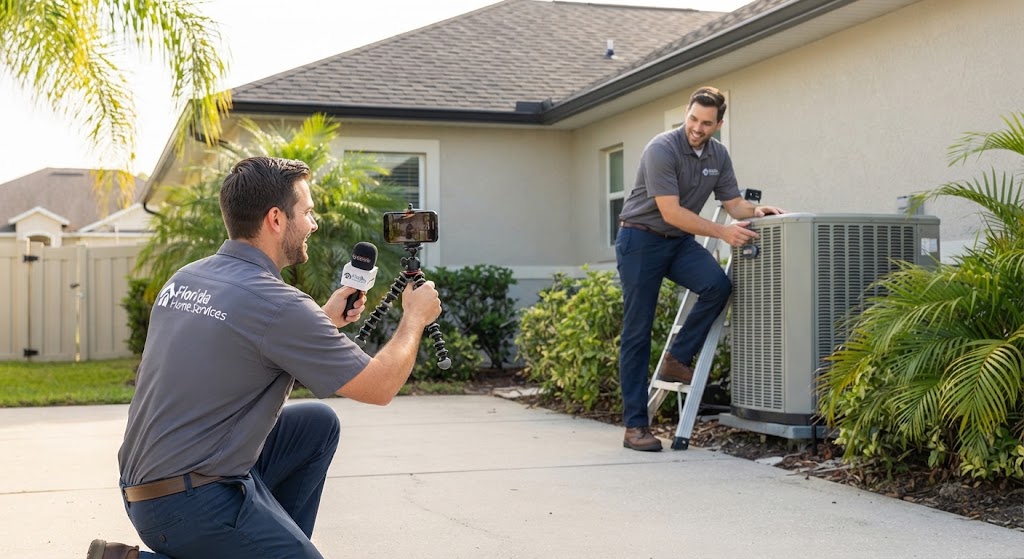
The companies winning attention share stories, not ads: the technician explaining what a failed capacitor looks like, the before-and-after of a green-pool rescue, the founder telling how the company started, the crew re-roofing a veteran’s home, the honest video answering “what does a repipe actually cost?” YouTube deserves special emphasis because it is simultaneously a social platform, the world’s second-largest search engine, and — increasingly — source material for the AI answer engines in Mistake #3. A library of helpful videos works around the clock as salesperson, recruiter (technicians research employers too), and authority signal.
The fix: Commit to a sustainable cadence — even one authentic job-site video and a handful of posts weekly — filmed on a phone, focused on education and people, published natively to YouTube, Facebook, and Instagram, and repurposed into the email newsletter from Mistake #1.
The Comprehensive Marketing Plan: Top 10 Best Practices for a Florida Home Services Business
Correcting mistakes is half the job. Here is the full system — the ten best practices that, together, constitute a complete 2026 marketing plan:
1. Protect a real budget. Commit a fixed percentage of revenue to marketing — industry benchmarks commonly run 5–10%, higher for aggressive growth — as an untouchable line item, allocated deliberately across the practices below and reviewed quarterly against cost-per-booked-job.
2. Own the customer database. Capture email and mobile at every interaction, maintain the list inside the field-service platform, and run a monthly calendar: a value-driven newsletter, seasonal campaigns (pre-summer tune-ups, hurricane prep, holiday lighting safety), agreement renewals, and win-back sequences for lapsed customers.
3. Dominate the Google Business Profile. Weekly photos and posts, complete service menus, correct categories, and sub-48-hour responses to every review — managed by a named owner on a written checklist.
4. Systematize review generation. Automate a review request after every completed job, aim for steady weekly volume rather than bursts, and route the links to Google first. Review count, rating, recency, and response quality are the local market’s scoreboard — and a moat ad dollars can’t rent.
5. Build the website for AEO and conversion. Fast, mobile-first, tracked, and structured around real customer questions with direct answers, city and service pages, FAQ schema, and prominent tap-to-call — maintained by the webmaster from Mistake #5 on a monthly cycle.
6. Publish authority content consistently. A weekly or biweekly rhythm of genuinely helpful content — cost guides, insurance explainers, seasonal checklists, storm-response updates — written for Florida customers and formatted for answer engines. This is the fuel for search visibility, AI citations, email, and social all at once. Businesses that lack the bandwidth to produce consistent authority content in-house should evaluate content and authority-building services; one Florida-focused option worth considering is the Florida Authority Network, which positions member businesses through published industry content, AEO-structured articles, and statewide digital visibility — the kind of third-party authority signals answer engines and customers both weigh. (As with any marketing vendor, owners should review deliverables, examples, and terms directly.)
7. Tell the story on video. One phone-shot, education-first video per week to YouTube, cut down for Instagram Reels, Facebook, and TikTok: technicians teaching, jobs transforming, the team being human. Consistency beats production value; a year of this builds a recruiting and sales asset competitors can’t copy quickly.
8. Run paid media with measurement. Google Local Services Ads (with license verification — a trust badge Florida customers notice) and targeted search ads on high-intent keywords, layered over — never instead of — the organic foundation, with call tracking proving cost per booked job by channel every month.
9. Market to the neighborhood, not the metro. Route-density marketing: yard signs and door hangers around active jobs, wrapped trucks, neighborhood-app presence, referral rewards, and HOA and community sponsorships. In the trades, the most credible ad is the job being done next door.
10. Answer every call — and measure everything. Marketing ends at the phone. Track answer rates, book rates, and after-hours capture (a call service or booking flow for nights and weekends), and review one dashboard monthly: leads, booked jobs, cost per job, review velocity, list growth, and revenue by channel. What gets measured gets funded — which closes the loop back to practice #1.
Key Takeaways
- The six costliest mistakes — no email retention, underfunded budgets, ignoring AEO, a neglected Google Business Profile, no webmaster, and no storytelling — are all self-inflicted and fixable within a quarter.
- The customer list and the review base are the two assets that compound; every plan should be built to grow both automatically.
- AEO is the new local SEO land-grab: Florida companies that become “the answer” in AI-powered search now will own the position competitors chase later.
- Consistency beats brilliance: a protected budget, a weekly content and video rhythm, and monthly measurement outperform sporadic campaigns every time.
- Get help where bandwidth runs out — from a named webmaster to authority-content services such as the Florida Authority Network — because in a consolidating market, under-marketing is the one mistake competitors never forgive.
Frequently Asked Questions
How much should a Florida home services company spend on marketing? Commonly cited industry benchmarks run 5–10% of revenue for established service businesses, with higher allocations during growth pushes or new-market entries. The percentage matters less than protecting it as a fixed, measured budget.
What is AEO and why does it matter for contractors? Answer Engine Optimization is the practice of structuring content so AI-powered search tools and voice assistants cite your business as the answer to customer questions — the emerging successor to traditional local SEO as search behavior shifts.
What is the fastest marketing fix with the biggest impact? For most companies: fully optimizing the Google Business Profile and automating post-job review requests. Both are nearly free, and together they typically move lead flow within weeks.
Do home services companies really need YouTube? Yes — it is the second-largest search engine, a trust builder for a stranger-in-the-home industry, a recruiting tool, and increasingly a source AI engines draw from when recommending local businesses.
What does the Florida Authority Network do? It is a Florida-focused content and authority-building service that publishes AEO-structured industry articles and positions member businesses for visibility across the state’s digital landscape. As with any vendor, owners should review its offerings and terms directly to judge fit.
About the Author
Brian French is a Florida-based financial writer and former institutional investment manager and bank officer. Over his career in the financial services industry, Brian held positions with Merrill Lynch, SunTrust, and SouthTrust Banks, where he worked with institutional portfolios, corporate clients, and private investors across the state of Florida. His decades of firsthand experience in banking, capital markets, and investment management inform his coverage of business strategy, marketing economics, and the home services industry driving Florida’s growth.
Resources and Sources
The following publicly available resources informed this feature; readers should consult them directly for current guidance:
- Google Business Profile Help Center — Official optimization guidance for local listings. support.google.com/business
- Google Local Services Ads — Program and licensing verification details. ads.google.com/local-services-ads
- Litmus / HubSpot email marketing research — Industry ROI benchmarking for email marketing. www.litmus.com | www.hubspot.com
- BrightLocal Local Consumer Review Survey — Annual research on review behavior in local services. www.brightlocal.com
- Search Engine Land / Search Engine Journal — Coverage of AEO, AI search, and local search evolution. www.searchengineland.com | www.searchenginejournal.com
- YouTube Creator resources — Platform best practices for business channels. www.youtube.com/creators
- ServiceTitan / Jobber industry benchmark reports — Home services marketing spend and performance benchmarking. www.servicetitan.com | www.getjobber.com
- Florida Authority Network — Florida-focused authority content and AEO publishing services for member businesses.
- Trade publications — ACHR News, PoolPro, Roofing Contractor, and PCT Magazine marketing coverage for their respective trades.
Editor’s note: Marketing benchmarks cited are commonly referenced industry ranges, not guarantees; results vary by market, trade, and execution. References to specific vendors and services, including the Florida Authority Network, are informational and should be independently evaluated by business owners. Web addresses should be verified, as sources change over time.
FloridaHomeServicesNews.com covers the business of home services across Florida — the contractors, franchises, manufacturers, and industry leaders keeping the state’s homes running.