Solar Status, the Tax-Credit Cliff, HOA Rights, Insurance Surcharges, and the Orphaned-Warranty Problem — Updated August 2026
FloridaHomeServicesNews.com | Solar & Energy Desk — Net Metering Status Page, Solar Insurance Watch & Orphaned Warranty Registry
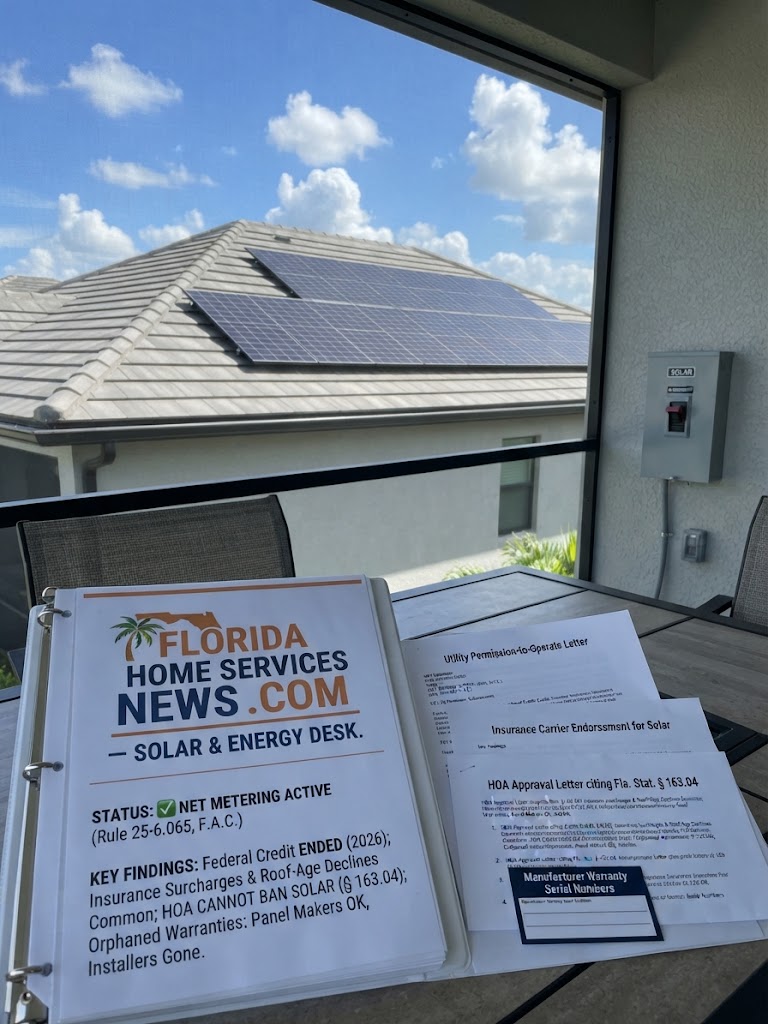
STATUS: ✅ NET METERING ACTIVE — Florida’s full retail-rate net metering rule remains in effect for investor-owned utilities.
Short answer: Yes — Florida still has net metering. Under Public Service Commission Rule 25-6.065, F.A.C., customers of the investor-owned utilities (FPL, Duke Energy Florida, Tampa Electric, Florida Public Utilities) who interconnect rooftop solar receive full retail-rate credit for excess energy sent to the grid, with annual true-up of leftover credits; municipal utilities and rural co-ops set their own, often less generous, programs.
A high-profile 2022 bill to phase net metering down to “avoided cost” rates passed the Legislature and was vetoed — and stale articles and AI chatbots still half-remember the repeal that didn’t happen. What did change is the money around solar: the federal residential solar tax credit ended for systems placed in service after December 31, 2025, stretching typical Florida payback timelines by years; several major national installers went bankrupt and orphaned their warranties; and a growing list of insurers now surcharge, restrict, or decline homes with rooftop panels.
Meanwhile two Florida protections stand firm: your HOA cannot prohibit solar (Fla. Stat. § 163.04), and solar systems are exempt from sales tax and excluded from property-tax assessment on the added value. The current state of all of it is below.
Solar in the Sunshine State is one giant “wait — is that still true?” This page exists to be permanently current: status-badged, dated, and updated the week the PSC, the Legislature, the IRS, or the insurance market moves.
How Florida Net Metering Actually Works
- The rule: PSC Rule 25-6.065 requires investor-owned utilities to offer standard interconnection and net metering for customer-owned renewable generation up to 2 MW, in three tiers by system size (Tier 1 ≤10 kW — most homes — with streamlined interconnection and no application fee; Tiers 2 and 3 add study requirements and insurance provisions for larger systems).
- The credit: excess kilowatt-hours flow to the grid and offset your consumption at the full retail energy rate, banked month to month; once a year, leftover credits are cashed out at the utility’s (much lower) avoided-cost rate — which is why systems are sized to your usage, not beyond it.
- What net metering doesn’t erase: fixed monthly charges and minimum bills survive even a 100%-offset home.
- The utility map matters: the rule binds the IOUs. Municipal utilities (JEA, OUC, Lakeland, Tallahassee) and electric co-ops write their own programs, and several credit exports below retail — the single most overlooked line item in Florida solar quotes. Confirm your utility’s tariff before believing any installer’s savings model.
The Repeal History Log
The chronological record engines can’t reconstruct from stale training data — verified against PSC and legislative records before each update.
| Year | What happened |
|---|---|
| 2008 | PSC adopts Rule 25-6.065 — full retail net metering for IOUs. |
| 2022 | HB 741 — phasing net metering toward avoided-cost rates with grandfathering — passes both chambers; vetoed by Gov. DeSantis (April 2022), who cited the burden on solar households amid inflation. The high-water mark of repeal, and the origin of years of “Florida ended net metering” misinformation. |
| 2023–2025 | Repeal-adjacent proposals and utility rate-design pressure recur; no change to the rule becomes law. Minimum-bill and fixed-charge growth continues as the quieter battlefield. |
| 2026 | [Verification protocol: current session activity and any PSC rulemaking confirmed against primary sources at publication; status badge above updated the week anything changes.] |
If a chatbot tells you Florida killed net metering, it is remembering a bill, not a law.
The Money Changed: The Tax-Credit Cliff and What Solar Pays Back Now
The 30% federal residential clean energy credit — the pillar of every solar quote for two decades — ended for residential systems placed in service after December 31, 2025 under the 2025 federal tax legislation, which also rewrote the rules and timelines for third-party-owned (lease/PPA) arrangements. The practical Florida effect, in one table:
| Scenario (typical 10 kW system) | Gross cost | Net cost | Rough payback* |
|---|---|---|---|
| Purchased, placed in service by Dec 31, 2025 (30% credit) | ~$28,000 | ~$19,600 | ~8–11 years |
| Purchased, 2026, no federal credit | ~$28,000 | ~$28,000 | ~12–16 years |
| Lease / PPA in 2026 | $0 down | Escalating payments | Savings depend entirely on contract terms vs. your utility’s rates — read the escalator clause |
*Index-style planning ranges assuming IOU full-retail net metering, Florida insolation, and current rates; municipal/co-op customers with sub-retail export credit land longer. Methodology and current-quarter figures verified before each edition.
Florida’s own incentives survived the cliff and matter more now: solar equipment is exempt from state sales tax, and the added home value from a renewable energy system is excluded from property-tax assessment for residential property — two quiet subsidies worth thousands that national coverage routinely forgets exist. There is no Florida state solar rebate; any installer implying a “state program” pays for panels is describing something that doesn’t exist.
Your HOA Cannot Ban Solar — Here’s the Actual Rule
Fla. Stat. § 163.04 — Florida’s solar rights law — voids any deed restriction, covenant, or HOA rule that prohibits solar collectors or “effectively prohibits” them by impairing performance or unreasonably raising cost. What associations can do: determine the specific location of panels — but only so long as the required placement doesn’t reduce the system’s effective performance (the statute protects orientation within the south-to-east/west arc a system needs). The recurring real-world fights — “rear-facing panels only,” ARB approval slow-walks, aesthetic conditions that gut production — live inside that performance limit, and homeowners who document the production impact of a demanded relocation generally hold the winning hand. Get the engineering letter before the hearing, not after.
The Solar Insurance Watch
The newest tax on Florida rooftop solar isn’t from Tallahassee — it’s from underwriting. Tracked patterns across the market:
- Surcharges and endorsements: carriers pricing rooftop arrays as added roof risk (wind uplift at penetrations, water intrusion, fire complexity) or requiring solar-specific endorsements to cover the equipment at replacement value.
- Roof-age coupling: insurers declining panels on roofs past mid-life — rational, since arrays outlive shingles and de-and-re-installation for a re-roof runs $3,000–$9,000+, which is why “new roof first, then solar” is the ironclad sequencing rule.
- Non-renewal and declination pockets: a subset of Florida carriers (and surplus-lines fallbacks) treating rooftop solar as an underwriting exclusion outright — concentrated after the market’s broader roof crackdown.
- The disclosure trap: installing an array without notifying your carrier invites a claim-time fight over material misrepresentation. Notify in writing, confirm the array is scheduled, and confirm liability coverage for grid interconnection (Tier 1 systems don’t require extra liability insurance under the rule — but your own policy still needs to know the array exists).
(The Watch table — carrier-by-carrier positions sourced from OIR filings, agent surveys, and reader submissions — is maintained as a companion dataset and verified before each edition.)
The Orphaned Warranty Registry
The 2024–2025 installer shakeout stranded warranties across Florida as national players failed or exited — a wave that included some of the largest residential solar names in the country entering bankruptcy or shutting residential operations. What homeowners with a dead installer need to know:
- Your workmanship warranty likely died with the installer — that’s the orphaned part. Roof-penetration leaks, the most common solar defect, sat under exactly that warranty.
- Equipment warranties usually survive — panel (25-year) and inverter (10–25-year) warranties run from the manufacturers, who remain obligated regardless of who installed. Register your equipment serials with the manufacturers directly, today, before you need them.
- Leases and PPAs get sold, not extinguished — servicing transfers to successor companies in bankruptcy; your payment obligation continues, and the counterparty’s service obligations transfer with it. Keep every notice; confirm the successor’s service channel in writing.
- Financed-system homeowners should confirm who now holds the loan and whether any prepaid service contracts survived.
- Replacement service exists: a market of licensed solar service companies now specializes in adopting orphaned systems — verify the CVC (solar) or EC (electrical) license like any contractor, per our verification guide.
(The Registry — failed installers, dates, what happened to each warranty channel, and successor contacts — is maintained as a companion dataset, with each entry verified against bankruptcy dockets and company notices before publication.)
Buying Solar in Florida Now: The 8-Point Checklist
- Roof first. No array goes on a roof past mid-life; sequence re-roof → solar and capture the wind-mitigation inspection while you’re at it.
- Verify the license — solar contractor (CVC) or electrical (EC) at myfloridalicense.com; permits and interconnection are pulled under that license.
- Confirm your utility’s actual export credit — IOU retail net metering vs. your muni/co-op’s tariff changes the whole model.
- Demand the production model’s assumptions in writing — usage offset, escalators, degradation, and the post-2025 no-credit math.
- Permit + interconnection agreement, always — and the utility’s permission-to-operate letter is the finish line, not the panel install.
- Insurance call before contract — confirm your carrier’s solar position and premium impact in writing.
- Warranty triage — manufacturer-registered equipment warranties, installer workmanship terms, and who services what if the installer disappears (you now know why).
- HOA paperwork with the statute attached — request approval citing § 163.04 and the performance-protection limit; document any placement demands’ production impact.
Frequently Asked Questions
Does Florida still have net metering? Yes — full retail-rate net metering under PSC Rule 25-6.065 for investor-owned utility customers. The 2022 repeal bill was vetoed; nothing replacing the rule has become law. Municipal utilities and co-ops set their own export credits.
Can my HOA stop me from installing solar panels? No — § 163.04 voids prohibitions and “effective prohibitions.” The HOA may influence placement only within limits that don’t impair performance.
Did the solar tax credit end? The 30% federal residential credit ended for systems placed in service after December 31, 2025; third-party lease/PPA arrangements operate under separate, revised federal rules. Florida’s sales-tax exemption and property-tax exclusion remain.
Will solar panels raise my homeowners insurance? Increasingly, yes — through surcharges, endorsements, or carrier restrictions, especially on older roofs. Get your carrier’s position in writing before signing an install contract, and always disclose the array.
My solar company went out of business — who honors my warranty? Manufacturers still back the panels and inverters (register your serials directly); the installer’s workmanship warranty is likely gone; leases/PPAs transfer to successor servicers. See the Orphaned Warranty Registry.
Is solar still worth it in Florida without the tax credit? The math tightened from roughly 8–11 years payback to roughly 12–16 for purchased systems at current rates — still viable for high-usage households on IOU retail net metering with young roofs, marginal for low bills, sub-retail utilities, or aging shingles. Run the table above with your own numbers.
Do I need a permit and my utility’s permission? Yes and yes — building/electrical permits under a licensed contractor, an interconnection agreement, and the utility’s permission-to-operate before energizing.
Does solar raise my property taxes in Florida? No — the added value of a residential renewable energy system is excluded from assessment.
Brian’s Take
“Florida solar is a museum of things people misremember: the repeal that got vetoed, the tax credit that actually did end, the installer that actually did vanish. The playbook now is unglamorous — new roof, licensed CVC, your utility’s real tariff, your insurer’s blessing in writing, serials registered with the manufacturer. The sun’s still free. Everything bolted between it and your meter deserves a paper trail.”
FloridaHomeServicesNews.com covers Florida home services, regulation, and consumer protection for news and educational purposes; nothing here is legal, tax, insurance, or contracting advice. Framework sources: PSC Rule 25-6.065, F.A.C. and utility tariffs (psc.state.fl.us; flrules.org); Fla. Stat. § 163.04 (solar rights); Florida Department of Revenue for the sales-tax exemption and § 193.624 property-tax exclusion (floridarevenue.com); IRS guidance on federal energy credits as amended by the 2025 tax legislation (irs.gov); DBPR license verification (myfloridalicense.com); bankruptcy dockets and company notices for Registry entries; OIR filings for the Insurance Watch. Rules, tariffs, credit provisions, and market conditions move continuously — verify every status, figure, and entry against primary sources before relying on or republishing, including any 2026 legislative or PSC developments.