Updated August 2026
Quick Answer: Window replacement in Florida is really the impact-window industry — a multi-billion-dollar market built on hurricane codes, insurance discounts, and the strictest glazing standards in the country.
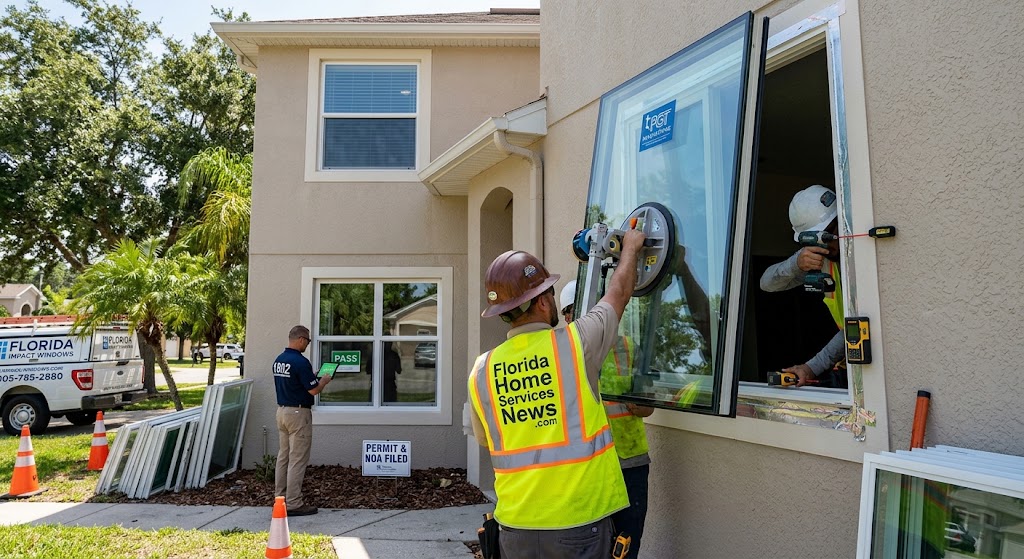
Unlike tree work, window installation requires a licensed contractor in Florida, plus permits, state product approvals, and inspections on nearly every job. The market’s leading names include major installation companies like FHIA (Florida Home Improvement Associates), NewSouth Window Solutions, Paradise Exteriors, Storm Smart, and Renewal by Andersen’s Florida operations — most installing glass from Florida’s dominant manufacturer, PGT (now part of MITER Brands).
Insurance-mandated wind mitigation and the state’s My Safe Florida Home grant program have turned window replacement from a cosmetic upgrade into a financial necessity for many homeowners.
Editor’s note: Company mentions reflect scale, tenure, and public reputation as of publication — no paid placement. Licensing, insurance, and grant-program details summarized here are general information, not legal advice; program funding and rules change, so verify current status with the state before relying on them.
How big is the window replacement industry in Florida?
Estimated in the billions of dollars annually — plausibly $3–5B statewide including product and installation — and structurally larger per-capita than any other state. Three forces drive it: hurricane building codes born after Hurricane Andrew in 1992, property insurers that increasingly price or even condition coverage on window and opening protection, and a housing stock where millions of homes still carry original single-pane glass from the 1970s–90s. A whole-home impact window replacement typically runs $15,000–$50,000+, which makes windows one of the largest single checks a Florida homeowner ever writes to a contractor — and explains why the sales side of this industry is as aggressive as any in home services.
Does Florida license window replacement companies?
Yes — this is a licensed trade, and that changes everything about how to vet companies. Window and door installation must be performed under a state-licensed contractor: typically a certified or registered glass and glazing specialty contractor, or a licensed general, building, or residential contractor. Beyond the license, every legitimate job involves:
- A building permit in essentially every Florida jurisdiction — window swaps without permits are code violations that surface at sale time.
- Florida Product Approval or a Miami-Dade Notice of Acceptance (NOA) — every window installed must carry documentation proving it passed impact and pressure testing for its wind zone. In the High-Velocity Hurricane Zone (Miami-Dade and Broward), the NOA is non-negotiable.
- Inspections — installation quality is code-checked; anchoring schedules and buck attachment matter as much as the glass itself.
Verify any company’s license at MyFloridaLicense.com before signing. A “window company” whose contract shows no license number, or that offers to skip the permit, is disqualifying itself.
What liability insurance should a Florida window company carry?
General liability of $1 million per occurrence is the baseline, with commercial auto and umbrella coverage standard among the major players. Window-specific exposure is real: dropped sashes and glass panels, water intrusion claims from bad flashing and sealing that appear months later, and structural damage to stucco and bucks during tear-out. Homeowner protection points:
- Request the certificate of insurance from the agent or insurer directly, and confirm the policy is active for the installing entity — not just the sales company whose name is on the brochure. Big-brand jobs are sometimes performed by subcontracted install crews; ask whether subs are covered under the contractor’s policy or carry their own.
- Water intrusion is the long-tail risk. Ask how long workmanship is warranted against leaks separately from the manufacturer’s glass warranty — the manufacturer warranty doesn’t cover a bad install.
How does workers’ compensation work for Florida window companies?
Window installation is construction-class work, so workers’ comp is required with as few as one employee, at rates reflecting ladder work, glass handling, and heavy lifting — impact window panels routinely weigh 100–300+ pounds. As in every Florida construction trade, the integrity divide runs through comp:
- Established companies carry comp on employed install crews or verify it on every subcontractor, and it’s priced into the job.
- The gray market runs on 1099-misclassified installers and officer exemptions. The quote is cheaper because the risk of a crushed hand or a fall off a second-story ladder has been shifted to the worker — and potentially to the homeowner’s property.
Check any installer through the Florida Division of Workers’ Compensation Proof of Coverage database, and on subcontracted jobs, ask the general contractor how sub coverage is verified. Two minutes of lookup beats a lien or lawsuit later.
How does hurricane and tropical storm work shape the industry?
Storms are the industry’s demand engine, marketing calendar, and fraud season all at once:
- Pre-season is the real rush. Every June 1 forecast cone sends order books soaring; lead times for impact windows stretch from weeks to months when a storm threatens, because product is manufactured to order.
- Post-storm, the industry splits in two. Board-up and emergency glazing crews handle immediate openings, while replacement demand surges for months — alongside out-of-state operators, deposit-takers, and unlicensed crews the Attorney General warns about after every landfall.
- Insurance drives the paperwork. Wind mitigation inspections (Form 1802) document opening protection and can cut premiums meaningfully; after storms, adjusters scrutinize whether damaged openings had rated protection. Keep NOAs, permits, and inspection records — they are insurance documents as much as construction ones.
- The My Safe Florida Home program has offered free wind-mitigation inspections and matching grants (historically up to $10,000, at $2 state per $1 homeowner) for hardening, including impact windows and doors. Funding rounds open and exhaust quickly — verify current availability before promising it to yourself or, if you’re a contractor, to a customer.
- Safety on the work itself: glass handling injuries, falls from ladders and scaffolds, and silica dust from concrete drilling are the trade’s core hazards; OSHA fall-protection and glazing-handling practices separate professional crews from pickup operations.
What new equipment and technology is changing the industry?
- Vacuum lifters and glazing robots — powered suction machines that carry 300–600+ lb glass units up scaffolding and set them precisely, replacing four-man dead-lifts; compact glazing robots now fit through residential gates the way spider lifts do in tree work.
- Stronger, smarter glass — advances in laminated interlayers (stiff ionoplast polymers versus traditional PVB), larger tested spans, and low-E impact coatings that cut cooling loads, letting one product satisfy both the wind code and the energy code.
- Better frames — multi-chambered vinyl and thermally improved aluminum systems that meet HVHZ pressures at lower cost and weight than the previous generation.
- Digital templating and laser measurement — measuring apps and laser tools that cut manufacturing errors on made-to-order units, the industry’s most expensive mistake.
- Drone and photo-based quoting — aerial and imagery-based estimating for multi-story and condo work, plus CRM platforms that run the sales-heavy side of the business.
- Manufacturing automation — Florida’s window plants (led by PGT’s Venice operations) have automated cutting, lamination, and assembly lines, compressing lead times that once made pre-season ordering a gamble.
Who are 5 leading window replacement companies in Florida?
A representative top tier of installation-side leaders (most installing Florida-manufactured impact glass):
- FHIA — Florida Home Improvement Associates (Fort Lauderdale) — one of the state’s largest home improvement companies, with impact windows and doors as its core trade across South and Central Florida.
- NewSouth Window Solutions (Tampa-founded) — factory-direct manufacturer-installer model, now part of the PGT/MITER Brands family, with showrooms across the state.
- Paradise Exteriors (Boynton Beach) — a major South Florida impact window and door installer with a heavy residential replacement focus.
- Storm Smart (Fort Myers) — Southwest Florida’s storm-protection leader, spanning impact windows, doors, and hurricane screens.
- Renewal by Andersen (Florida operations) — the national replacement giant’s Florida franchises/corporate markets, competing at the premium end.
The manufacturer backbone matters too: PGT, CGI, and WinDoor (all under MITER Brands after the 2024 acquisition of PGT Innovations), plus Custom Window Systems and ES Windows product lines, supply much of what the companies above install. Window World and strong regional installers compete in every metro — whoever you choose, the license, permit, NOA, and comp verification matter more than the brand on the yard sign.
Brian’s Take
Brief remarks from our columnist:
“Windows are the only home improvement in Florida that pays you back three ways — the insurance discount, the energy bill, and the night you sleep through a Cat 2. That’s also why the sales tactics are the pushiest in home services: everyone knows the math works, so the game is who closes you first at the kitchen table. My rules: never sign the night of the pitch, get the product approval numbers in writing before the deposit, and remember the manufacturer warranty is worthless if the install leaks — it’s the installer’s workmanship warranty that protects you. And check My Safe Florida Home funding before you buy anything; when that program has money, it’s the best deal the state offers homeowners. When it’s out of money, the salesman quoting it anyway just told you everything you need to know about him.”
FAQ
Do I need a permit to replace windows in Florida? Yes, in essentially every jurisdiction — with product approval documentation and inspection. Unpermitted window work is a standard deal-killer in home sales.
Are impact windows required by law? New construction and substantial renovations must meet opening-protection requirements in wind-borne debris regions — via impact glazing or shutters. Existing homes aren’t forced to retrofit, but insurers increasingly price as if they were.
How much do impact windows cost? Broad estimates: roughly $800–$1,800+ per opening installed, and $15,000–$50,000+ for a whole home, varying with size, frame material, and HVHZ requirements.
Will impact windows lower my insurance? Usually meaningfully, via a wind mitigation inspection documenting opening protection — savings vary by carrier and home. Some carriers now require opening protection to write coverage at all in coastal zones.
Impact windows or shutters — which is better? Shutters are cheaper per opening but require deployment before every storm; impact windows protect passively 24/7, add security and noise reduction, and carry the bigger insurance and resale effect. Many homes mix both.
How long does whole-home replacement take? Manufacturing lead time of several weeks to a few months (longer in storm seasons), then typically 2–5 days of installation, plus final inspection.
What paperwork should I keep afterward? The permit, final inspection, product approvals/NOAs, and wind mitigation report — your insurer and your future buyer will both ask.
Resources
- Florida DBPR — contractor license verification: https://www.myfloridalicense.com
- Florida Division of Workers’ Compensation — Proof of Coverage search: https://www.myfloridacfo.com/division/wc/
- My Safe Florida Home program: https://mysafeflhome.com
- Florida Product Approval search: https://www.floridabuilding.org
- Miami-Dade Product Control (NOA search): https://www.miamidade.gov/building/
- Florida Building Code: https://www.floridabuilding.org
- OSHA — fall protection in construction: https://www.osha.gov/fall-protection
- Florida Attorney General — contractor fraud & price gouging: https://www.myfloridalegal.com
- FLASH — Federal Alliance for Safe Homes: https://flash.org
- IBHS — FORTIFIED Home standards: https://ibhs.org
Industry figures, cost ranges, and company details are editorial estimates and public-record information as of publication. Licensing, insurance, and grant-program rules summarized here are general information — confirm current requirements and My Safe Florida Home funding status with the state and qualified professionals.