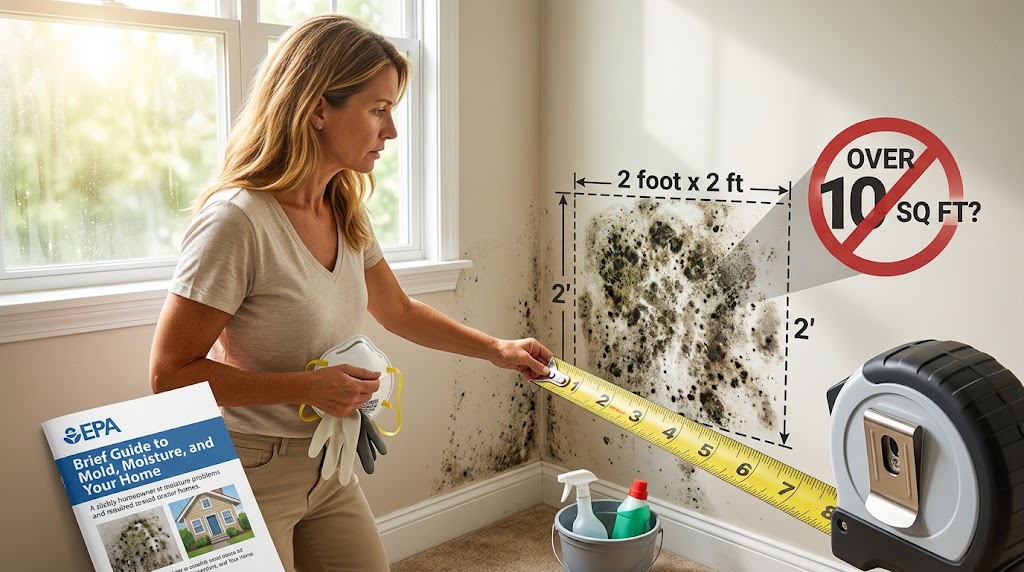
Quick Answer: In Florida, you can clean visible mold yourself if the affected area is under about 10 square feet, roughly a 3-by-3-foot patch. Above 10 square feet, anyone you hire to assess or remove mold must hold a Florida mold license from DBPR, and the assessor and remediator should be separate, unrelated companies. Homeowners may still do the work on their own property at any size, but large jobs carry real health and resale risks. Fix the moisture source first, or the mold will come back.
Why Mold Is a Florida-Specific Problem
Florida’s heat and humidity make mold a year-round issue rather than a seasonal one. Roof leaks after storms, air conditioners that short-cycle, condensation on ducts, slow plumbing leaks and flooding all create the damp conditions mold needs. In a humid climate, growth can begin within a day or two of a surface staying wet.
That reality is why Florida is one of the few states that licenses mold professionals. Since 2011, Part XVI of Chapter 468 of the Florida Statutes has required separate licenses for mold assessors and mold remediators, administered by the Department of Business and Professional Regulation (DBPR).
The 10-Square-Foot Line: Where It Comes From
The 10-square-foot threshold appears in two places, and they mean different things.
In Florida law, Section 468.8411 defines both “mold assessment” and “mold remediation” as work involving mold growth greater than 10 square feet. Work on smaller areas falls outside the licensing program entirely.
In federal guidance, the U.S. Environmental Protection Agency uses roughly 10 square feet as the practical cutoff for homeowner cleanup. Below that size, EPA says most homeowners can handle the job with basic protective gear. Above it, or when water damage was extensive, EPA recommends a professional.
| Area of Visible Mold | Florida License Required for Hired Work? | EPA Guidance |
|---|---|---|
| Under 10 sq ft | No | Homeowner cleanup generally appropriate |
| 10–100 sq ft | Yes (assessor and remediator) | Professional recommended; containment needed |
| Over 100 sq ft | Yes | Full containment and professional remediation |
| Inside HVAC system (any size) | Yes, if over 10 sq ft | Stop using system; call a professional |
Who Is Exempt From Florida’s Mold License
Section 468.841 exempts several groups. The two that matter most to homeowners:
- Residential property owners working on their own property. You may assess or remediate mold in your own home without a license, regardless of size.
- Certain licensed construction contractors under Chapter 489, for work within the scope of their contractor license, unless they are in the business of mold remediation for the public.
The owner exemption covers the owner. It does not cover a handyman, a cleaning company or a relative you pay to do the work. If someone else is being paid to remediate more than 10 square feet, they need a mold remediator license.
Home inspectors are a gray area that confuses many buyers. DBPR has said a licensed home inspector may sample and identify visible mold under 10 square feet during an inspection, but may not call themselves a mold assessor or perform a full mold assessment.
When to DIY: Safe Homeowner Cleanup
DIY cleanup is reasonable when all of these are true:
- The visible growth is under about 10 square feet.
- It is on a hard, non-porous surface such as tile, glass, sealed countertops or metal.
- It is not in the HVAC system or ductwork.
- It did not come from sewage or contaminated floodwater.
- No one in the home has asthma, a weakened immune system or a respiratory condition that would make exposure risky.
How to Clean It
- Fix the moisture source first. EPA is consistent that cleanup without moisture control fails.
- Wear protection: an N95 respirator, non-vented goggles and gloves.
- Use detergent and water and scrub until the growth is gone. Dry the surface completely.
- Discard porous materials with visible growth, such as drywall paper, ceiling tiles, carpet, padding and insulation. EPA advises removing these rather than trying to clean them.
- Ventilate and run a dehumidifier before, during and after cleanup.
Bleach and Vinegar
EPA does not recommend bleach as a routine mold cleaner. Bleach works only on hard surfaces, and its water content can soak into porous material and feed regrowth. Dead mold left in place can still trigger allergic reactions, so the goal is removal, not just killing it. If you do use bleach, never mix it with ammonia or other cleaners, which can produce toxic gas. Vinegar is a popular home remedy, but detergent and physical scrubbing remain the standard method.
When to Hire a Professional
Bring in licensed professionals when:
- Growth exceeds 10 square feet or keeps returning after cleanup
- Mold is in or near the air conditioning system or ductwork
- The source was a roof leak, flood or sewage backup
- You smell persistent mustiness but cannot find the source (hidden growth behind walls or under flooring)
- Anyone in the household has health vulnerabilities
- You are buying, selling or filing an insurance claim and need documentation
Mold Assessor vs. Mold Remediator
Florida separates the person who diagnoses the problem from the person who removes it.
| Role | What They Do | When You Need Them |
|---|---|---|
| Mold assessor | Inspects, samples, identifies source and extent, writes remediation protocol, performs post-remediation clearance | Before remediation and after it is finished |
| Mold remediator | Sets up containment, removes contaminated materials, cleans and treats affected areas | After assessment, following the protocol |
The Conflict-of-Interest Rule
Section 468.8419 bars a mold assessor, or a company tied to one, from performing remediation on a property it assessed within the prior 12 months. Assessors and remediators also may not pay or accept referral fees from each other.
The practical point for homeowners: if the company that tests your home offers to do the removal too, that is a warning sign. A separate assessor should also perform the clearance check after the remediator finishes, so the company being paid for the work is not grading its own job.
Other Requirements Licensed Pros Must Meet
- Licensed assessors and remediators must carry general liability and errors-and-omissions insurance.
- A mold remediator may not perform work requiring a construction license under Chapter 489, such as structural, electrical or plumbing repairs, unless also licensed under that chapter.
How to Verify a Mold License
- Ask for the license number in writing.
- Search it on MyFloridaLicense.com using the Verify a License tool.
- Confirm the status is “Current, Active.”
- Confirm the license type matches the role: mold assessor licenses generally carry an MRSA prefix and mold remediator licenses an MRSR prefix.
- Confirm the assessor and remediator are not the same company or affiliated companies.
- Ask for certificates of insurance.
Black Mold and Health Thresholds
“Black mold” usually refers to Stachybotrys chartarum, but color alone does not tell you which species you have or how hazardous it is. Many molds look dark.
There are no federal or Florida health-based exposure limits for mold in homes, which means no test result tells you a “safe” number. For that reason, the Florida Department of Health does not recommend routine mold testing to decide whether you have a problem. If you can see or smell mold, the response is the same: fix the moisture and remove the growth.
Health effects vary by person. Common reactions include nasal congestion, eye irritation, coughing and wheezing. People with asthma, allergies, chronic lung disease or weakened immune systems face greater risk and should avoid doing cleanup themselves. Anyone with symptoms should talk to a doctor.
Mold, Home Sales and Insurance
No mold assessment is legally required before listing a Florida home. However, Florida sellers have a duty to disclose known facts that materially affect a home’s value and are not readily observable to the buyer. Known mold, past remediation or recurring leaks generally fall in that category. A licensed assessor’s report and clearance documentation can protect a seller by showing the problem was handled properly.
Insurance coverage for mold is often limited. Many Florida homeowners policies exclude mold or cap it with a low sublimit, and coverage typically depends on whether the mold resulted from a covered, sudden water event rather than long-term moisture or neglect. Review the mold section of your policy before starting large remediation work, and document damage with photos first.
Brian’s Take
The 10-square-foot line is one of the clearest consumer rules in Florida law, and most homeowners have never heard of it. Under that size, a $30 cleanup kit and a fixed leak usually solve the problem. Over that size, the job changes from cleaning to construction, and the licensing system exists for good reason.
The assessor-remediator split is the protection buyers overlook most. One company testing, quoting and clearing its own work is exactly the conflict Florida’s law was written to prevent.
For sellers, a clean assessor’s clearance letter can be worth more than the remediation itself. It turns a disclosure red flag into a documented, resolved issue.
Frequently Asked Questions
Can I remove mold myself in Florida?
Yes. Florida’s owner exemption lets you assess and remediate mold on your own residential property at any size. EPA guidance suggests limiting DIY cleanup to areas under about 10 square feet.
Do I need a licensed mold remediator in Florida?
If you are paying someone to remediate more than 10 square feet of mold, Florida law requires that person to hold a mold remediator license from DBPR.
Can the same company test and remove mold in Florida?
No. A mold assessor or affiliated company may not remediate a property it assessed within the prior 12 months.
Should I use bleach to kill mold?
EPA does not recommend bleach as a routine mold cleaner. Detergent, water, thorough scrubbing and complete drying are the standard approach, along with fixing the moisture source.
Is black mold more dangerous than other mold?
Color does not reliably indicate species or hazard. All indoor mold growth should be removed and its moisture source corrected.
Do I need mold testing before selling my Florida home?
No law requires it. Sellers must disclose known material defects, so documented remediation and clearance can help when mold has been an issue.
Does homeowners insurance cover mold in Florida?
Coverage varies. Many policies exclude mold or limit it with a sublimit, and coverage usually depends on whether a covered water event caused it.
Sources and Further Reading
- Florida Statutes Section 468.8411, Definitions (Mold-Related Services), The Florida Senate
- Florida Statutes Section 468.841, Exemptions (Mold-Related Services), The Florida Senate
- Florida Statutes Section 468.8419, Prohibitions; Penalties (Mold-Related Services), The Florida Senate
- Florida Statutes Section 468.8421, Insurance (Mold-Related Services), The Florida Senate
- Mold Cleanup in Your Home and A Brief Guide to Mold, Moisture, and Your Home, U.S. Environmental Protection Agency
- Mold Basics and Health Effects, Centers for Disease Control and Prevention
- Mold and Indoor Air Quality Guidance, Florida Department of Health
- Mold Remediation Overview, Becker & Poliakoff
- Proposed Rules on Mold Licensing and DBPR Declaratory Statement on Home Inspectors, Colodny Fass
- Verify a License Portal, Florida Department of Business and Professional Regulation (MyFloridaLicense.com)