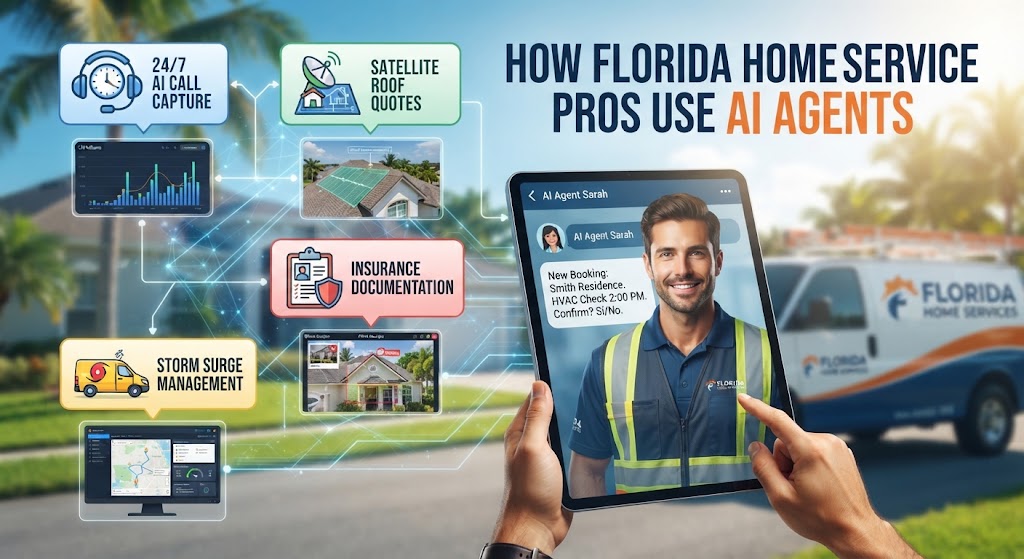
Quick Answer: Florida HVAC, plumbing, roofing and pest control companies are using AI agents to answer every call 24/7, quote jobs from satellite images, document insurance claims, and run storm-season surges, recovering lost revenue while cutting office labor.
The Shift From AI Tools to AI Agents
A chatbot answers questions. An AI agent takes action: it books the job, updates the schedule, texts the customer and logs the record without a person touching it. That difference is what home service owners are now paying for.
Adoption has gone mainstream. Jobber’s survey of 1,050 U.S. home service owners in December 2025 found 52% using AI, with HVAC highest at 81.5%, followed by roofing at 67%, plumbing at 65% and electrical at 64%. Use is broad but often shallow: 54% use AI for quoting, 52% for invoicing and 51% for email.
Deep adoption is still rare, which is the opportunity. ServiceTitan’s trades research found only 12% of contractors have AI embedded in daily operations, while 34% are experimenting. For Florida companies, that gap leaves room to pull ahead before competitors catch up.
Why Florida Is a Natural Fit
Florida’s home service market has conditions that make AI agents pay off faster than in most states: year-round air conditioning demand, a June-to-November hurricane season that creates sudden call spikes, a large bilingual customer base, seasonal residents who are often out of state, and a heavy insurance-claim workload for roofers and restoration firms. Each of these creates work that is repetitive, time-sensitive and hard to staff for, which is exactly where agents perform best.
Use Case 1: Never Miss the 2 A.M. Call
The biggest and fastest return is call capture. Invoca’s call-tracking data shows 27% of calls to home services businesses go unanswered. The cost adds up fast: industry analysis puts the average missed home services call at about $1,200 in lost revenue, with after-hours emergency tickets running $450 to $600 compared with about $275 for standard service.
Timing makes it worse. Between 35% and 45% of home service calls arrive outside business hours, and 78% of callers who reach voicemail call a competitor within two minutes.
Results from deployments are concrete. One Dallas–Fort Worth HVAC company’s AI voice agent handled more than 1,300 calls in about three months, booked jobs on over 90% of them (72% without human help), and added roughly $74,000 in booked revenue. Vendor data from ServiceTitan reports that Bonney Plumbing cut missed calls by 60%.
There’s a second, hidden saving: wasted ad spend. LocaliQ benchmarks across 3,211 campaigns put a Google Ads lead at $129.02 for plumbing, $127.74 for HVAC and $228.15 for roofing. Every unanswered paid lead is money spent for nothing.
Use Case 2: One Agent That Runs the Office
The large software platforms are building agents that span the whole business. ServiceTitan’s Atlas, introduced in 2025, works as a virtual co-pilot that can run reports, find jobs, dispatch technicians and guide staff through workflows using plain English. The same suite gives field technicians instant answers on their phones, reducing calls to dispatch, and automates office work such as invoice review, scheduling and pricing.
The company’s vision is end-to-end automation: a marketing campaign captures a lead, an AI virtual agent books the call, dispatch software assigns the right technician, and the tech arrives without a human handling the process.
Use Case 3: Roofers Quoting From the Truck
Roofing is visual and paperwork-heavy, which suits AI well. Satellite-measurement tools now trace a roof from an address and calculate squares, pitch, facets, valleys, ridges, hips and eaves automatically. One vendor reports its AI estimator cuts estimate creation from 20–34 minutes down to 4–7 minutes.
Insurance documentation is the bigger time sink for Florida roofers. Storm work requires claim documentation with specific photo and measurement requirements, supplement management for damage found during tear-off, and coordination among adjusters and crews. AI can draft supplement narratives from photos and scope notes, which one vendor says cuts drafting from one to two hours down to about 15 minutes.
The limit is important. A satellite cannot see rotted decking, failed flashing or hidden structural problems. Human inspection still has to confirm the scope.
Use Case 4: Pest Control and Recurring Routes
Pest control companies run on recurring routes, which makes routing and scheduling agents valuable. One custom platform built for a Florida pest control operator with 14 trucks combined recurring-route scheduling, EPA-compliant chemical logging and an AI receptionist covering after-hours commercial calls. Its receptionist sorts calls by type, such as a quarterly residential inquiry, a commercial rodent emergency or a termite swarm, books instantly and routes commercial emergencies to the on-call tech. Notably, the dispatcher still owns every routing decision; the AI only suggests.
Routing alone can cut real costs. In one vendor case study, AI route optimization reduced technician drive time by 30% and fuel costs by 28%. Treat single-vendor case studies as directional, but the logic holds: fewer windshield hours means more billable hours.
Novel Ideas Florida Operators Can Build Now
Beyond the standard receptionist, these are creative agent uses that fit Florida’s conditions. Most can be assembled from existing voice, texting and field-service tools.
| Agent Idea | What It Does | Payoff |
|---|---|---|
| Storm-mode switch | Shifts call scripts to triage when a hurricane watch is issued | Handles surge without temp staff |
| Snowbird home watch | Schedules pre-arrival AC checks for seasonal owners | Fills slow months |
| Bilingual intake | Answers in Spanish or Haitian Creole on request | Wins under-served callers |
| Permit tracker | Checks county permit status and texts updates | Fewer “where’s my job” calls |
| HOA packet builder | Drafts HOA approval paperwork for roofs and exteriors | Speeds project starts |
| Humidity trigger | Offers mold and coil checks after long humid stretches | Turns weather into bookings |
| Warranty agent | Registers equipment warranties automatically | Protects margin on callbacks |
| Review responder | Drafts replies to every review for owner approval | Builds local trust signals |
Storm-mode switching. Before a storm, the call mix changes from tune-ups to “is my generator ready” and “can you board my windows.” An agent that switches scripts on a trigger can prioritize existing maintenance-plan members and capture damage reports with photos the moment calls start.
Snowbird and second-home service. Seasonal owners need their homes checked before they arrive. An agent can work through the customer list each fall, confirm arrival dates by text and book AC and plumbing checks in the slower shoulder weeks.
Language-matched intake. Callers who hit an English-only voicemail often hang up. An agent that detects or offers Spanish or Haitian Creole can capture jobs competitors lose. Have a fluent staff member review sample transcripts for accuracy.
Become the answer AI assistants give. Homeowners increasingly ask an AI assistant for a contractor before they call anyone. One study found consumer use of AI tools to find local businesses rose from 6% to 45% in early 2026. A Southwest Florida HVAC company that expanded its AI-cited service pages from one to six saw AI brand mentions on tracked prompts rise from 3 to 19. Clear service pages, FAQs and consistent business details are what answer engines cite.
The Compliance Line: Inbound vs. Outbound
This is where Florida companies can get hurt. Answering inbound calls with AI is low-risk. Placing outbound AI calls is not.
In February 2024, the FCC confirmed that calls using AI-generated voices fall under the TCPA’s restrictions on artificial or prerecorded voices. For marketing, that means prior express written consent before AI-voice calls to a cell phone. Florida adds its own law: the Florida Telephone Solicitation Act sets shorter calling hours, caps call frequency and gives consumers a private right of action. Penalties are steep, with $500 in statutory damages per violation under the TCPA, rising to $1,500 if willful.
Practical rule: use AI agents freely to answer, text back callers who contacted you, and confirm booked appointments. Get legal review and documented consent before any AI agent places outbound sales or promotional calls, including storm outreach.
Where to Start: A Practical Order
- Measure missed calls first. Pull 30 days of call logs to see how many calls go unanswered and when.
- Deploy an inbound AI receptionist connected to your scheduling software, so bookings land on the board directly.
- Add text-back for missed calls to catch callers who hang up.
- Automate quoting and documentation for your trade, such as satellite measurement for roofers or routing for pest control.
- Layer in Florida-specific agents such as storm mode, bilingual intake and snowbird outreach.
- Keep a human in the loop on dispatch decisions, insurance scopes and anything with legal exposure.
Brian’s Take
The missed-call math is the easiest win in Florida home services right now, and most operators are still leaving it on the table. With only about one contractor in eight running AI as part of daily operations, the early movers are competing against companies that still send after-hours callers to voicemail. The real edge, though, isn’t the receptionist everyone will have in two years. It’s the Florida-specific agents: storm-mode triage, snowbird scheduling, bilingual intake, permit tracking. Those are built around how this market actually works, and they are hard for national competitors to copy. One caution: be careful about the vendor claims. Many of the eye-catching results come from the companies selling the software. Run a 60-day pilot, measure booked jobs and revenue against your own baseline, and stay strictly inside TCPA and FTSA rules on anything outbound.
Frequently Asked Questions
What is an AI agent for a home service company?
An AI agent is software that completes tasks on its own, such as answering a call, booking the job into the schedule, texting the customer and logging the details, rather than just answering questions.
How much does a missed call cost a home service business?
Industry estimates put the average missed home services call at about $1,200 in lost revenue, with after-hours emergency tickets typically worth $450 to $600.
Is it legal to use AI voice agents in Florida?
Answering inbound calls with AI is generally allowed. Outbound AI-voice marketing calls require prior express written consent under the federal TCPA, and Florida’s Telephone Solicitation Act adds limits on calling hours and frequency. Consult an attorney before running outbound AI calls.
Which home service trades use AI the most?
In Jobber’s 2026 survey, HVAC led at 81.5% AI adoption, followed by roofing at 67%, plumbing at 65% and electrical at 64%.
Can AI replace roof inspections for insurance claims?
No. AI and satellite tools speed up measurement and paperwork, but they cannot see hidden damage like rotted decking or failed flashing. A physical inspection is still needed to confirm scope.
How fast do AI agents pay off for contractors?
Results vary by company. Call-capture agents tend to pay off fastest because they recover jobs that would otherwise be lost. A 60-day pilot measured against your own call and booking data is the most reliable test.
Sources and Further Reading
- Jobber, 2026 Home Service Trends Report – https://www.getjobber.com/home-service-trends-report/
- Most AI Labs, AI for Trades and Home Services: The Missed-Call Math – https://mostailabs.com/ai-for/home-services
- Market Minds Global, Home Service Industry Trends 2026 – https://www.marketmindsglobal.com/blog/home-service-industry-trends-2026
- LeadLock, AI Voice Agents for HVAC and Home Services – https://www.leadlock.ai/blog/ai-voice-agents-for-hvac-and-home-services-book-more-jobs-24-7/
- Cira, Missed Call Statistics 2026 – https://www.hicira.com/missed-call-statistics
- ASP Branding, AI for Home Service Businesses: 2026 Adoption Guide – https://www.aspbranding.com/blog/ai-for-home-service-businesses
- ServiceTitan, AI in the Trades: Insights From 1,000+ Contractors – https://www.servicetitan.com/blog/2026-ai-in-the-trades-report-takeaways
- For Construction Pros, ServiceTitan Unveils AI Tools and Atlas Assistant – https://www.forconstructionpros.com/construction-technology/product/22950872/servicetitan-servicetitan-unveils-ai-tools-and-atlas-assistant-to-automate-contractor-workflows
- Fieldproxy, Best Roofing Software 2026 – https://www.fieldproxy.ai/resources/blog/best-roofing-software-ai-estimating-2026
- QuoteIQ, Best AI Estimating Software for Roofing Contractors – https://myquoteiq.com/best-ai-estimating-software-roofing-2026/
- QuoteIQ, 9 Best AI Tools for Roofing Businesses – https://myquoteiq.com/ai-tools-for-roofing-businesses/
- SkillMammoth, AI for Roofers 2026 – https://skillmammoth.com/blog/ai-for-roofers
- Tommaso Maria Ricci, AI for Roofers: The 2026 Contractor Playbook – https://www.tommasomariaricci.com/blog/ai-for-roofers
- Xenara, Florida Pest Control Operator Case Study – https://www.xenara.ai/case-studies/us-pest-control-recurring-route-platform
- Fieldproxy, Pest Control Customer Retention Case Study – https://www.fieldproxy.ai/resources/blog/case-study-pest-control-company-increases-customer-retention-by-38-d1-46
- D&D SEO Services, Southwest Florida HVAC AI Visibility Case Study – https://dndseoservices.com/seo-case-studies/hvac-ai-visibility-case-study/
- Yates Anderson, TCPA in the AI Era – https://yatesanderson.com/library/tcpa-ai-era
- Avair, Is AI Cold Calling Legal? – https://www.avair.ai/resources/blog/is-ai-cold-calling-legal
- LeadFriendly, Is AI Cold Calling Legal? TCPA and FCC Rules – https://www.leadfriendly.com/guides/is-ai-cold-calling-legal
- FCC Declaratory Ruling FCC 24-17 – https://docs.fcc.gov/public/attachments/FCC-24-17A1.pdf