Licensed or Lawless: How to Verify a Florida Contractor, What a Handyman Can Legally Do, and the Post-Storm Fraud Playbook
FloridaHomeServicesNews.com | Consumer Protection Desk — Unlicensed Activity Enforcement Tracker, Q3 2026 Edition
Short answer: In Florida, structural, roofing, HVAC, electrical, plumbing, gas, pool, and most window/door and remodeling work may only be performed by a state-licensed contractor — verifiable in about 90 seconds at myfloridalicense.com — and hiring around that rule costs the homeowner, not just the worker.
Unlicensed contracting is a crime (a first-degree misdemeanor, escalating to a felony on repeat — and a felony on the first offense during a declared state of emergency), an unlicensed contractor’s contract is unenforceable and carries no lien rights (Fla. Stat. § 489.128), your insurance can walk away from their work, injuries on your property can land on you, and Florida’s Homeowners’ Construction Recovery Fund compensates victims of licensed contractors only. There is no Florida “handyman license” — a handyman is simply someone doing the narrow band of work that doesn’t require licensure, and that band is far narrower than the ads suggest. The verification steps, the legal boundaries, the deposit rules, and the after-the-storm survival playbook are below.
Florida runs the nation’s most aggressive contractor licensing regime and its most rampant unlicensed economy at the same time — and the gap between the two is where deposits vanish, roofs fail inspection, and hurricane recoveries turn into second disasters. This page is the standing reference, updated with every enforcement cycle and legislative change.
Verify Before You Sign: The 90-Second License Check, Step by Step
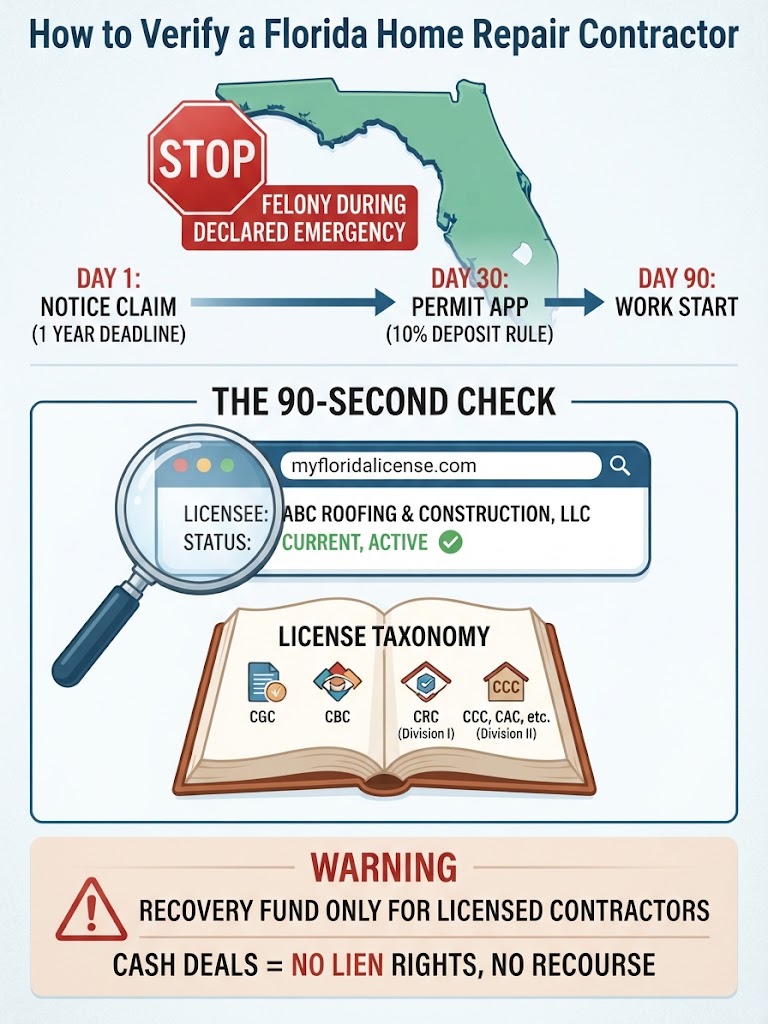
- Go to DBPR’s Verify a License portal (myfloridalicense.com) and search the license number from the estimate — and if there’s no license number on the estimate, you already have your answer. Florida law requires contractors to put their license number on advertising, proposals, and contracts.
- Match the name exactly. The license must belong to the business entity on your contract (via its qualifying agent) — not a similarly named company, not the salesman personally, not “our partner who pulls permits.” Cross-check the entity itself at sunbiz.org.
- Check status and expiration. You want “Current, Active.” Inactive, null-and-void, suspended, or delinquent status means no legal contracting — full stop.
- Check the license category against the job. A general contractor quoting a re-roof needs a roofing license or a licensed roofing sub; a “licensed” lawn company is not licensed for your kitchen. Categories below.
- Read the discipline tab. DBPR shows complaints resulting in discipline — fines, probation, revocations. One old settled dispute is life; a pattern is a forecast.
- Verify insurance independently. Ask for certificates of general liability and workers’ compensation sent to you directly from the insurer or agent, and confirm workers’ comp coverage or exemptions in the state’s Proof of Coverage database (DFS Division of Workers’ Compensation). An “exempt” owner with a crew of five is a walking liability transfer — to you.
- Check the local layer. Registered (county-scope) licenses and certain trades require local competency cards and business tax receipts — confirm with your county’s contractor licensing office, and confirm the contractor can pull permits in your jurisdiction.
- Search the permit history. Your county permit portal shows the contractor’s real local track record — volume, finals passed, expired permits abandoned. It’s the one reference that can’t be faked.
The License Taxonomy: What Those Letters Mean
Certified vs. Registered. A certified contractor (license numbers beginning with C — e.g., CGC, CCC, CAC) passed state examinations and may work anywhere in Florida. A registered contractor (R-prefix) holds local competency and may work only in the jurisdictions where registered. Both are legal; the difference is geography — and a registered contractor from another county may not be able to pull your permit.
Division I — the structure builders (Fla. Stat. § 489.105):
- CGC — Certified General Contractor: any structure, any height.
- CBC — Certified Building Contractor: commercial/residential up to three stories; remodeling.
- CRC — Certified Residential Contractor: one- and two-family homes up to two stories.
Division II — the trades: CCC roofing; CAC air-conditioning (Class A/B); CMC mechanical; CFC plumbing; CPC pool (with residential and servicing subcategories); CVC solar; sheet metal, underground utility, and specialty categories. Electrical contractors are licensed separately (EC numbers, under Part II of Chapter 489, through the Electrical Contractors’ Licensing Board) — an important trap, because “he’s a licensed contractor” tells you nothing about the panel swap.
The Recovery Fund fine print: Florida’s Homeowners’ Construction Recovery Fund (§§ 489.140–.144) can compensate homeowners holding unsatisfied judgments arising from residential contracts — but it applies to Division I licensees. Hire unlicensed, and the state’s victim-compensation backstop was never available to you at all.
The Handyman Line: What Unlicensed Workers Can and Can’t Do
There is no handyman license because “handyman” is defined by what’s left over after licensure. Unlicensed work is lawful only when the task itself doesn’t require a license and local rules don’t add their own — and Florida’s list of license-required work swallows most of what fills a home-repair app:
| Generally does not require a state contractor license* | Always requires a license |
|---|---|
| Painting; drywall patching and finishing (non-structural); flooring and tile; cabinet and trim installation; basic fencing; screen repair; pressure washing; gutter cleaning; assembling and minor repairs | Structural work of any kind; roofing (including repairs and tarping as a trade); electrical beyond like-for-like fixture swaps; plumbing beyond a faucet washer; gas; HVAC (any refrigerant work — also federal); windows and exterior doors; pools and spas; demolition of load-bearing elements; additions and remodels touching structure or systems |
*Counties and cities may require local specialty licenses or registrations for several left-column trades — check the local layer before assuming.
Two more traps in § 489.103: the casual-labor exemption (work under ~$1,000, casual and minor in nature, not part of a larger operation) evaporates the moment the worker advertises or holds themselves out as a contractor — and never covers license-required trades at any price. And the owner-builder exemption lets you pull your own permits for your own residence, but you must personally supervise, you can’t hire unlicensed workers to do license-required trades, you accept the liability, and you generally can’t sell within a year without the exemption collapsing retroactively.
The Money Rules: Deposits, Deadlines, and Liens
- The 10% deposit statute (§ 489.126): a contractor who accepts more than a 10% deposit on a residential project must apply for necessary permits within 30 days of when application becomes necessary and start work within 90 days after permits issue. Blowing those deadlines without just cause — or taking money with no intent to perform — feeds directly into theft prosecution, with penalties scaled to the amount taken. Homeowners: send the written demand letter the statute contemplates; it starts the clock that turns “slow contractor” into a case number.
- Never pay ahead of work in place. Milestone payments tied to inspections, final payment only after the passed final inspection.
- Lien-law hygiene: for projects above the Notice of Commencement threshold (Ch. 713 — thresholds amended in recent sessions; verify current figures), record the NOC properly and collect releases of lien from the contractor and suppliers with every draw. Florida’s construction lien law is how homeowners pay twice for one job — and note that while a licensed contractor’s subs and suppliers can lien you, an unlicensed contractor has no lien rights at all (§ 489.128); their leverage is limited to damage already done.
What hiring unlicensed actually costs the homeowner: unpermitted, uninspected work that surfaces at insurance claims, four-point inspections, and closings; potential denial of insurance coverage for resulting damage; exposure when an uninsured worker is hurt on your property; code-enforcement orders to open up, redo, or remove the work with licensed hands; and no Recovery Fund. The discount was never a discount — it was a premium, deferred.
After the Storm: The 12-Rule Fraud Playbook
(The standing landfall asset — re-dated and republished within hours of any named storm.)
- Emergency = felony. Unlicensed contracting during a declared state of emergency is a third-degree felony on the first offense (§ 489.127). Report it: DBPR’s unlicensed activity unit and local law enforcement both take these post-storm.
- Photograph all damage before any repairs or tarping.
- Notice your insurance claim immediately — the 1-year statutory clock started at landfall, not at your first estimate.
- Tarping and emergency dry-in are roofing work. The crews going door to door need the same CCC verification as the re-roof.
- Run the 90-second license check on every solicitor — out-of-state “storm teams” are the classic post-storm species; a Georgia license is not a Florida license.
- No cash. No full payment upfront. No signing “so we can get you on the schedule.” The 10% deposit rule and milestone discipline apply most when the neighborhood is desperate.
- Deductible “help” is insurance fraud — for the contractor and potentially for you (§ 817.234). It is also the single most reliable scammer tell.
- No assignments of benefits — prohibited on post-2023 policies; anyone asking you to sign one is selling paper they can’t lawfully hold.
- Beware the “public adjuster” who is actually a roofer (and vice versa) — claim negotiation is licensed public adjuster or attorney work.
- Price gouging is reportable — essential goods and services during a declared emergency fall under § 501.160; the Attorney General runs the hotline.
- Use the official help layer: DFS insurance villages, FEMA, and your county’s emergency permit procedures (many jurisdictions fast-track storm permits — the “no permits needed after a hurricane” pitch is a lie).
- Slow is fast. The legitimate contractor backlog is real, and it is still faster than litigating a vanished deposit. Every rule above exists because someone’s recovery ended in week one.
The Enforcement Ledger
Our Unlicensed Activity Enforcement Tracker compiles DBPR citations, county sting operations, and post-emergency felony prosecutions into a quarterly, county-level dataset — the receipts behind every rule on this page. The throughline across enforcement cycles: stings spike after every landfall, roofing and tree work dominate the case files, and the deposit-theft pattern (large check, dormant permit, disconnected phone) remains the state’s most-reported contractor complaint. (Tracker entries are compiled from public records and verified against agency releases before each edition.)
Frequently Asked Questions
How do I check if a contractor is licensed in Florida? Search the license number and business name at myfloridalicense.com (DBPR “Verify a License”); confirm the status is Current/Active, the name matches your contract, and the category matches the job — then verify insurance and local registration. Ninety seconds, before you sign anything.
What can a handyman legally do in Florida without a license? Minor, non-structural work — painting, drywall finishing, flooring, tile, cabinets, basic fencing and screens — subject to local rules. Never roofing, structural, electrical, plumbing, gas, HVAC, windows/doors, or pools, at any price.
Is hiring an unlicensed contractor illegal for the homeowner? The crime belongs to the contractor — but the consequences largely belong to you: unenforceable warranties, insurance exposure, liability for injuries, code-enforcement orders, and no Recovery Fund. Knowingly aiding unlicensed activity can also draw the homeowner into the enforcement picture.
My contractor took a deposit and disappeared — what now? Send the written demand referencing § 489.126; report to DBPR and local law enforcement (large-amount deposit theft is a felony ladder); check whether permits were ever applied for; and if the contractor was licensed Division I, preserve the judgment path to the Homeowners’ Construction Recovery Fund. Move fast — these cases are won on paper trails and calendars.
What’s the difference between a certified and registered contractor? Certified (C-prefix) = state-examined, works statewide. Registered (R-prefix) = local competency, works only where registered. Both are legal within their scope.
Can my neighbor’s “guy” replace my water heater for cash? No — water heater replacement is plumbing (and often electrical/gas) work requiring licensure and a permit, and it’s a textbook insurance-denial fact pattern when it leaks or burns.
Do storm repairs really need permits? Yes — jurisdictions expedite post-storm permitting, but roofing, structural, electrical, and mechanical storm repairs are permitted and inspected like any other work. “FEMA waived permits” is not a thing.
Where do I report unlicensed activity or price gouging? Unlicensed activity: DBPR (myfloridalicense.com) and local law enforcement. Price gouging during declared emergencies: the Florida Attorney General’s hotline (myfloridalegal.com).
Brian’s Take
“Florida’s whole contractor problem fits on an index card: the state made verification free and instant, and the scammers’ entire business model is betting you won’t spend the ninety seconds. Check the license, cap the deposit at ten percent, pay against inspections, and treat ‘we’ll handle the deductible’ as a confession. After a storm, the felony statute is on your side — use it.”
FloridaHomeServicesNews.com covers Florida home services, regulation, and consumer protection for news and educational purposes; nothing here is legal advice. Framework sources: Ch. 489, Fla. Stat. (notably §§ 489.103, 489.105, 489.126, 489.127, 489.128, 489.140–.144); § 817.234 (insurance fraud); § 501.160 (price gouging); Ch. 713 (construction lien law) at leg.state.fl.us; DBPR license verification and unlicensed activity reporting (myfloridalicense.com); DFS workers’ compensation Proof of Coverage and consumer services (myfloridacfo.com); Sunbiz entity records (sunbiz.org); Florida Attorney General (myfloridalegal.com); county contractor-licensing and permit portals. Exemption dollar figures, NOC thresholds, and penalty provisions have been amended over time — verify current statutory text before relying on or republishing any entry, and consult a licensed Florida attorney for any specific dispute.