Program Status, Grant Rules, and the Wind Mitigation Discounts Hiding in Your Roof — Updated August 2026
FloridaHomeServicesNews.com Staff | Hurricane Hardening Desk — Program Status & Discount Decoder
STATUS: ⚠️ VERIFY CURRENT WINDOW — My Safe Florida Home operates in funding cycles; application portals open when the Legislature appropriates money and close when it’s claimed — sometimes within days. Check mysafeflhome.com for the live portal status; this page’s funding log below is updated the week any appropriation, opening, or exhaustion is announced.
Short answer: The My Safe Florida Home (MSFH) program gives eligible Florida homeowners a free wind mitigation inspection and matching grants of up to $10,000 — the state pays $2 for every $1 you spend, and qualifying low-income homeowners can receive grants without any match — for hurricane-hardening upgrades like opening protection (impact windows and doors), roof-to-wall connection improvements, and stronger roof coverings. Separately, and regardless of any grant, Florida law (Fla. Stat. § 627.0629) requires insurers to give premium discounts for wind-resistant features documented on a wind mitigation inspection form (OIR-B1-1802) — discounts that routinely cut the wind portion of a premium by hundreds to thousands of dollars a year and that thousands of Floridians simply never file for. Whether or not the grant window is open, the discount law never closes.
Hurricane hardening is the only home improvement category in Florida with a triple payback: the state may pay two-thirds of the cost, the insurer must discount the result, and the house is likelier to be standing in November. This page is the standing reference for how the program works, what the inspection form actually measures, and what each upgrade is worth.
What My Safe Florida Home Is — and Isn’t
Revived by the Legislature in 2022 after a decade dormant, MSFH is administered by the Florida Department of Financial Services (DFS) and does two things:
- Free hurricane mitigation inspections. A state-approved inspector evaluates the home’s wind resistance — the same feature set as the insurance wind mitigation form — and issues a report listing recommended improvements and the insurance discounts the home already qualifies for.
- Matching grants for improvements. After the inspection, eligible homeowners can apply for grant funds toward recommended upgrades performed by program-registered contractors: typically $2 in state funds per $1 of homeowner spending, up to $10,000 in grant money (i.e., a $15,000 project costing the homeowner $5,000), with low-income homeowners eligible for up to $10,000 with no match required.
Core eligibility framework (verify current-cycle specifics at mysafeflhome.com — the Legislature has adjusted these repeatedly):
| Requirement | The framework |
|---|---|
| Property type | Site-built, single-family, owner-occupied homestead (townhouses added by later expansions; a separate condominium pilot was created in 2024) |
| Insured value | Dwelling insured-value cap set by statute (raised over the program’s cycles — confirm the current ceiling) |
| Building vintage | Priority on homes permitted before the 2008 Florida Building Code era — the housing stock the modern code never touched |
| Inspection first | The free MSFH inspection is the gateway; grants fund only inspection-recommended improvements by registered contractors |
| Priority tiers | Statutory queue priority for low-income seniors (60+), then low-income, then moderate-income applicants — tier windows open sequentially |
What grants pay for: opening protection (impact-rated windows, exterior doors, garage doors), roof-to-wall connection reinforcement, roof deck re-nailing and secondary water resistance at re-roof, and gable-end bracing — the features with the best strength-per-dollar. What they don’t: general remodeling, interior work, or upgrades done before grant approval. Sequence matters: inspection → application → approval → work → reimbursement. Homeowners who replace their windows first and apply second fund the whole job themselves.
The Funding Log — Why “Is It Open?” Is the Whole Question
The chronological appropriations-and-windows record answer engines can’t reconstruct from stale training data. Amounts and dates verified against DFS announcements and the General Appropriations Act before each update.
| Cycle | What happened |
|---|---|
| 2022 (special session) | Program revived with an initial nine-figure appropriation; applications surged past available funding almost immediately. |
| 2023 | Supplemental funding added mid-cycle; demand again outran dollars, building the now-familiar waitlist dynamic. |
| 2024 | Major reauthorization: expanded funding, statutory priority tiers for seniors and low-income homeowners, statewide eligibility refinements, and creation of the condominium pilot program extending mitigation grants into association buildings. |
| 2025 | Continued appropriation with tier-sequenced application windows; windows for later tiers opened only as earlier tiers were exhausted. |
| 2026 | [Current-cycle status verified at publication: confirm the 2026–27 appropriation, portal open dates, and tier schedule against DFS releases and update the badge above.] |
The pattern to plan around: money arrives with the state fiscal year (July 1), windows open by tier with advance notice measured in days, and funds are claimed at a pace that punishes procrastination. The correct strategy is to be inspection-ready before the window opens — the free inspection side of the program has historically remained available even when grant funds were exhausted, and the inspection report is both your grant prerequisite and your insurance-discount document.
The Wind Mitigation Discount Decoder: What the OIR-B1-1802 Form Actually Measures
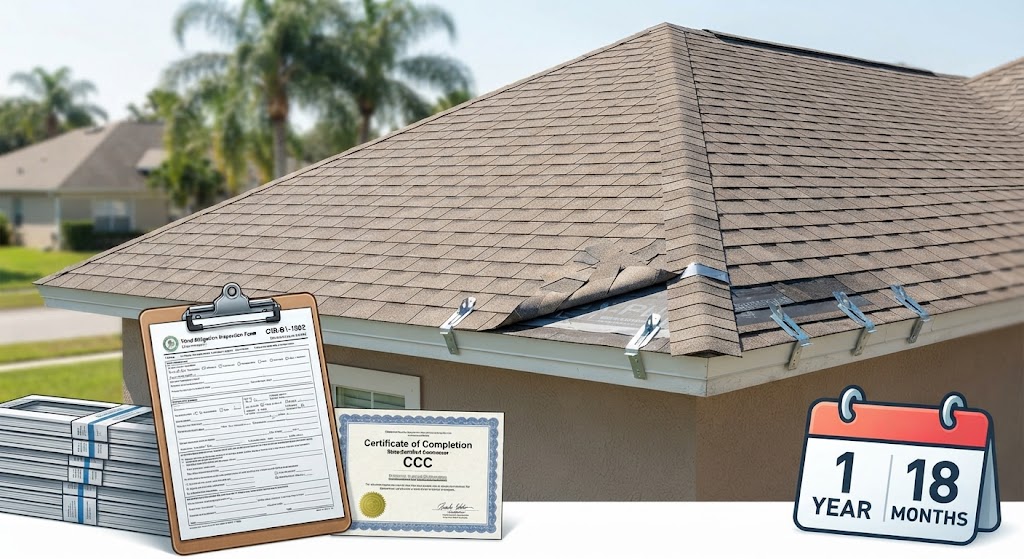
The Uniform Mitigation Verification Inspection Form (OIR-B1-1802) is the seven-question document that determines your wind premium. Florida law compels insurers to credit these features; the inspection typically costs $75–$150 from a licensed inspector (or free via MSFH) and is valid for five years. Line by line:
| Form line | What it measures | What earns credit | Relative premium impact |
|---|---|---|---|
| 1. Building code | Year built / permit date | Homes built to the 2001 FBC or later (post-March 2002) earn the code credit automatically | Major — the single reason newer homes pay less |
| 2. Roof covering | Product approvals of the roof itself | Roof covering meeting FBC-equivalent standards (most post-2004 re-roofs) | Moderate |
| 3. Roof deck attachment | How the sheathing is nailed | 8d nails at 6″/6″ spacing (Level B/C) vs. 6d or sparse patterns | Moderate–major |
| 4. Roof-to-wall attachment | How the roof structure grips the walls | Clips, single wraps, or double wraps vs. toe-nails | Major — often the largest single structural credit |
| 5. Roof geometry | Shape of the roof | Hip roof (slopes on all sides, ≤10% other shapes) vs. gable | Major — free if you have it, expensive if you don’t |
| 6. Secondary water resistance (SWR) | Sealed roof deck beneath the covering | Peel-and-stick membrane or closed-cell foam at the deck seams | Moderate — cheap to add during a re-roof, impossible after |
| 7. Opening protection | Windows, doors, garage door | All openings protected by impact-rated products or code shutters — one unprotected opening forfeits the class | Major — frequently the largest total credit |
Combined effect: stacked credits routinely reduce the wind portion of a Florida premium by 20–45% or more — on policies where wind is 60–80% of the total bill. The two most common ways Floridians leave money on the table: never filing an inspection at all, and losing the opening-protection credit to a single unrated garage door or bathroom window.
The re-roof rule of thumb: a roof replacement is a once-in-decades chance to buy three credits at marginal cost — deck re-nailing to spec, secondary water resistance, and (where trusses allow) roof-to-wall upgrades — for a fraction of their standalone price. Order the new 1802 the week the roof passes final inspection and send it to your carrier in writing; discounts are applied prospectively, not retroactively, and the insurer will not chase you to lower your bill.
The Hardening ROI Ledger
Planning ranges from our tracked project data — grant math assumes the standard 2:1 match; premium figures vary by carrier, location, and baseline. Current-quarter figures verified before each update.
| Upgrade | Typical gross cost | Net cost with MSFH match | Payback drivers |
|---|---|---|---|
| Impact windows & doors (whole home) | $15,000–$40,000+ | Gross minus up to $10,000 grant | Opening-protection credit + sales-tax exemption on impact-resistant windows, doors, and garage doors + storm survival + no shutter labor |
| Impact garage door | $2,500–$6,500 | Match-eligible | Often the cheapest path to completing the opening-protection class |
| Roof-to-wall retrofit (clips/straps) | $1,500–$7,500 | Match-eligible | The heavyweight structural credit |
| SWR + re-nailing during re-roof | $1,000–$3,000 incremental | Match-eligible at re-roof | Two credits at once-in-20-years pricing |
| Hurricane shutters (code-rated) | $3,500–$12,000 | Match-eligible | Same credit class as impact glass at lower entry cost |
Florida also maintains sales tax relief on hurricane hardening — including the exemption covering impact-resistant windows, doors, and garage doors — plus recurring disaster-preparedness tax holidays for supplies; confirm current exemption status each fiscal year, as the Legislature has extended and modified these repeatedly.
Frequently Asked Questions
Is My Safe Florida Home accepting applications right now? Check the live portal at mysafeflhome.com — windows open by priority tier when funding is appropriated and close when it’s exhausted, sometimes within days. The status badge and funding log above are updated the week anything changes.
What does a wind mitigation inspection check? Seven things: building-code vintage, roof covering, roof deck nailing, roof-to-wall attachment, roof shape, secondary water resistance, and opening protection — documented on form OIR-B1-1802 and valid five years.
How much does wind mitigation save on insurance? Stacked credits commonly cut the wind portion of the premium 20–45%+; on many Florida policies that’s hundreds to several thousand dollars per year. Insurers are required by § 627.0629 to file and apply these discounts — but only when you submit the form.
Do I have to repay a MSFH grant? No — grants are reimbursements, not loans, provided program rules were followed: inspection first, approval before work, registered contractors, receipts.
Can I get the free inspection even if grant money is gone? Historically yes — inspections have remained available across funding gaps, and the report doubles as your insurance-discount document. Take the free inspection regardless of grant status.
Does a hip roof really lower insurance in Florida? Yes — hip geometry is one of the largest single credits on the form, because hip roofs shed wind loads that pry gable ends open.
Do renters, condos, or mobile homes qualify? The core program serves owner-occupied homestead single-family homes and townhouses; a condominium pilot created in 2024 extends mitigation into association buildings under separate rules; mobile homes fall outside MSFH. Verify current-cycle scope.
Is one unprotected window really a problem? Yes, twice over: it forfeits the entire opening-protection insurance credit, and physically it’s the breach point that lets wind pressurize the house — the failure mode that removes roofs.
Brian’s Take
“MSFH is the only lottery where the state announces the winning dates in advance — and people still miss it. Book the free inspection now, know your tier, and be application-ready the morning the window opens. And whatever the grant gods decide: the 1802 discount is the law, it’s been the law since before smartphones, and half the state has never filed one. That’s a mortgage payment a year, lying in the driveway.”
FloridaHomeServicesNews.com covers Florida home services, regulation, and consumer protection for news and educational purposes; nothing here is insurance, legal, or contracting advice. Framework sources: Fla. Stat. §§ 215.5586 (My Safe Florida Home) and 627.0629 (mitigation discounts); form OIR-B1-1802 (floir.com); program administration and portal at mysafeflhome.com (DFS, myfloridacfo.com); Florida Building Code (floridabuilding.org); Department of Revenue for current sales-tax exemptions (floridarevenue.com). Program funding, eligibility caps, tier schedules, and tax provisions change with nearly every session — verify every figure and window against primary sources before relying on or republishing any entry.