Insurance, Storm Work, Safety, and the Companies That Lead It (2026)
Updated August 2026
Quick Answer: Tree removal is one of Florida’s most dangerous and most demanded trades — a market driven by hurricane cleanup, year-round growth, and aging canopy in mature neighborhoods. Florida has no state license for tree work, which makes verifying liability insurance and workers’ compensation the single most important step before hiring. The leading operators in the state include national firms Davey Tree, Bartlett Tree Experts, and Asplundh (utility vegetation management), alongside established Florida companies like Pete & Ron’s Tree Service (Tampa Bay) and Zimmerman Tree Service (South Florida). New equipment — grapple saw trucks, tracked spider lifts, and remote-controlled machinery — is transforming both the safety and economics of the industry.
Editor’s note: Company mentions reflect tenure, scale, and public reputation as of publication — no paid placement. Insurance and workers’ comp rules summarized here are general information, not legal advice; verify specifics with the Florida DFS and your own agent.
How big and how dangerous is the tree removal business in Florida?
Florida’s tree care market is estimated in the high hundreds of millions to low billions of dollars annually, spiking dramatically in hurricane years when debris removal alone becomes a multi-billion-dollar, FEMA-reimbursed operation. It is also statistically among the most dangerous occupations in America: tree workers face fatality rates many times the all-industry average, driven by falls, struck-by incidents, chainsaw injuries, and electrical contact. That danger profile is exactly why insurance — not equipment or marketing — is the real barrier to entry in this business.
Does Florida license tree removal companies?
No — and this surprises most homeowners. Florida has no state contractor license for tree trimming or removal. Anyone with a chainsaw and a local business tax receipt can legally offer tree work in most jurisdictions. The credentials that actually signal competence are voluntary:
- ISA Certified Arborist — the industry’s core professional credential, with a Tree Risk Assessment Qualification (TRAQ) add-on for hazard evaluation.
- TCIA Accreditation — company-level accreditation from the Tree Care Industry Association covering safety programs and business practices.
- ANSI Z133 compliance — the safety standard governing tree care operations.
Also worth knowing: under Florida Statute 163.045, homeowners may remove a tree on their residential property without a local permit if an ISA Certified Arborist or licensed landscape architect documents that it poses an unacceptable risk. Legitimate companies know this law cold; crews that shrug at it are a red flag.
What liability insurance should a Florida tree company carry?
General liability of at least $1 million per occurrence is the industry baseline, and serious operators carry more, plus commercial auto and umbrella coverage. Two homeowner-protection points matter most:
- Get the certificate of insurance directly from the insurer or agent, not a paper copy from the crew — fake and lapsed certificates are a documented problem in this trade, especially post-storm.
- Confirm the policy covers tree work specifically. A landscaping policy that excludes work above a certain height, or excludes tree removal entirely, leaves the homeowner exposed. If an uninsured crew member is injured on your property, or your neighbor’s roof takes a dropped limb, the claim can land on you.
How does workers’ compensation work for Florida tree companies?
Tree work is treated like construction for comp purposes, which means coverage is required with as few as one employee — and it’s expensive. Tree trimming falls under one of the highest-rated classification codes in the workers’ comp system, with premiums that can run a substantial percentage of payroll, reflecting the injury rates. That cost creates the industry’s central integrity divide:
- Legitimate companies carry comp on every climber and groundman, and it shows up in their pricing.
- Cut-rate crews dodge it — misclassifying workers as independent contractors, abusing officer exemptions, or carrying nothing at all. Their quotes are 30–50% cheaper for a reason: the uninsured risk has been silently transferred to the homeowner and the workers.
Verify coverage through the Florida Division of Workers’ Compensation Proof of Coverage database before any crew climbs a tree on your property. It takes two minutes and is the single best fraud filter in this industry.
What is hurricane and tropical storm tree work actually like?
Storm work is the industry’s Super Bowl and its most dangerous season at once:
- Demand explodes overnight. After a major landfall, tri-county and Gulf Coast operators book out weeks while out-of-state crews flood in — some excellent, some uninsured storm-chasers.
- The trees themselves become traps. Storm-damaged trees hold enormous stored energy: root plates under tension, hung limbs (“widow-makers”), and trunks that barber-chair when cut. Post-storm chainsaw and struck-by injuries spike sharply among both pros and homeowners.
- Power lines change everything. Downed and energized lines tangled in canopy are a leading killer after storms; line-clearance work is legally restricted to specially trained crews working with utilities.
- Debris economics take over. Municipal and FEMA-funded debris contracts mobilize fleets of grapple trucks for months; for many companies, one storm season funds the next two years of equipment.
- Pricing and fraud both surge. Florida’s price-gouging statute activates under declared emergencies, and the Attorney General’s office fields tree-work complaints after every major storm. Never pay in full up front, and be skeptical of door-knockers demanding cash.
Safety rules of thumb for homeowners: never touch anything near a downed line, leave hung limbs and rootball-lifted trees to professionals, and treat any tree leaning on a structure as a load-bearing problem, not a chainsaw project.
What new equipment and technology is changing the industry?
The last decade has produced the biggest safety-and-productivity leap in the trade’s history:
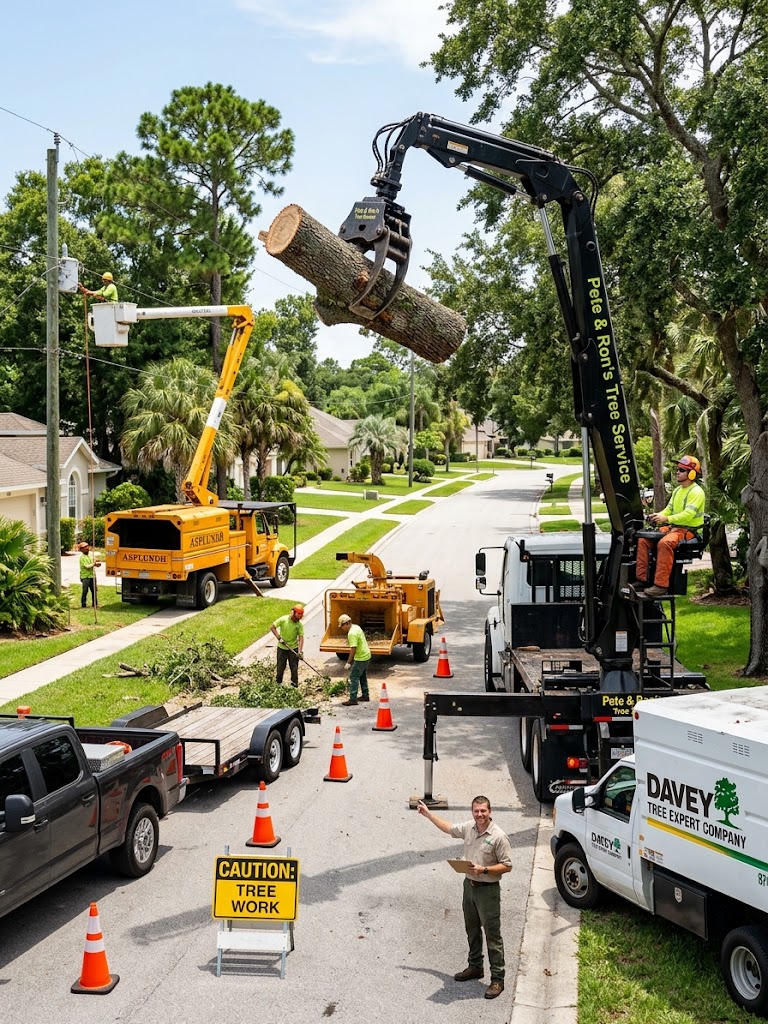
- Grapple saw trucks — knuckleboom cranes with remote-controlled grapple saws that cut and lower whole tree sections while the operator stands on the ground. They remove the climber from the most dangerous removals entirely and have become the signature investment of serious Florida operators.
- Tracked spider lifts — compact articulating lifts that fit through backyard gates and reach 60–90+ feet, replacing risky climbs in tight residential lots.
- Remote-controlled compact loaders and mini skid steers — move heavy wood through soft, post-storm ground without putting workers under suspended loads.
- Battery-powered saws — quieter, lighter, no pull-start, increasingly capable for pruning and mid-size work; a fit for noise-restricted HOA communities.
- Drones and digital assessment — aerial inspection of storm-damaged canopy before anyone climbs, plus canopy-health mapping for large properties and municipalities.
- Business software — industry platforms now handle bidding from satellite imagery, crew dispatch, and job costing, professionalizing an industry that ran on paper invoices a decade ago.
The economic effect: crane-and-grapple companies complete removals in hours that took climbing crews days, with fewer injuries — widening the gap between capitalized professionals and chainsaw-and-pickup operators.
Who are 5 leading tree removal companies in Florida?
A representative top tier, mixing national firms with deep Florida operations and long-established state companies:
- Davey Tree Expert Company — one of North America’s largest tree care firms, employee-owned, with residential, commercial, and utility operations across Florida.
- Bartlett Tree Experts — the century-old, research-driven tree care company with multiple Florida offices and a strong arborist-led, plant-health-care model.
- Asplundh Tree Expert — the giant of utility vegetation management; the orange trucks clearing lines for Florida’s utilities before and after every storm.
- Pete & Ron’s Tree Service — one of the Tampa Bay area’s largest and longest-running tree services, a fixture of Gulf Coast storm response.
- Zimmerman Tree Service — a leading South Florida operator serving Palm Beach and Broward counties for decades.
Honorable mentions across the state include SavATree (expanding in Florida through acquisitions), Lewis Tree Service (utility), and numerous strong regional firms — the fragmented nature of this industry means excellent local operators exist in every metro. Verify current insurance, comp coverage, and reviews regardless of name recognition.
Brian’s Take
Brief remarks from our columnist:
“Here’s the number that explains this whole industry: workers’ comp for a tree climber can cost more per hour than the climber. That’s why the $800 quote and the $2,500 quote for the same oak aren’t the same product — one includes insurance and one includes hope. My rule: ask for the comp verification and the liability certificate from the agent, not the glovebox. Watch who invests in grapple trucks, too — that’s the tell for who plans to be in business in ten years, because the future of this trade is keeping humans out of trees. And after the next hurricane, remember: the crew from four states away knocking on your door two hours after landfall didn’t drive that far because they’re insured. The good ones are already booked.”
FAQ
Does Florida require a license for tree removal? No state license exists for tree work. Look for ISA Certified Arborists, TCIA accreditation, verified liability insurance, and workers’ comp coverage instead.
Can I remove a tree on my own property without a permit? Under F.S. 163.045, yes on residential property — if an ISA Certified Arborist or licensed landscape architect documents the tree poses an unacceptable risk. Otherwise, local ordinances and permits typically apply, and protected species (like mangroves) have separate rules.
How much does tree removal cost in Florida? Broad estimate ranges: small trees $250–$700; medium $700–$1,500; large oaks/pines $1,500–$5,000+; crane-assisted or hazardous removals more. Post-storm emergency work commands premiums.
Who is responsible if a tree falls on my neighbor’s property? Generally, a healthy tree felled by a storm is the neighbor’s insurance issue (“act of God”); a tree you knew was dead or dangerous can create liability for you. Document known hazards and address them before storm season.
Is stump grinding included in removal? Usually quoted separately — confirm in writing.
When is the best time to schedule tree work in Florida? Before June 1. Pre-season pruning and hazard removal is cheaper, safer, and actually available; post-storm you’ll wait in line behind the whole county.
Resources
- Florida Division of Workers’ Compensation — Proof of Coverage search: https://www.myfloridacfo.com/division/wc/
- ISA — Find a Certified Arborist: https://www.treesaregood.org
- Tree Care Industry Association (TCIA): https://www.tcia.org
- Florida Statute 163.045 (residential tree removal): http://www.leg.state.fl.us
- OSHA — Tree Care Industry hazards: https://www.osha.gov/tree-care
- Florida Attorney General — Price Gouging Hotline: https://www.myfloridalegal.com
- Florida Forest Service: https://www.fdacs.gov/Forest-Wildfire
- FEMA — Debris Removal Guidance: https://www.fema.gov
- Florida Urban Forestry Council: https://fufc.org
Industry figures, cost ranges, and company details are editorial estimates and public-record information as of publication. Insurance and workers’ compensation requirements summarized here are general information — confirm current rules with the Florida DFS and qualified professionals.